
Better Golf Starts in Your Mind — Text Sandy free →
By Sandy Dunlop — Better Game Golf
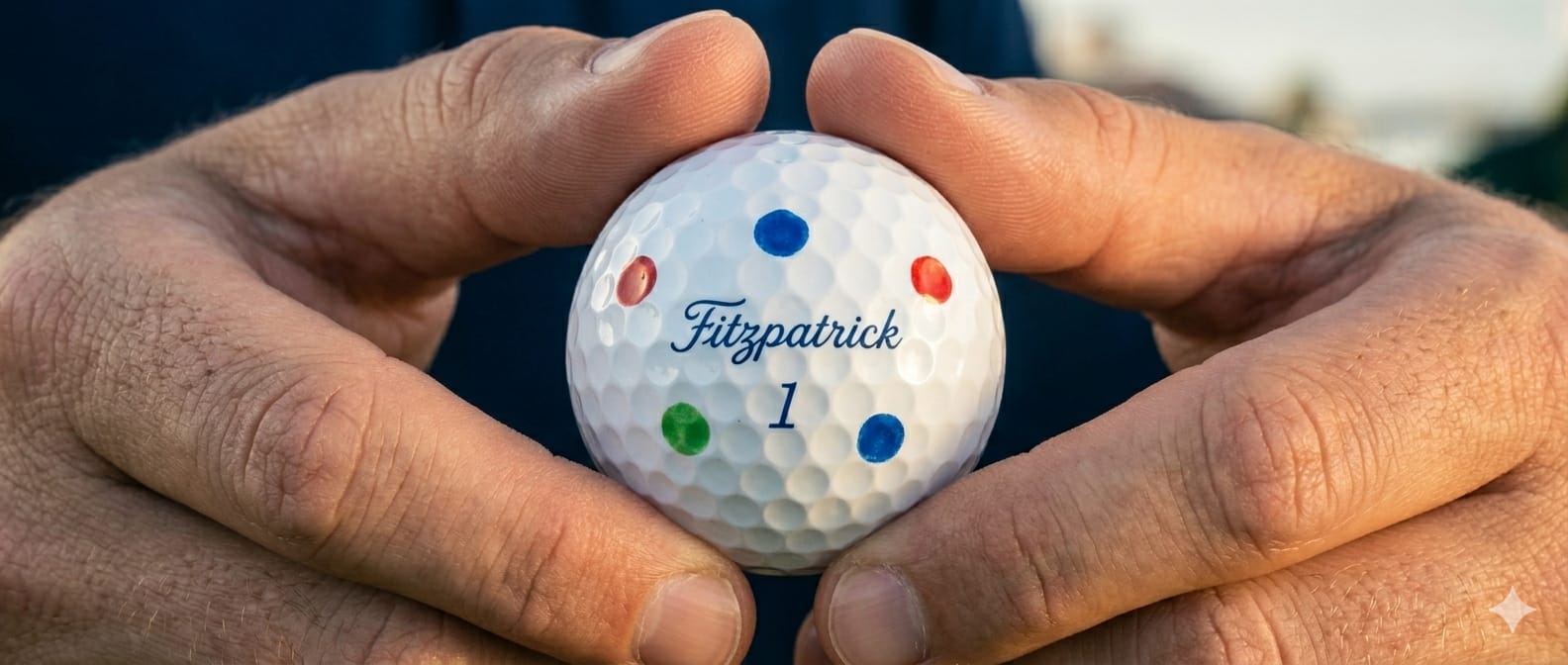
We live in an era where you can measure almost anything in golf. Trackman, force plates, 3D imagery, Gears, Whoop straps... there are numbers all over the place. But as Einstein told us, not everything that counts can be counted. When Matt Fitzpatrick walked off the 18th green having surrendered a three-shot lead to the world's number one, having hit his first major bad shot with a very poor chip, and headed back to the playoff hole... what happened next is very difficult to measure. You can find out your heart rate through a Whoop strap. But what are the thought processes that go on at a moment of potentially golfing existential crisis, of huge golf under pressure? What Fitzpatrick demonstrated was some really good thinking in the clutch. It was the inner golfer that won. And that's what we look at in Better Game Golf.
Picture the scene. You've held a three-shot lead in a major championship. You've watched it evaporate. On the 18th hole, you've just hit the worst chip of your week... possibly the worst chip at the worst possible time. The world's number one player has reeled you in. Now you're walking to a playoff hole, and every instinct in your body is screaming. Your heart rate is elevated, your breathing has gone shallow and quick, your nervous system is in full fight-or-flight mode. A Whoop strap can tell you all of that. Force plates can tell you about your ground reaction forces. Trackman can tell you your club path and face angle. But none of those instruments can tell you what's going on inside the mind of a golfer facing what I'd call a golfing existential crisis.
This is the territory where golf under pressure becomes a completely different game. The numbers stop mattering. What matters is whether you can think clearly when everything around you suggests you should be falling apart. Fitzpatrick put down a score of three on the playoff hole and won the tournament. The data didn't win that. The inner golfer did. And that inner golfer... the quality of his thinking, his capacity to manage his state of mind, his ability to inhibit the habitual panic response... none of that shows up on a spreadsheet. This is precisely why I've spent decades working on what I call the golfing bodymind, because the things that decide outcomes in moments like these are the things no technology can capture.
When I say Fitzpatrick demonstrated "really good thinking in the clutch," I don't mean he used positive self-talk or repeated an affirmation. I mean something far more specific. He managed his state of mind at a moment when his nervous system was almost certainly pushing him toward what I'd describe as the red zone... a state of high arousal, anxiety, and contracted awareness where choking becomes almost inevitable. If you've ever experienced that feeling on the first tee of a medal round, multiply it by a thousand, and you begin to get close to what a playoff hole in a major feels like.
The skill here is what I call inhibition, a concept drawn from the Initial Alexander Technique. It's the ability to stop... to not react habitually. When everything in your system is saying "rush, grip tighter, protect yourself," inhibition is the capacity to pause and choose a different response. Fitzpatrick didn't just "stay calm." He actively directed himself through a moment of extreme pressure, and that direction produced an integrated, coordinated movement when it mattered most. This is something I explore extensively in my work on choking in golf and why it happens. Choking is what happens when inhibition fails. What Fitzpatrick demonstrated is what happens when it holds.
Here's the distinction I keep coming back to. Modern golf is obsessed with the outer game. The measurables. The data. And I'm not against any of it... Trackman is a wonderful instrument, biomechanics research has been hugely valuable, and understanding your body through force plates and 3D imaging can be genuinely useful. But there's a whole dimension of the game that this obsession with measurement misses entirely. The inner golfer... the one who actually has to stand over the ball and execute... doesn't operate on data. That golfer operates on state of mind, on the quality of the relationship between mind and body, on breath, on the capacity to stay present rather than catastrophise.
When I wrote The Golfing Bodymind, the whole premise was that human beings are an integrated whole and can only be changed as a whole. You cannot separate the parts from the whole. A golf swing is a coordinated whole... well, maybe in many cases a poorly coordinated whole... but it can only be changed as a whole. The 700-plus muscles in your body work in groups in relation to the whole, and they need to work in an integrated way with the 200-plus bones and 350-plus joints. When you're under pressure, that integration either holds or it doesn't. Fitzpatrick's held. And that's the story no number could tell.
When you face a high-pressure moment on the golf course, your nervous system doesn't politely wait for your conscious mind to decide what to do. It reacts. And the way it reacts is shaped by deeply wired survival mechanisms that have nothing to do with golf. Anxiety and stress trigger your nervous system, raise your blood pressure, make you tighten up. Your breathing becomes shallow and quick. Your proprioception... the internal sense of your body, its parts, and how it's moving... actually becomes less reliable, because your attention narrows and shifts upward into your head. I call this having your mind in the brain, not in the body.
This is why golf and anxiety are so deeply connected. The course itself becomes a training ground for your nervous system, whether you realise it or not. Every time you face a pressure situation... a first tee shot in competition, a putt to win the match, a chip to save par when your round is on the line... your nervous system is learning. The question is what it's learning. If it's learning to tighten, rush, and grip harder, then you're training yourself to choke. If it's learning to pause, breathe, and redirect attention into the body, then you're training yourself to perform under pressure. Fitzpatrick clearly had the latter pattern available to him, and that didn't happen by accident.
One of the most powerful tools available for managing golf under pressure is also one of the simplest. Breath control. People in the East have known this for thousands of years. The yogic tradition calls it pranayama, and there's a Sanskrit saying: "Breath is life. If you breathe well, you will live long on Earth." I grew up in India for my first eleven years, and we used to be visited by characters who did yoga. What they understood, and what Western science is finally catching up to, is that control of the breath is the key to control of mind and body... control of the golfing bodymind.
Here's what's so paradoxical about breathing. It can do two things that seem contradictory. Deep breathing can anchor you, centre you, give you a feeling of being rooted. That's extremely important in a competitive sporting situation. But it can also elevate you to a higher state... the states of flow, or peak experience, or what's now called being in the zone. So breath can both anchor and elevate, energise and calm. On that playoff hole, I'd wager Fitzpatrick's breathing was slow and deliberate. Not because someone told him a breathing tip, but because he'd trained himself to use breath as a master switch for his state. (Try: Three-Compartment Breathing — available in the Training section of the app)
There's a concept from systems thinking that's critical to understanding why most golfers crumble under pressure. Our nervous system is set up to give us a good enough result. Our primary focus is to get by. It's called satisficing. And being better than you ever thought you could be is not satisficing. It's optimising. So our human nature is not naturally going to be helpful in the quest to perform at our best when it matters most.
The brain, when faced with a situation, wheels out what you've done before, and this all happens in a split second. Especially when it matters, the brain will always select what it knows best. And what it knows best is not what's optimal... it's what it's familiar with. So there's a real tendency to revert to what you know, even if you know it's not optimal. This is why golfers who hit beautiful shots on the range suddenly can't do it on the course. This is why a three-shot lead evaporates. The brain reverts to survival patterns, not performance patterns. What Fitzpatrick did on that playoff hole was override that reversion. He optimised when his system wanted to satisfice. That takes training, and it takes a fundamentally different approach to what most golfers are doing when they say they're "working on their mental game." For a deeper look at how this works, explore all of our mental game articles.
The standard approach in golf instruction is to break things down into pieces. Fix the grip. Fix the takeaway. Fix the transition. Fix the follow-through. It's a method rooted in Western science, which worked out by breaking things into bits and studying how one variable affected another. And much was achieved. But this approach has a fatal flaw when it comes to golf under pressure: the pieces don't hold together when the heat is on.
What I offer instead is rooted in systems thinking. It's radically different from a typical method that tries to change things like a golf swing piece by piece, fault by fault, symptom by symptom. This approach is holistic. It means recognising that human beings are an integrated whole, and they can only be changed as a whole. It means that a golf swing is a coordinated whole, and it can only be changed as a whole. Emergent science... quantum physics, neuroscience, complexity theory, neurobiology... are all rooted in systems thinking. In this worldview, everything is connected. You cannot separate the parts from the whole. That's why I draw on three powerful systems approaches: the Initial Alexander Technique for integrated movement, Psychosynthesis for the undivided self, and Eastern disciplines like Yoga, Zen, and Tai Chi for states of mind. Together, these deliver something no tip or quick fix ever could.
The Initial Alexander Technique offers a unique way of involving the mind in its vital relationship with the body called Conscious Guidance and Control, or CG&C. This is not "thinking about your swing." It's the opposite. It's a way of directing attention through the body so that movement becomes integrated rather than fragmented, free rather than gripped.
IAT directly addresses the vice-like grip of habits and habitual ways of playing golf. Its techniques of inhibition... stopping and inhibiting the habitual ways... and then giving conscious direction, is a very innovative way of getting mind and body working together to deliver real, integrated change. When Fitzpatrick stood on that playoff tee, the habitual response would have been to tighten, to try harder, to grip the club with everything he had. That's what fear-based swing patterns look like in action. What he did instead was something closer to what CG&C trains: a pause, a direction, and then a release into coordinated movement. The result was a three on the playoff hole. The result was a tournament victory. The result was the inner golfer winning.
The zone, or flow state, is not some mystical, uncontrollable phenomenon that descends upon you if you're lucky. It's a state of mind that can be trained. What Yoga and Tai Chi offer are disciplines that work on posture, breath, balance, and a way of thinking with paradoxical ideas like beginner's mind and effortless effort. They understand energy and its direction. But their real focus, their essence, is on states of mind. Can you learn to manage and control your state of mind, especially under the pressures of competitive sport?
I believe you can. And I believe Fitzpatrick demonstrated exactly that. The three systems thinking approaches I work with deliver, respectively, the fundamentals of integrated movement, the promise of an undivided self, and the ability to control states of mind. This all leads to those rare moments of peak performance, or what is now called the zone or flow. As I've written about before in my exploration of the golf zone versus choking, what separates the two is remarkably thin. But that thin line is everything. It's the difference between a three on the playoff hole and a collapse. And it's the thing that not a single instrument in golf can measure. (Try: Zone State Training — available in the Training section of the app)
In the film The Matrix, the ultimate choice facing Neo was the red pill or the blue pill. The red represents enlightenment and breaking free of the system. For us, that system is our habits. The blue represents comfort, the known, and being trapped. What the golfing bodymind offers is a potential practical way out. It's a tough road, and it needs discipline and will. But you can be the architect of your golfing destiny.
Here's the honest truth about this journey. As Machiavelli put it, "there's nothing more difficult to take in hand, more perilous to conduct, or more uncertain in its success than to take a lead in the introduction of a new order of things." What I'm describing is a golfing new order of things. It's tough. It's really tough to change deeply rooted habits of a lifetime and of playing the game. There are many obstacles... the demon of inertia, the demon of cynicism, the demon of fear. Our awareness, our brain, our nervous system, and our senses are all set up in ways that make real change difficult. Most golfing habits are so hardwired we don't even know what they are. They're unconscious, taken for granted, so familiar we don't have to think about them anymore.
Here's something that stops most golfers dead in their journey toward better performance under pressure. When you try to change, you naturally tune into proprioception... the internal sense of your body, its parts, and how it's moving. Proprioception comes from sense organs and stretch receptors in your body that give you feedback. But the problem is that these messages initially reward what is familiar, not what is right. When you're trying to do the new, because you think you know what it is or you've been told what it is, the problem is it's going to feel wrong. What feels right is wrong, and what is wrong feels right. It's called faulty sensory perception.
So to sum up, we can work towards being better than we ever thought we could be. But what this means is working against our human nature, working against satisficing, working with habits that are largely unconscious and that we don't really know what they are, and working with senses that are faulty because they reward the familiar and comfortable. In short, we don't know what we're doing, and every instinct in our bodymind is not to change it anyway. That's why you need a framework, a guide, a scaffolding. And it's why what Fitzpatrick did on that playoff hole is so remarkable. He had built a structure of inner skills that held when everything else was falling apart. That's not talent. That's training. And it's the kind of training most golfers have never been introduced to. You can start your free trial and begin exploring these ideas today.
Fitzpatrick demonstrated what I call "good thinking in the clutch." After surrendering a three-shot lead and hitting a very poor chip on the 18th hole, he faced what I'd describe as a moment of golfing existential crisis. Rather than collapsing under the weight of that pressure, he managed his state of mind, inhibited the habitual panic response, and put down a score of three on the playoff hole to win the tournament. What makes this remarkable is that none of it can be measured by technology. Trackman can't capture it, force plates can't detect it, Whoop straps can only show the physiological symptoms. It was the inner golfer that won. The quality of his thinking, his capacity to direct his attention, and his ability to stay integrated when everything in his nervous system was pushing toward fragmentation... that's what decided the outcome. And that's what I mean when I say not everything that counts can be counted.
Technology measures the outer game brilliantly. Trackman gives you club data, force plates measure ground reaction forces, 3D imagery captures movement patterns, Whoop straps track heart rate and recovery. All valuable. But none of these instruments can tell you what thought processes are happening at a moment of intense pressure. They can't measure the quality of your attention, the depth of your breathing pattern, whether your mind is in your brain or in your body, whether you're inhibiting habitual responses or being controlled by them. These are the things that actually decide whether you perform or choke. It's like trying to measure the quality of a conversation by counting the words spoken. The numbers are real, but they miss the essence entirely. In my systems thinking approach, we work with the dimensions that technology cannot capture, because those are often the dimensions that determine the outcome.
Inhibition is a concept from the Initial Alexander Technique, and it's one of the most powerful skills a golfer can develop for pressure situations. It's the ability to stop... to not react habitually when your nervous system is pushing you toward a familiar but unhelpful response. Under pressure, the habitual response for most golfers is to tighten the grip, rush the swing, shorten the backswing, and essentially contract into a protective, fear-based pattern. Inhibition is the conscious decision to pause before that pattern takes over, creating a gap between stimulus and response. In that gap, you can give conscious direction... what I call Conscious Guidance and Control... and produce an integrated movement instead of a fragmented one. Fitzpatrick demonstrated this beautifully on the playoff hole. Rather than being swept along by the momentum of his collapse, he stopped, redirected, and executed. That's inhibition in action under the most extreme pressure golf can offer.
When I say "it was the inner golfer that won," I'm referring to the whole dimension of golf that exists beneath the measurable surface. The inner golfer is the integrated relationship of mind, body, emotion, and spirit that you bring to every shot. It's your state of mind, your quality of attention, your capacity to breathe and stay present, your ability to inhibit habitual responses and direct yourself consciously. The inner golfer is what the golfing bodymind approach trains. Most golfers spend 95% of their time on the outer game... technique, equipment, data... and almost no time on the inner game in any structured, disciplined way. But when pressure arrives, it's the inner golfer that decides the outcome. Fitzpatrick's technique didn't suddenly improve on the playoff hole. His inner golfer held together when the outer game had wobbled, and that's what produced the three that won the tournament.
Satisficing is the tendency of our nervous system to produce a good enough result rather than an optimal one. Our primary biological focus is to get by, to survive, to do what's familiar. Being better than you ever thought you could be is not satisficing... it's optimising. And our human nature is not naturally going to be helpful in that quest. Under pressure, this tendency becomes even stronger. The brain, when faced with a stressful situation, wheels out what you've done before in a split second. It always selects what it knows best, and what it knows best is what it's familiar with, not what's optimal. This is why golfers revert to old patterns under pressure even when they've been working hard on changes. To overcome satisficing requires a disciplined, systems-based approach that builds new patterns deeply enough that they become available even when the nervous system wants to default to old habits. It requires the kind of training that goes beyond tips and into genuine transformation of the bodymind.
Breath control is the master switch for the golfing bodymind. When you're under pressure, your breathing almost certainly becomes shallow and quick. This triggers your nervous system into a heightened state of arousal, raises your blood pressure, tightens your muscles, and narrows your attention. Simply directing your attention to your breath and breathing slowly and deeply into your abdomen, chest, and neck... what I call three-compartment breathing... has an immediate calming effect on the nervous system. But here's the paradox that makes breathing so powerful: it can both anchor you and elevate you. Deep breathing can centre you and give you a feeling of being rooted, which is critical in competition. But it can also elevate you toward the higher states of consciousness associated with being in the zone. Breath can energise and calm. It can ground and transcend. That's why exercises on breathing are central to the Better Game Golf programme. It's the first skill we teach in the 7-day introductory course, because it's the foundation upon which everything else is built.
Start your free 7-day trial at bettergamegolf.com — let Sandy's AI caddie walk you through these concepts on your next round.
Stories are not decoration. In my experience, they are one of the most powerful transmission systems human beings have ever invented for getting wisdom from one person to another. That is exactly why ...
16 min read →You've got a round coming up and you're already dreading it. Your game hasn't been sharp, life has been relentless, and somewhere in the back of your mind a quiet voice is already writing the disaster...
15 min read →A golf mental reset isn't just a nice idea. It's a neurological necessity. When a bad shot cascades into a worse one, something very specific happens in your bodymind... your breathing shortens, your ...
15 min read →