
Better Golf Starts in Your Mind — Start 7-Day Free Trial
By Sandy Dunlop — Better Game Golf
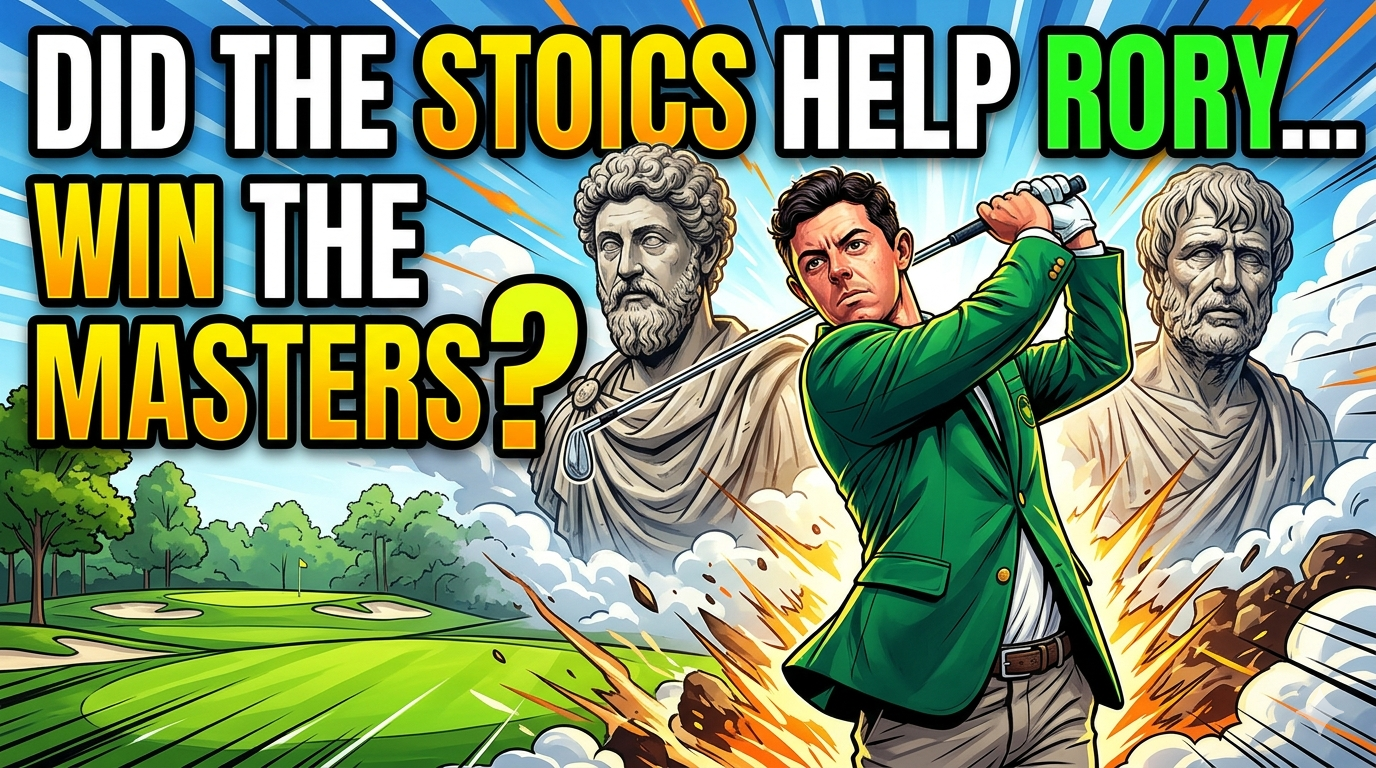
Did the Stoics help Rory McIlroy win the 2025 Masters? I believe they genuinely might have. At the press conference after the Rome Ryder Cup, Rory told us he read the Stoics. Not self-help books, not pop psychology... the actual Stoics. Zeno, Seneca, Epictetus, Marcus Aurelius. You might remember Marcus Aurelius from the film Gladiator, the Roman emperor. So when I watched that extraordinary final day at Augusta, the question I kept coming back to was: how much of what we witnessed was stoic philosophy in action? The Rory McIlroy mental game we saw that Sunday was defined by one quality above all others: resilience. And resilience is precisely what Stoicism is designed to cultivate. What Stoicism is essentially about is maintaining tranquility and calmness when the stakes are high... very high. So yes, perhaps the Stoics did help Rory win the Masters in 2025.
One obvious connection between Stoicism and what Rory showed us at Augusta is the stoic practice of negative visualisation, or as the ancients called it, premeditatio malorum. This is where you imagine the things that could go wrong or be taken from us. It is not pessimism. It is preparation. You rehearse adversity in your mind so that when it arrives, it does not destroy you. It has already been anticipated, already been processed.
Now, as we all know, on that final day Rory had a series of setbacks in the round. Moments where lesser competitors, or a less prepared version of himself, might have unravelled entirely. We have seen Rory unravel before. We have seen him lose leads, lose composure, lose tournaments he should have won. I have written about what happens neurologically when the brain encounters threat and failure in my piece on choking in golf, and it is not pretty. The temporal lobe sends memories of previous failings, and these can easily trigger the response of tightening the body, shortening the body, and causing the brain to freeze. But perhaps the stoic practice of premeditatio malorum helped. Which is exactly what it is intended to do: develop the quality of resilience, the ability to bounce back. And certainly on that final day, if there was one quality Rory showed in abundance, it was resilience.
The practical application for any golfer is straightforward. Before a competition round, spend a few minutes imagining specific setbacks. A poor opening tee shot. A three-putt on a crucial hole. A competitor making birdies. Do not dwell in catastrophe. Simply acknowledge that these things may happen, and picture yourself continuing calmly. When they do happen, and they will, the shock is absorbed because the ground has already been prepared.
The second stoic practice that almost certainly played a role is what they call the dichotomy of control. It is about the importance of making a distinction between what is in our power, our thoughts and choices, and what is not, such as what other people do. This is a deceptively simple idea that is incredibly difficult to live by when the pressure is on.
On that final day, it was obvious someone was going to have a great day. And the particular context was that Justin Rose had 10 birdies in a brilliant last round, a 66. That kind of performance from a competitor can wreck your focus if you let it. The leaderboard is right there. The roars from other holes are unmistakable. But what the dichotomy of control tells you is: focus on what you can control, not what others are going to do. And surely that may have played an important role in terms of Rory's focus on the final day.
In my work with golfers, I see this constantly. The nervous system fires up not because of what is happening to them, but because of what is happening to someone else. A playing partner holes a long putt, and suddenly your body tightens. That is your nervous system responding to something entirely outside your control. The stoic discipline here is to notice that response and redirect attention to your own process, your own shot, your own breath. If you want to understand more about how the nervous system drives these reactions, I explore the mechanisms in detail across all mental game articles.
(Try: Breath Work Exercise... available in the Training section of the app)
Another stoic practice is called the view from above. In Better Game Golf, I call this the Psychosynthesis discipline of dis-identification, disidentifying from emotions. It means getting up on the balcony and looking down on things. Sometimes it is called the Belvedere approach. And the wider perspective that you get from being up on the balcony helps you see the stuff of everyday life within the wider scheme of things.
This is not about disconnecting from reality. It is about gaining enough altitude to see what is actually happening rather than being swallowed by it. When you are standing over a four-foot putt to save par on the 13th hole of the final round of the Masters, your world has shrunk to the size of that four-foot gap between ball and hole. Every cell in your body is screaming that this is life or death. The view from above says: step back. See the whole round. See the whole tournament. See the whole of your life. This putt matters, but it does not define you.
Scottie Scheffler seems to be really good at doing this, a sort of detached way of looking at the ups and downs of the game. And I explored what was happening in Rory's brain throughout that final round in my earlier article on how Rory McIlroy's brain won the Masters. So did Rory practise this stoic discipline of the view from above? I believe he did. The evidence was in his demeanour. When setbacks came, there was a composure that suggested he was observing his experience rather than being consumed by it.
Now, this is where people get Stoicism wrong, and it is a total misunderstanding. Stoicism is often seen as being about repressing the emotions, being emotionless, the stiff upper lip. But this is completely wrong. Stoicism welcomes these emotions. It helps the practitioner process them, especially the harmful ones like fear and anger and shame.
In Psychosynthesis, we make this distinction very clearly. Dis-identification does not mean denial. It means recognising that you have emotions without being those emotions. "I have fear" is a very different statement from "I am afraid." The first gives you space. The second collapses you into the feeling. On that final day at the Masters, Rory felt intense emotions. Sure, we all did as spectators. But the ability to work with emotions rather than be hijacked by them is right at the core of Stoicism.
This connects directly to what I call the creative management of pain and crisis and failure. When the temporal lobe sends those memories of previous failings, you need a practice that creates space between the memory and your physical response. Without that space, the body tightens, shortens, freezes. With that space, you can choose a different response. This is what dis-identification gives you. I have covered this in detail in relation to the yips, which are perhaps the most extreme example of emotional hijacking in golf.
(Try: Emotion Exercise... available in the Training section of the app)
Not disconnected from the view from above is another relevant stoic practice called pause and reflect. It helps create a vital space between the stimulus and the response. This is one of the most practically important ideas in my entire body of work, because golf is a game of responses. A bad shot is a stimulus. A competitor's birdie is a stimulus. A gust of wind, a bad lie, a wayward bounce... all stimuli. And what determines the quality of your golf is not the stimulus itself, but the space between the stimulus and your response.
The stoic practice here is one of awareness, assessment, and action. The three A's. First, you become aware of what has happened and what you are feeling. Not reacting... just noticing. Second, you assess the situation clearly, from that wider perspective the view from above provides. Third, you act. And you act from choice rather than from reflex.
This is directly related to what FM Alexander called inhibition in the Initial Alexander Technique, the capacity to stop before doing, to create a gap where the habitual response would normally rush in. As I write in Chapter 1 of The Golfing Bodymind, our brain maps store familiar movements and responses, and when faced with a situation, the brain wheels out what you have done before, all in a split second. The three A's interrupt this automatic process. They give you the chance to choose something different.
On that final day, Rory had multiple moments where the three A's were either in play or they were not. Every setback was a test. Every recovery was evidence that the pause, the reflection, the choice had been made rather than the old reactive pattern being allowed to run. This is what separates the zone from choking... the presence or absence of that critical space.
In practical terms, how does a golfer build this pause into their game? It starts with breath. The breath is the bridge between stimulus and response. When something goes wrong, the first thing that changes is your breathing. It becomes shallow, quick, tight. The simple act of stopping and taking a deep three-compartment breath... into the abdomen, into the chest, into the neck, and then gently letting the air out... creates the pause. It is both a stoic practice and an Alexander practice. Two ancient traditions, one pointing to the same fundamental truth: you must stop before you can choose.
What I have seen with golfers over decades is that the ones who can create this space, even for a second, perform dramatically better under pressure than those who cannot. It is not about talent. It is not about technique. It is about whether you have a practice that gives you agency in the moment. The Stoics had it. Alexander had it. And I believe Rory McIlroy has it now.
The key thing to understand is that this is a skill. It is not a personality trait you either have or you do not. It can be trained. It can be practised. And it can be taken onto the golf course and used when the stakes are very high.
(Try: Concentration Exercise... available in the Training section of the app)
What Stoicism to sum up is essentially about is maintaining tranquility and calmness when the stakes are high... very high. That is it. That is the whole game. Everything else, the negative visualisation, the dichotomy of control, the view from above, the pause and reflect... they are all in service of this one outcome. Can you remain calm, centred, and clear-minded when everything in your nervous system is telling you to panic?
In my systems thinking approach to golf, I draw on three powerful disciplines: the Initial Alexander Technique for integrated movement, Psychosynthesis for the undivided self, and Eastern disciplines like Yoga and Zen for states of mind. What strikes me about Stoicism is that it touches all three. The emphasis on physical composure (Alexander would recognise this instantly), the work on understanding your emotional landscape (pure Psychosynthesis), and the cultivation of specific states of mind under pressure (the Eastern traditions have been doing this for thousands of years). Stoicism is, in a sense, a Western version of what the East has always known: that mind, body, emotion, and spirit are connected, and that mastery of one requires attention to all.
In The Golfing Bodymind, I use the term bodymind deliberately. It is a made-up word, but it describes exactly what we are focused on. The body and the mind that you bring to the golf course. The two are connected, and it is important that they are connected. The Stoics understood this. They were not just philosophers sitting in rooms thinking. They were practitioners. Marcus Aurelius was running the Roman Empire while practising Stoicism. Epictetus was a former slave. Seneca navigated the murderous politics of Nero's court. These were people under extreme pressure, and their philosophy was forged in that pressure.
When I watched Rory on that final Sunday, I saw someone who had done the work. Not just the swing work, not just the putting practice, but the deep inner work that allows a human being to perform at their peak when everything is on the line. Perhaps the Stoics helped. Perhaps the reading Rory did after Rome planted seeds that flowered at Augusta. What I do know is that the qualities he displayed... resilience, focus, emotional composure, the ability to stay present... are precisely the qualities Stoicism is designed to cultivate. And they are precisely the qualities I have spent my career helping golfers develop.
If you want to start building these capacities yourself, start your free 7-day trial and let the AI caddie walk you through the foundational exercises in breath, body, mind, and emotion that underpin everything I have discussed here.
Premeditatio malorum is the Stoic practice of negative visualisation. You deliberately imagine things that could go wrong before they happen. In golf, this might mean visualising a poor opening drive, a three-putt, or a competitor going on a birdie run. The point is not to dwell in negativity but to prepare your nervous system for adversity. When setbacks actually occur during a round, the shock is diminished because you have already processed the possibility. This directly cultivates resilience. I believe this practice played a role in Rory McIlroy's mental game at the 2025 Masters, where his ability to bounce back from setbacks was the defining quality of his performance. Golfers at any level can practise this for five minutes before a competitive round.
The dichotomy of control is a Stoic principle about distinguishing between what is in your power and what is not. In golf, you can control your preparation, your routine, your breathing, your shot selection. You cannot control the weather, the bounces, the pairings, or what your competitors do. On the final day of the 2025 Masters, Justin Rose had 10 birdies in a brilliant 66. That was entirely outside Rory's control. What the dichotomy of control tells you is: focus on what you can control, not what others are going to do. In my experience, golfers who internalise this principle suffer far less from the nervous system activation that comes from watching a competitor play well. It keeps your attention where it belongs... on your own game.
The Stoic view from above is a practice of gaining altitude on your experience, seeing things from a wider perspective rather than being consumed by the immediate moment. In Better Game Golf, I call this the Psychosynthesis discipline of dis-identification. It means getting up on the balcony and looking down on things. The wider perspective helps you see the stuff of everyday life within the wider scheme of things. Scottie Scheffler seems particularly good at this, maintaining a sort of detached way of looking at the ups and downs of the game. For golfers, this practice is invaluable when a round begins to go sideways. Instead of being swallowed by a bad hole, you step back and see the round as a whole, the tournament as a whole, and your game within the wider scheme of things.
Absolutely not, and this is a total misunderstanding. Stoicism is often seen as being about the stiff upper lip, repressing emotions, being emotionless. But Stoicism welcomes emotions. It helps the practitioner process them, especially the harmful ones like fear and anger and shame. In Psychosynthesis, I teach dis-identification, which means recognising that you have emotions without being those emotions. "I have fear" gives you space and agency. "I am afraid" collapses you into the feeling. On that final day at Augusta, Rory clearly felt intense emotions. We all did as spectators. The ability to work with emotions is right at the core of Stoicism, and it is right at the core of what I teach in Better Game Golf.
The Three A's are awareness, assessment, and action. They come from the Stoic practice of pause and reflect, which creates a vital space between the stimulus and the response. In golf, a stimulus might be a bad shot, a bad break, or a rush of memories from previous failings. Without the pause, the body tightens, shortens, and the brain freezes. With the Three A's, you first become aware of what has happened and what you are feeling. Then you assess the situation from a wider perspective. Then you act from choice rather than reflex. This is closely related to what FM Alexander called inhibition... the capacity to stop before doing. It is a skill that can be trained, and it is perhaps the single most important skill that separates golfers who perform under pressure from those who do not.
Reading alone will not improve your golf game. But reading that leads to practice... absolutely. What the Stoics offer is a framework for navigating pressure, adversity, and emotion. The practices of negative visualisation, the dichotomy of control, the view from above, and pause and reflect are all directly applicable to competitive golf. Rory McIlroy told us he read the Stoics. But more importantly, the evidence of that final round at the 2025 Masters suggests he practised what he read. The Rory McIlroy mental game we saw that day was not an accident. It was the product of deep inner work. My systems thinking approach in The Golfing Bodymind draws on similar traditions... Alexander Technique, Psychosynthesis, and Eastern disciplines like Yoga and Zen. The Stoics are another powerful tributary flowing into the same river: the mastery of mind, body, and emotion under pressure.
Start your free 7-day trial at bettergamegolf.com... let Sandy's AI caddie walk you through these concepts on your next round.