
Your golf is the sum of everything you do. Text Sandy free →
By Sandy Dunlop, Better Game Golf
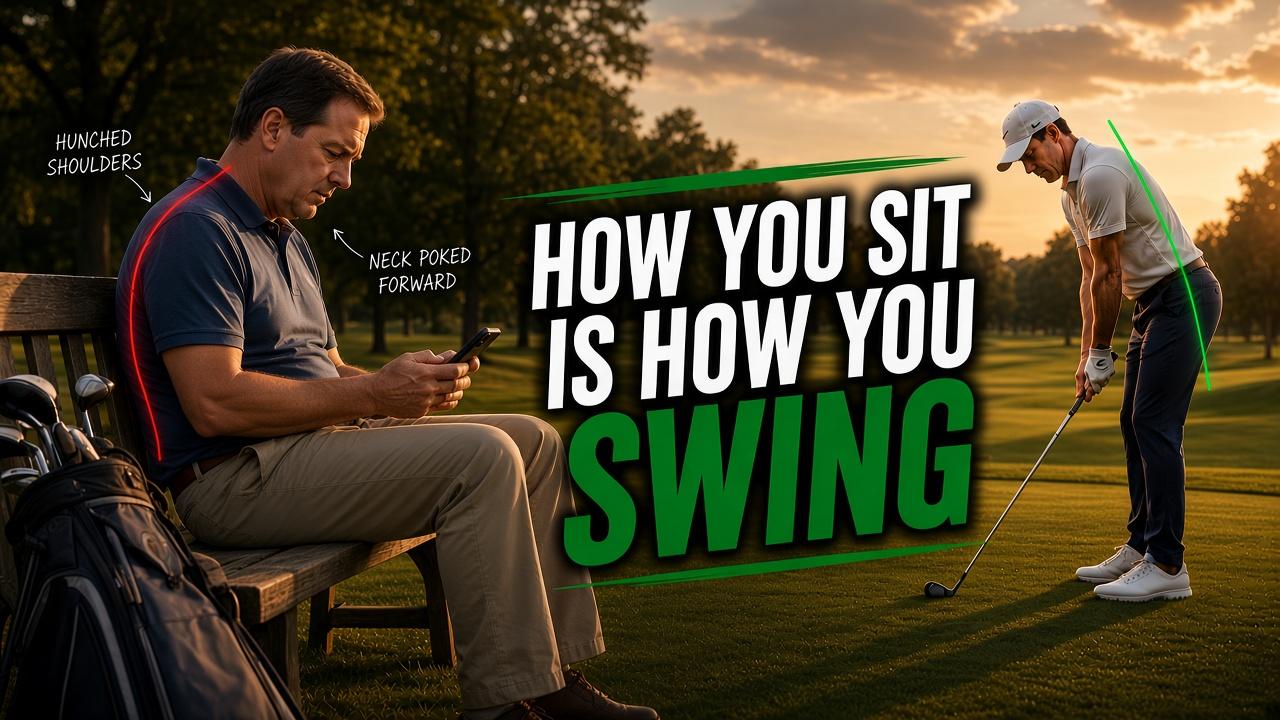
How you sit is how you swing. I don't mean that as a clever line, I mean it literally. The body-mind you bring to the golf course on a Saturday morning was built, or broken, by how you sat, stood, bent and walked every day that week. Welcome to Alexander Golf, the way of the mind, from Better Game Golf. A common sitting habit is essentially a collapse, and for the golfer there are serious consequences, because that collapse doesn't stay in the chair. It travels with you to the first tee. The question most golfers never ask is where the swing actually gets built. Not on the range. In the everyday. That's the whole of what follows.
How do we sit? Most of the time, badly, and not through any fault of character. A common sitting habit is essentially a collapse, and that happens whether you're at a computer at work or, particularly, at home, because the chairs at home are actually designed to collapse into. Soft furniture invites you to sink. Nobody sits down intending to wreck their swing. It happens slowly, through thousands of ordinary moments at a desk, in a car, on a sofa scrolling through the day's social media, and none of those moments feel significant at the time.
That's precisely the problem. The collapse is invisible because it's familiar. You don't notice your ribcage dropping toward your hips, your head sinking forward, your weight rolling back onto your tailbone, because it has become your normal. And unfortunately for the golfer, there are some serious consequences to that normal, because the body you're folding into that chair is the same body you're asking to rotate, extend and strike a ball with speed and precision a few hours later. You cannot spend most of your waking life in collapse and expect your body to simply switch into integrated movement on demand when you step onto the first tee. The chair doesn't stay in the office. It comes with you.
The consequences of that collapse show up in specific places. In the lower body, the abdominal muscles become weak, the glutes become weak, while the erector spinae running along the spine and the psoas, the deep core muscles connecting your lower back to your pelvis and upper leg, become tight. In the upper body, the neck flexors and the rhomboids become weak, while the pecs and the trapezius become tight. These muscles, and the fascia that surrounds them, matter enormously.
Here's why it matters beyond anatomy. If some muscles in your hips and legs are weak and others are tight, you simply will not even begin to be able to move, like this golfer, the world-class player you're picturing right now with the free hips and the full turn. You won't even start being able to move like that. And the same is true of your shoulders and arms. It isn't a question of trying harder on the range. The tissue itself isn't available for that movement yet. So it all begins with how you sit during the everyday, and the real question becomes: what can I do about it?
One option is the way of the master coach. In 1985, Nick Faldo engaged David Leadbetter, and the two of them understood going in that it was going to be a lot of work, probably two years. This is the way of a hundred thousand reps. Faldo used to hit a thousand shots a day under supervision with the new technique in the Florida sun, rebuilding his swing from the ground up through sheer, supervised repetition until the new pattern overwrote the old one completely.
It worked, and it's a remarkable story of commitment. But notice what made it possible. Faldo had the time, the access to a master coach, and the daily hours on a range in the Florida sun to put in that volume of reps. One of the consequences of that daily routine was that Faldo wasn't sitting for a prolonged period. His days were built around movement, around practice, around the course. That's not most golfers' lives, and it's worth being honest about that gap before reaching for the same solution.
Most of us do not have the time or the inclination for a thousand supervised shots a day over two years. We have jobs, commutes, families, and one slot in the week, if that, for golf itself. So because of time, the way of the 100,000 reps is simply not available to the overwhelming majority of golfers, no matter how much they might want Faldo's result.
That's not a discouraging fact, it's a clarifying one. If the master-coach route depends on hours most of us don't have, then chasing it as the only path to change sets up a frustration that has nothing to do with effort or talent. It's simply a mismatch between the method and the life. So the real question isn't how do I find more range time, it's what else is available to someone whose week doesn't look like a touring professional's. That question is what the rest of Alexander Golf answers.
This isn't a new idea. In the 1940s, Percy Boomer, a great coach and professional to British royalty, wrote On Learning Golf, still one of the best books ever written on the game. In it, he recommended the Alexander Technique, because he saw in it the detailed attention to the integrated movement of the body-mind and the focus on the means whereby my outstanding achievement is achieved. Today, we'd call that a focus on process over outcome. He recognised how valuable the approach is and would be. Nobody took much notice.
But what's inherent in Boomer's recommendation is a genuinely radical idea: that you can change your golf not on the practice ground, not on the course, but actually through everyday life. In how you sit, how you stand, how you bend, how you walk, and even how you lie. The movements we make in the everyday are the location of this golfing transformation. That single sentence reorganises where you think the work happens. Not the range. Not the course. The kitchen, the car, the office chair, the bed.
As F.M. Alexander put it, we can throw away the habits of a lifetime in a few minutes if we use our brains. The way we do it is two things. First, inhibition: we stop the movements that are unhelpful and associated with poor body use, before we do them. Then, having inhibited the old habit, we give directions.
This is a skill, and it's not one direction, it's multiple directions. That matters because the body, as modern functional anatomy confirms, is hugely interconnected. There's no point giving a direction to one bit of the body. You need to give direction to two. In the Alexander Technique, much of this is about lengthening and broadening the muscles and the fascia, working with the body as a connected whole rather than a single joint in isolation. And this is exactly where the mind comes in, because it's through the way of the mind that these directions, and the changes and transformation that follow from them, actually happen. You can read more of this thinking across all Golfing Bodymind articles.
Look honestly at a week. We spend 40 to 50% of our time at work or travelling to work. We spend maybe 30 to 40% with family and friends. Golf is only 10% of the time if we're lucky, and for most of us it might be just one round a week, which is more like 5%.
Put those numbers side by side and the conclusion is unavoidable. If golf itself is only 5 to 10% of your week, then trying to fix your swing exclusively within that narrow window was always going to be an uphill fight. The real opportunity sits in the other categories, the work time and the family time, because that's where you're sitting, standing, bending, walking, lying, hour after hour, day after day. That's a far bigger canvas to work on than any range session.
In the way that we sit, stand, bend and walk during that work time and family time, we can apply the fundamentals of integrated movement. Do that consistently and the body-mind you turn up to the course with is one that's toned and ready for the kind of integrated movement that's so essential in the golf swing. Rather than arriving with weak or tight joints and muscles and fascia around your hips, legs, shoulders and arms, you arrive with nicely toned muscles, because of the new habitual uses of the body-mind you've developed away from the course entirely.
This is the way of the mind. Welcome to Alexander Golf. Welcome to the way of the mind, by Better Game Golf.
Alexander Golf is the application of the Alexander Technique to the game of golf, and it's what I call the way of the mind. It isn't a new swing method or a set of positions to copy. It's built on the idea, first flagged by Percy Boomer in On Learning Golf back in the 1940s, that the detailed attention to integrated movement of the body-mind, and a focus on process over outcome, can transform how you move. The practical core of it is two skills: inhibition, where you stop an unhelpful habitual movement before you do it, and giving directions, where you consciously direct multiple connected parts of the body at once. It happens in everyday life, not on the range.
Because a common sitting habit is essentially a collapse, and your body doesn't separate "sitting you" from "swinging you." If you spend most of your week collapsed into a chair at work or at home, your abdominals and glutes weaken, your erector spinae and psoas tighten, and the same pattern plays out in your upper body with weak neck flexors and rhomboids against tight pecs and trapezius. With that imbalance in place, you simply will not even begin to be able to move like the free-turning golfer you're trying to copy. The swing isn't failing you on the range, the tissue built by your sitting habit hasn't given you access to that movement yet.
You can, if your life looks like Faldo's did in 1985 when he engaged David Leadbetter for a two-year rebuild. That route worked because Faldo could hit a thousand shots a day under supervision in the Florida sun, and because his days weren't built around prolonged sitting the way most of ours are. Most of us don't have that time or that inclination, and that's not a failing, it's simply a different life. Because of time, the way of the 100,000 reps is simply not available to the majority of golfers. That's exactly why the everyday, rather than the range, becomes the more realistic place to do the work.
It happens in the 40 to 50% of your week you spend at work or travelling to work, and the 30 to 40% you spend with family and friends. Since golf itself might be as little as one round a week for most people, trying to confine all your change to that small window makes change unnecessarily hard. Instead, in the way you sit, stand, bend and walk during ordinary work and family time, you can apply the fundamentals of integrated movement. Do that consistently and you arrive at the course with a body-mind already toned and ready, rather than arriving with the weak and tight patterns built by a week of collapse.
Giving directions is the second half of the Alexander Technique process, after inhibition. Once you've stopped the old habitual movement, you consciously direct how your body organises itself, and crucially, this is never just one direction. Because the body is hugely interconnected, there's no point giving a direction to one bit of the body, you need to give direction to two, often more. Much of this work, particularly in the Alexander Technique, involves lengthening and broadening the muscles and the fascia together rather than isolating a single joint or muscle. It's a skill that takes attention to develop, and it's the mind that drives it.
Because the body doesn't work in isolated parts, it works as an interconnected whole, which is exactly why giving a direction to one bit of the body on its own achieves very little. A single cue, like "sit up straight," ignores the weak glutes, tight psoas, weak rhomboids and tight pecs that a collapsed sitting habit has already built into you. Real change needs inhibition of the old pattern first, then multiple directions given together, practiced in the actual everyday moments where the collapse happens, sitting at your desk, standing in a queue, bending to pick something up. That's the way of the mind, and it's a different kind of work than a single postural fix.
Free Download
Sandy Dunlop's introduction to the Golfing Bodymind, free PDF, delivered instantly.
No spam. One email with your download.
Tell Sandy and he will answer as a coach would, not as an article, then build it into a plan if you want one. Free, and no card.
No card. Start on WhatsApp, take the quiz, or sign up on the web.
Free Download
Sandy Dunlop's introduction to the Golfing Bodymind, free PDF, delivered instantly.
No spam. One email with your download.
He will take this piece and tell you what it means for you. Free, and no card.
No card. WhatsApp, the quiz, or the web.
If you want to understand how sitting affects your golf swing, stop looking at your swing and start looking at your chair. Eight hours a day compressed into a desk seat doesn't just make you stiff. It...
18 min read →Most golfers trying to improve their swing body mechanics get handed a checklist. Rotate here. Shift weight there. Keep your elbow in. What they rarely get is a way of understanding how their body act...
17 min read →To **stop overthinking your golf swing**, shift your focus from conscious control to developing integrated, habitual movement patterns. Adopt a **systems thinking approach** that incorporates techniqu...
21 min read →