
Better Golf Starts in Your Mind — Text Sandy free →
By Sandy Dunlop — Better Game Golf
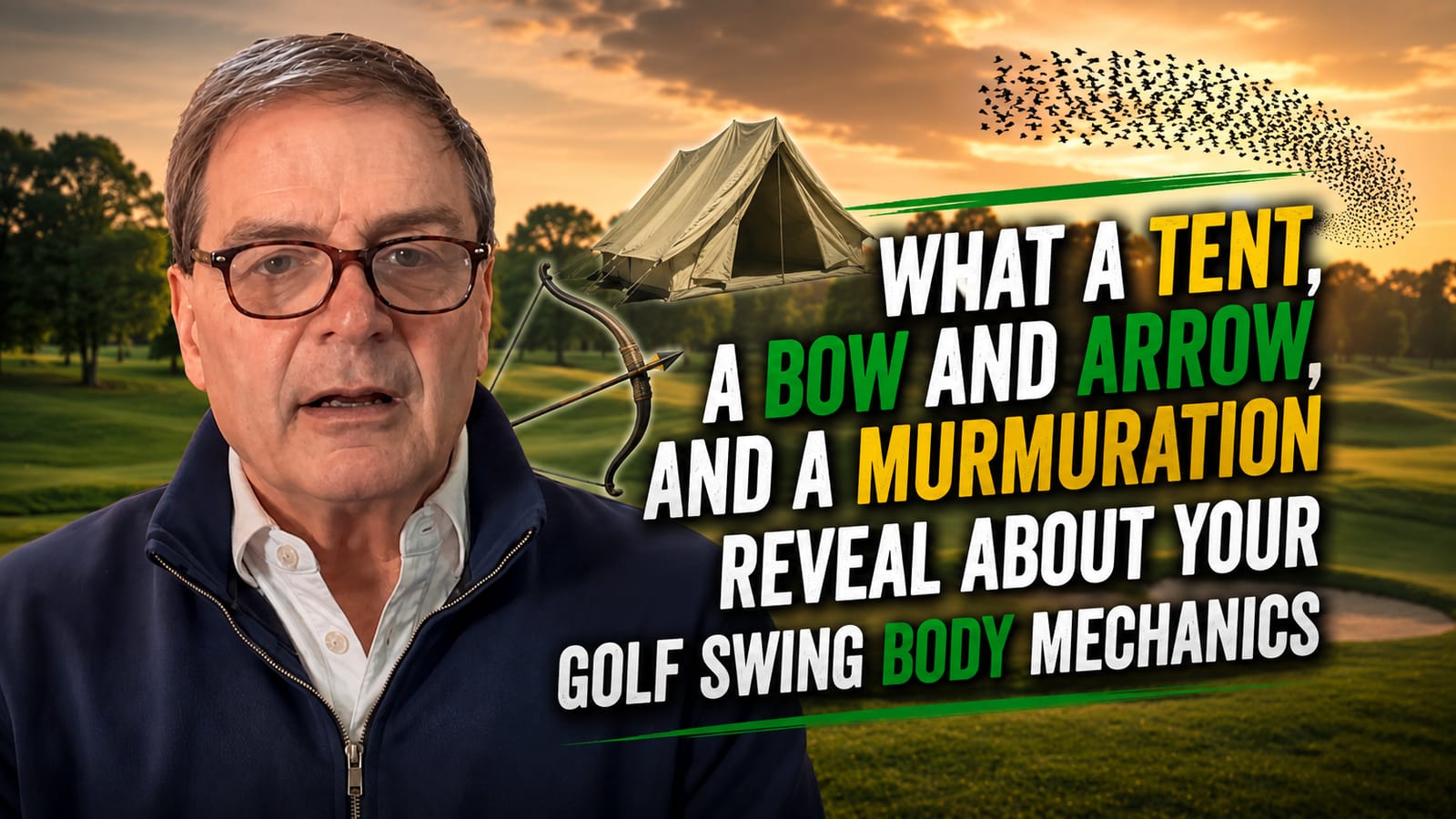
Most golfers trying to improve their swing body mechanics get handed a checklist. Rotate here. Shift weight there. Keep your elbow in. What they rarely get is a way of understanding how their body actually works as a whole. That is what I want to offer you here. Through five nature-based metaphors, a tent, a bow and arrow, a bridge, a double helix, and a murmuration, I want to give you a felt, intuitive grasp of the integrated movement science underpinning everything I teach in the Better Game Golf approach. These aren't pretty illustrations. They are genuinely useful models that reveal how your body organises itself when it moves well.
When I wrote The Golfing Bodymind, I was already convinced that the standard approach to teaching golf was fundamentally flawed. The typical method tries to change a golf swing piece by piece, fault by fault, symptom by symptom. And it doesn't work, not really, not under pressure. Because a golf swing is a coordinated whole. It can only be changed as a whole.
The emergent sciences, quantum physics, neuroscience, complexity theory, functional anatomy, they all confirm this. Everything is connected. The 700-plus muscles in your body need to function in a very interconnected way. They work in groups, in relation to the whole, alongside the 200-plus bones and 350-plus joints. You cannot separate the parts from the whole. When a teaching method tries to do exactly that, it produces golfers who can execute a drill on the range and then revert completely under pressure on the course. The brain, under stress, wheels out what it knows best. And what it knows best is not what's optimal, it's what's familiar.
This is why I believe the model matters at least as much as the method. If you don't have a way of seeing your body as an integrated system, you will always fall back on tinkering with parts. You can explore more about this in my article on why every golfer needs a model, not just tips.
Here is something I've noticed consistently in my work with golfers: when you give someone a technical instruction, they process it analytically. They try to consciously engineer the movement. And the moment conscious control takes over in a golf swing, fluency breaks down. The analytical mind is too slow, too serial, too self-conscious to coordinate a movement that happens in under two seconds.
Metaphor works differently. A good metaphor activates pattern recognition. It gives the nervous system an image to organise around rather than a checklist to execute. When I tell a golfer to think of the bow bending before release, something shifts in how they prepare to swing, not because they've been told what to do, but because they've understood something about the nature of the movement. That is a fundamentally different learning process. It's also why I use five metaphors rather than one. There's no one magical metaphor that explains everything. Each one illuminates a different facet of the same integrated reality.
Let me start with the tent, because it's the foundation of everything else. A tent is a structure where poles and canvas are stretched by ropes pegged into the ground. What makes that light but very strong structure work is the stretch. Imagine one tent pole, the rope connecting it, angled out on the other side. The whole structure is in dynamic balance through tension. And you can immediately imagine what happens if one of the tent strings goes slack. The whole structure loses its integrity.
Functional anatomy has revealed something very interesting about the body's fascia. Fascia is a filmy web of tissue that connects all bits of the body, and like the tent, it works best when it's stretched, lengthened and broadened. This is what's called a tensegrity structure. The word comes from tensional integrity, and it describes a system that maintains its shape and transmits force through balanced tension rather than compression alone. In your body, you actually want this tensegrity working optimally. You want your body lengthened and broadened.
The problem is that the way most people sit, hunched at a desk or slouched in a chair, compresses that system. The fascia and muscles get either compressed or overly stretched in unhelpful ways. They become non-performing or too tense to move freely. This is why I say that your golf posture is built before you step on the course. The quality of your tensegrity before you even take the club back determines what's available to you in the swing.
(Try: Lengthening and Broadening Directions -- available in the Training section of the app)
Now extend that tent image into a bow and arrow. The bow has a stable wood or metal structure, but it also has the string that you stretch. You pull back with the arrow in place, and there's a lot of stored energy in that bowstring. When released, that energy propels the arrow. In the bow you have stable and moving, but you also have stretching and the stored energy that comes from that stretch. The release is the payoff of the preparation.
This is directly analogous to what I call antagonistic pulls in the body, and it's right at the core of the Alexander Golf approach. The insight is this: it's no good just moving one thing in one direction, because what will tend to happen is another part will move to counteract it. You pull the head up and the lower back hollows. You lift the chest and the chin drops. Nothing is isolated. So the direction you give your body has to work in two directions simultaneously, like the tent poles and the tent strings working together. Like the bow bending in both directions before the release.
In practice, this means learning to lengthen upward through the crown of the head while dropping the tailbone downward. To widen across the shoulders while the feet ground. These are not contradictory instructions. They are antagonistic pulls that create the conditions for a swing that generates power through stretch rather than through brute muscular effort. This is why the two-pillar approach of Golfing Bodymind and Alexander Golf is so central to what I teach.
The bridge metaphor, particularly a cantilever structure, adds another dimension to the picture. In a cantilever bridge, you have both compression and lengthening working together in elaborate structures that carry enormous load. The famous Forth Rail Bridge in Scotland was one of the first places engineers worked this out systematically. What makes it stand is not any single element but the precise balance of forces distributed through the whole structure.
Your body carries load in exactly the same way. When you stand at address, when you rotate in the backswing, when you deliver the club through impact, your skeleton and fascial system are distributing and transmitting forces across the whole structure. Various forces of compression and tension need to be aligned, like in a bridge. If one part of that system is slack, compressed, or misaligned, the load gets shunted somewhere else. You may not even feel it immediately, but over time, or under pressure, it shows up as inconsistency, compensation, or injury.
This is a completely different way of thinking about golf swing body mechanics than the usual focus on individual joint angles or muscle groups. The bridge doesn't have a "most important cable." It's the whole structure or nothing. And that's exactly how I approach integrated movement in the Better Game Golf method.
Perhaps the most elegant of these metaphors is the double helix. You'll have seen the image from DNA: two spirals winding around a central axis. What researchers have found is that the body's muscles and fascia work in a series of interlocking spirals. The stretching of those spirals is a core part of how movement is generated and controlled.
Critically, what I find most useful about this metaphor is the division of labour it implies: typically one of the spirals will be focused on movement while another will be focused on stability. So the two work hand in hand, stability and mobility, in a continuous dynamic relationship. This is not stability in the rigid sense. It's the stability of a structure that is alive and responsive, like the bow that bends without breaking, like the bridge that flexes under load.
When golfers try to manufacture a stable base by gripping the ground or stiffening the lower body, they are actually disrupting the spiral system. Real stability in a golf swing comes from the tensegrity of the whole structure working through its natural double-helix patterns of movement. Interfere with that through tension or collapse and you lose both stability and mobility at once. This connects directly to what I write about in why your best golf happens when you stop trying.
(Try: Spiral Movement Awareness -- available in the Training section of the app)
A murmuration is one of the most extraordinary sights in nature. Thousands and thousands of starlings moving in elaborate, shifting patterns across the sky, and then at exactly the same moment, the whole flock turns in another direction. No conductor. No instruction. Just an emergent, self-organising system responding to information flowing through the whole group in real time.
This is a useful analogy for how the systems in the body can work in a self-organising way once the appropriate communication between the different parts of the body are freed up. That phrase matters: freed up. The murmuration doesn't happen because the starlings try harder. It happens because nothing is blocking the flow of information between them. The same is true in your body. When the fascial tensegrity is working well, when the antagonistic pulls are properly established, when the spiral patterns are unobstructed, your body can self-organise its movement in a way that no conscious checklist could ever replicate.
This is what I mean when I talk about the golfing bodymind as an integrated whole. You are not managing a collection of parts. You are creating the conditions for a system to express itself. The murmuration doesn't need external management. It needs internal freedom. And that is exactly the promise of this approach to golf swing body mechanics. It is also why how to stop overthinking your golf swing is not primarily a mental tip but a whole-system question.
Let me pull these together, because each one is useful and none of them tells the whole story on its own. The tent shows you why length and breadth matter in the fascial system. The bow and arrow shows you how stored energy through antagonistic pulls powers the release. The bridge shows you how your body distributes and carries load across a whole structure. The double helix shows you the spiral nature of muscular movement and how stability and mobility are always paired. And the murmuration shows you the self-organising intelligence available when none of that is blocked.
These five metaphors of integrated movement explain much of the science. They're not the whole truth. They're just useful. Together, they give you a way of understanding golf swing body mechanics that no amount of technical fragmentation can provide. They invite you to recognise the pattern rather than engineer the parts. That is a fundamentally different, and I believe far more effective, learning relationship with your own movement. You can browse all mental game articles to see how this body-based understanding connects to everything else in the Better Game Golf approach.
Tensegrity, which stands for tensional integrity, describes a structure that maintains its form and transmits force through balanced tension rather than through rigid compression alone. Think of the tent: it's held in shape not by the poles alone but by the interplay between poles and stretched ropes. In the body, fascia, the filmy web of connective tissue running through and around every muscle, works on exactly this principle. It works best when it's stretched, lengthened and broadened. When you slouch at a desk all day or carry habitual compression in your posture, you compromise that tensegrity before you even pick up a club. In the swing, this matters enormously because a tensegritic body transmits force efficiently through the whole structure. A compressed or slack system leaks energy, produces compensation patterns, and ultimately creates inconsistency. The goal is a body that is genuinely lengthened and broadened at address, and that maintains that quality through the movement.
Antagonistic pulls are the simultaneous directions you give to your body in opposite directions, modelled on the way the tent poles and tent strings work together, or the way a bow bends in both directions before releasing the arrow. In practice, this means something like lengthening upward through the crown of the head at the same moment as you release the tailbone downward, or widening across the back while the feet ground into the earth. The key insight is that giving direction in only one way tends to produce a counter-movement somewhere else in the body, which cancels the effect. Antagonistic pulls, by working in two directions at once, create a dynamic equilibrium, stored energy like a drawn bow, that the swing can then release. This is right at the core of the Alexander Golf approach within the Better Game Golf method.
Technical instructions engage the analytical mind. They invite you to consciously control and engineer a movement that needs to happen in under two seconds. The brain under that kind of self-monitoring tends to produce exactly what you're trying to avoid: stiffness, interference, and reversion to old habits. Metaphors work differently. They activate pattern recognition. When you understand the bow bending before release, or the tent held taut by its ropes, you give your nervous system an organising image rather than a checklist. The body is remarkably good at recognising and reproducing natural patterns when you give it the right model. This is not a soft or mystical claim: it is consistent with what systems thinking and neuroscience tell us about how movement is actually learned and coordinated. There is no one magical metaphor that explains everything, which is exactly why I use five of them.
The murmuration is a model for self-organisation. Thousands of starlings shift direction simultaneously without any individual bird conducting the movement. The information flows through the whole system in real time. In a well-integrated golf swing, something similar is available. Once the fascial tensegrity is working, once the antagonistic pulls are established, once the spiral patterns of the double helix are unobstructed, the body can self-organise its movement. You don't have to manage every part consciously. The system coordinates itself. What blocks that self-organisation is interference: tension, compression, habitual collapse, or the kind of anxious over-control that fear-based swing patterns produce under pressure. The murmuration reminds you that the goal is not more control but the right conditions for the system to work.
The double helix model comes from the observation that the body's muscles and fascia work in a series of interlocking spirals, much like the double helix structure of DNA. Two spirals working around a central axis, each doing a different job. In movement terms, typically one spiral is focused on mobility while the other is focused on stability. They work hand in hand. This is why real stability in a golf swing cannot come from stiffening or gripping: that interferes with the spiral system and actually undermines both stability and mobility simultaneously. The double helix model suggests that a powerful, flowing swing is not the product of rigid stability with mobile parts layered on top. It is the product of two complementary spiral systems working in dynamic relationship, storing and releasing energy throughout the movement.
The separation of body mechanics and mental game is itself part of the problem. In the Better Game Golf approach, the golfing bodymind is a single system. The same tension that compresses your fascial tensegrity at address is the tension that narrows your attention, quickens your breathing, and puts you into the kind of reactive state where old habits dominate. Conversely, when you establish genuine length and breadth, when the antagonistic pulls are working and the system is self-organising like a murmuration, you are also in a very different mental state. You are more present, more open, more capable of the kind of absorbed attention associated with golf flow state. The body is not the servant of the mind in this model. They are one integrated system, and working on your movement is working on your mind.
My honest answer is that you need to internalise them off the course first, then let them inform your on-course awareness. The body work and Alexander direction work that these metaphors point toward requires repetition in a calm, deliberate setting before it becomes available under pressure. If you try to think "am I a drawn bow?" on the first tee with four people watching, you'll be back in the analytical mind immediately. What I would suggest is spending time with the lengthening and broadening directions, working on the sense of antagonistic pulls, and doing the body relaxation exercises in the app until the physical feeling of a well-organised tensegrity becomes familiar. Then, on the course, a simple cue or image, the tent held taut, the bow ready to release, is enough to reconnect you to that whole-body state without triggering the analytical overthinking that undermines the swing.
The five metaphors I've described here, the tent, the bow and arrow, the bridge, the double helix, the murmuration, are not just ideas. They are doorways into a completely different relationship with your own movement. Every one of them has corresponding exercises and guided experiences in the Better Game Golf app, where Sandy's AI caddie will walk you through these concepts on your next round.
Start your free 7-day trial at bettergamegolf.com and let Sandy's AI caddie walk you through these concepts on your next round.
Stories are not decoration. In my experience, they are one of the most powerful transmission systems human beings have ever invented for getting wisdom from one person to another. That is exactly why ...
16 min read →You've got a round coming up and you're already dreading it. Your game hasn't been sharp, life has been relentless, and somewhere in the back of your mind a quiet voice is already writing the disaster...
15 min read →A golf mental reset isn't just a nice idea. It's a neurological necessity. When a bad shot cascades into a worse one, something very specific happens in your bodymind... your breathing shortens, your ...
15 min read →