
Better Golf Starts in Your Mind — Text Sandy free →
By Sandy Dunlop — Better Game Golf
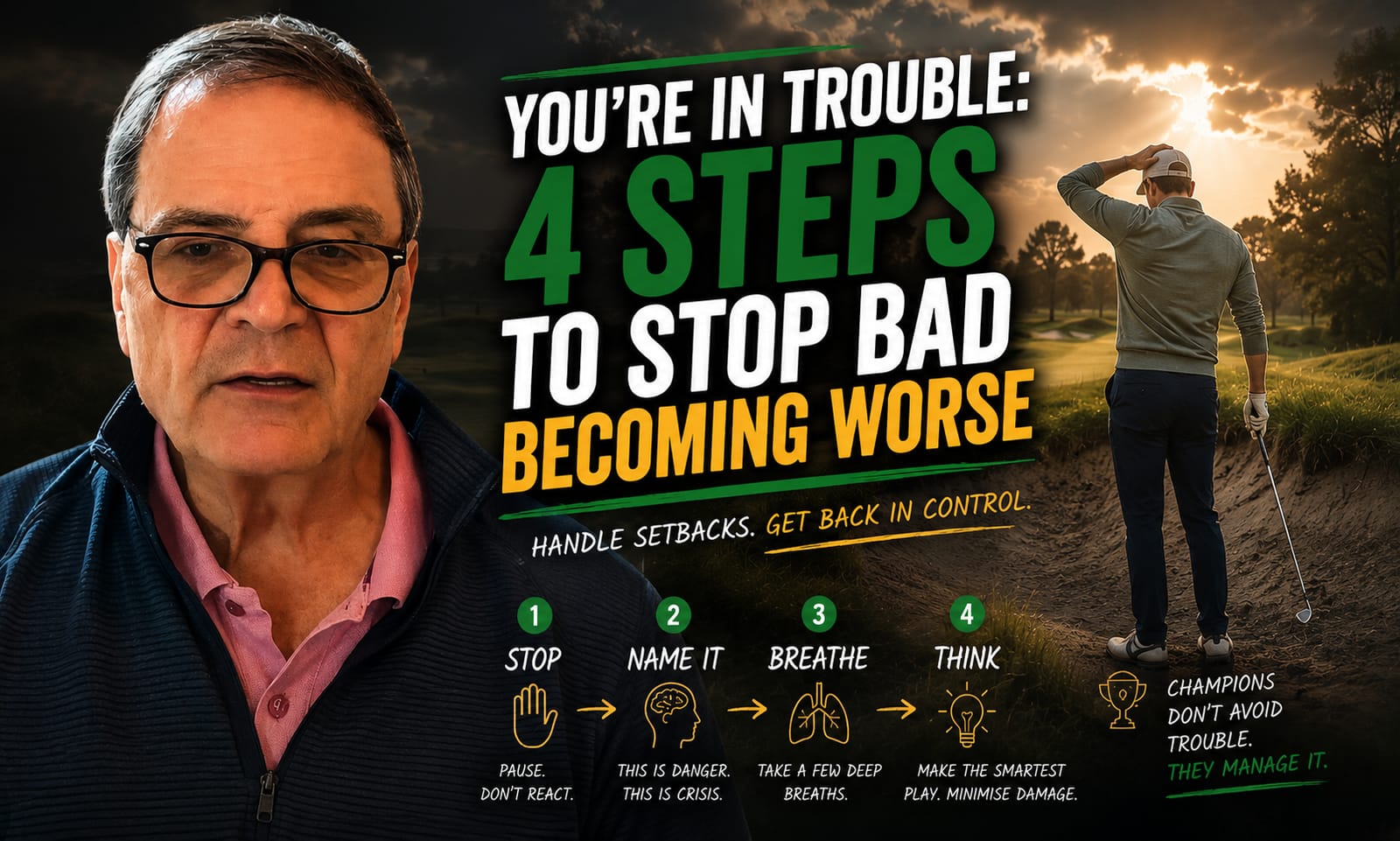
A golf mental reset isn't just a nice idea. It's a neurological necessity. When a bad shot cascades into a worse one, something very specific happens in your bodymind... your breathing shortens, your thinking speeds up or goes numb entirely, and you lose the composure you had. That's not weakness. That's your autonomic nervous system doing exactly what it's designed to do under threat. The problem is, what it's designed to do and what you need it to do on a golf course are two very different things. In this article I want to share what I've seen in my own game and in golfers I've worked with, and give you four concrete steps to interrupt that nervous system response before bad becomes catastrophic.
Here's the situation I want to describe, because it happened to me in my last two rounds. You've got a winning score going. You hit a bad shot amidst playing well. But there's a chance to remedy it. The problem is there's a high risk element involved... a narrow gap between the trees, a bad lie, a tough bunker shot. And it goes wrong again. You hit the trees trying to get out. You leave the ball in the bunker. You thin the shot from the bad lie. So bad has gone to worse.
What happens then in the bodymind is the part that really matters. Things speed up in your mind. Quite likely the mind will go numb. Your breathing speeds up. And you've kind of lost it. You've lost the composure you had. You've lost the state of mind.
This isn't a character flaw. It's autonomic activation. When the nervous system registers failure and then compound failure, it responds as it would to any threat: fight, flight, or freeze. In golf, that looks like rushing the next shot, going mentally blank, or standing over the ball unable to pull the trigger. Understanding this is the foundation of any genuine golf mental reset, because you cannot think your way out of a nervous system response. You have to move through it deliberately.
Here's something from my work that most golfers never hear about. When we do a movement frequently, the brain stores it in what are called brain maps. And when faced with a situation it recognises, it wheels out what it's done before. This all happens in a split second. Now, in a moment of crisis on the course, the brain isn't reaching for your best swing. It's reaching for what's most familiar under stress... and under stress, what's familiar is tension, speed, and contraction.
The nervous system compounds this. Anxiety and stress trigger our nervous system, raise our blood pressure, make us tighten up. The breathing becomes shallow and quick. And as I've written about in Golf and Anxiety: How the Course Trains Your Nervous System, this isn't a random response. The course is literally training your nervous system every time you play, for better or worse. The question is whether you're training it to recover or to spiral.
The four-step reset I'm about to outline is specifically designed to interrupt the brain's default crisis pattern before it takes you somewhere you don't want to go.
This sounds almost insultingly simple. But stopping... actually stopping, not just slowing down slightly... is the hardest thing to do in the immediate aftermath of a bad-to-worse moment on the course. The instinct is to keep moving. To get to the ball quickly, assess quickly, decide quickly. That instinct is your autonomic nervous system trying to resolve the threat through action. Resist it.
Just stop for a minute. Physically stop. Stand still. Don't walk to the ball with urgency. Don't start planning the next shot while you're still processing the last one. The act of physical stillness sends a signal back through the nervous system. It begins to interrupt the cascade. In polyvagal terms, you are giving your system a moment to shift out of sympathetic dominance. You don't need to know that terminology for it to work. You just need to stop.
I've seen golfers who know their swing inside out completely disintegrate after a bad lie because they never gave themselves this moment. They moved too fast, decided too fast, and swung with a nervous system still flooded from the previous mistake. The stop is the gateway to everything else in this reset. Without it, the remaining steps don't have the ground to stand on.
(Try: Body Scan at the Ball... available in the Training section of the app)
Once you've stopped, the next step is to name what's happening. And the naming is this: this is danger, this is crisis. Not as a catastrophe statement. As a clear-eyed recognition. Naming activates the prefrontal cortex. It brings the observing mind back online after the limbic system has tried to hijack proceedings. There's solid neuroscience behind this... affect labelling, as researchers call it, demonstrably reduces the intensity of the emotional response.
But in my framework, the naming does something even more specific. It signals that it's time for some clever thinking and some clever acting. You are no longer in reactive mode. You are in assessment mode. The danger is real. The crisis is real. And precisely because it's real, it deserves a deliberate response rather than a panicked one.
This is related to what the Stoics called premeditatio malorum... the premeditation of adversity. To have anticipated this will happen. And it will happen. It could well happen when you've got a good round going. The golfer who has named this possibility in advance, who has said to themselves before the round begins "at some point today I may face a crisis moment," is neurologically better prepared to name it when it arrives. Surprise amplifies the stress response. Anticipation dampens it. So name it. This is the moment. This is the test.
After stopping and naming, the third step is to breathe. Not a casual breath. The specific, deliberate three-compartment breath that sits at the heart of my bodymind work: breathe in to the abdomen, into the chest, into the neck, and gently let the air out. Do it several times. Don't rush it.
Here's why this matters physiologically. As I explain in the Better Game Golf programme, one of the effects of this breathing exercise is that it calms the nervous system. And calming the nervous system is not a soft outcome. It directly affects your perception, your decision-making, and your ability to execute under pressure. When the breathing becomes shallow and quick, the stress response intensifies. When you deliberately slow and deepen the breath, you are activating the parasympathetic nervous system. You are physiologically downregulating the crisis state.
The Ancients knew this. In yoga, breath control is called pranayama... and for breath is life is a Sanskrit saying that's been guiding practitioners for thousands of years. I wrote about breath in The Golfing Bodymind decades ago, and the science has only caught up since. Even slight changes to how you inhale and exhale measurably improve sports performance. On a golf course, in a crisis moment, slow deep breathing is not a relaxation technique. It is a performance intervention. It is your golf mental reset, delivered through the lungs.
(Try: Three-Compartment Breathing... available in the Training section of the app)
Now, and only now, do you think. Not before you've stopped. Not before you've named it. Not before you've breathed. The sequence matters because the quality of your thinking at step four depends entirely on the work done in steps one through three.
What you're thinking about at this point is one clear question: how can I get out of this situation without causing further damage? Because the problem is bad can become really bad, can become completely destructive. That's what I've lived through in recent rounds, and I suspect you have too. The thinking at step four is not about recovery shots or heroics. It is about damage limitation. It is strategic and calm, not ambitious and adrenaline-fuelled.
This connects directly to what I explore in The Art of Minimising Bad: How to Win by Losing Less. The real skill in golf is not always making great shots. It is frequently stopping disaster from becoming catastrophe. The golfer who completes step four with a clear, calm assessment... take your medicine, punch out sideways, make sure of the bogey... has turned a crisis into a managed setback. That is what golf mental resilience looks like at the sharp end.
The four steps I've outlined draw directly on what the Stoics called premeditatio malorum... the premeditation of adversity. The idea is to have anticipated that this will happen, before it happens. Not pessimism. Preparation. When the crisis arrives and you've already rehearsed your response to it, the nervous system is not blindsided. The autonomic activation is still real, but the recovery is faster because the pathway back to composure is already grooved.
I'd encourage you to build this into your pre-round routine. Before you tee off, take thirty seconds to acknowledge to yourself: at some point today, something will go wrong. Maybe badly wrong. I have a response to that. I know what to do. That simple act of anticipation changes the psychological landscape of the entire round. It's the difference between being swept away by the crisis and having a rope in your hand when the current arrives. For more on building that kind of mental architecture before you play, see my article on how to build a golf pre-shot routine that holds under pressure.
The goal of the four-step golf mental reset is not to eliminate bad shots or bad situations. It is to handle setbacks in a smart way, so that you get back on track again, back to composure. And here's what I've consistently seen: when you do the work of the reset, when you actually stop, name it, breathe, and think, the recovery shot often delivers. Not because you've suddenly acquired a better technique, but because you've returned the nervous system to a state where the technique you already have can actually express itself.
That's the insight that most golf instruction misses entirely. Bad shots in a crisis are often not technical failures. They are nervous system failures. You had the swing. The system was too flooded to let it out. The reset clears the path. See also the broader mental game articles in the learn section for how this connects to consistency, focus, and flow across your whole game.
A golf mental reset is a deliberate intervention to interrupt the autonomic nervous system response that follows a bad shot, particularly when one bad shot cascades into another. What I've observed in my own game and in the golfers I work with is that the critical moment isn't the first bad shot. It's the second or third one, when bad has gone to worse. At that point, the mind speeds up or goes numb, the breathing shortens, and composure is lost. A golf mental reset is the sequence of steps... stop, name it, breathe, think... that interrupts that cascade before it becomes destructive. Without it, you're playing the next shot with a nervous system still flooded from the previous failure. With it, you return to a state where your actual capability can express itself.
Because breath is the most direct lever you have over your autonomic nervous system. When stress and anxiety activate the nervous system, breathing becomes shallow and quick. That shallowness feeds the stress response, creating a feedback loop that worsens your state. When you deliberately shift to deep, three-compartment breathing... into the abdomen, the chest, and the neck... you activate the parasympathetic nervous system. You are physiologically downregulating the crisis state. I've been teaching this since I wrote The Golfing Bodymind, and the science has only strengthened the case since. Even small changes to how you inhale and exhale measurably affect performance. On a golf course, in a pressure moment, this isn't relaxation. It's a performance intervention.
Naming it means saying clearly to yourself: this is danger, this is crisis. Not as a dramatic statement, but as an accurate one. The reason this step matters neurologically is that affect labelling... putting words to an emotional or stress state... demonstrably reduces the intensity of that state by bringing the observing, reasoning mind back online. In my framework, naming it does something additional: it signals that it's time for some clever thinking and some clever acting. You move from reactive mode to assessment mode. It also connects to the Stoic practice of premeditatio malorum... having anticipated this kind of moment before it arrives. When you've named the category of experience in advance, you're less blindsided when it occurs, and the nervous system recovers faster.
The key question to ask at step four of the reset is: how can I get out of this situation without causing further damage? Because bad can become really bad, can become completely destructive. The impulse under stress is to attempt the heroic recovery shot... the one through the gap in the trees, the aggressive bunker play from a tough lie. That impulse comes from a nervous system still in crisis mode, not from clear thinking. Once you've stopped, named the situation, and breathed, the question becomes damage limitation. Take your medicine. Punch out sideways. Make the bogey. The golfer who does this has not failed. They've exercised exactly the kind of smart strategic thinking that keeps a good round from becoming a disaster. Minimising bad is itself a form of winning.
The four-step golf mental reset is specifically designed to return you to the conditions in which flow becomes possible. Flow, or being in the zone, requires a nervous system that is neither flooded with stress nor numb with shutdown. It requires composure, clear perception, and the ability to execute without overthinking. When bad has gone to worse and your bodymind has lost its equilibrium, you are about as far from the zone as it's possible to be. The reset doesn't put you directly into flow. What it does is remove the obstacles that prevent flow from returning. It clears the nervous system, restores the breathing, and brings the thinking mind back online. From that ground, composure returns, and with composure, the possibility of getting back to the kind of golf you're capable of.
Absolutely, and I'd argue you must. The reason the four steps work under pressure is the same reason any skill works under pressure: repetition in advance of the moment you need it. The Stoic principle of premeditatio malorum is precisely about rehearsing your response to adversity before adversity arrives. In practice terms, this means building the breath work into your daily routine, not just reaching for it on the course in crisis. It means running through the reset mentally before a round, acknowledging that a crisis moment may come and that you have a response ready. The Better Game Golf app gives you the breathing exercises and the mental rehearsal tools to do exactly this. The more you've practised the sequence off the course, the more naturally it fires when you need it most.
Because knowing and doing are processed in different parts of the nervous system. You can intellectually know that you should slow down, breathe, and think... and still rush the next shot, because the autonomic nervous system doesn't respond to knowledge. It responds to practice and to physiological interventions. The brain maps that govern behaviour under stress contain what you've done most often, not what you know you should do. As I put it in my work: the brain will always select what it knows best, and what it knows best is not what's optimal, it's what it's familiar with. The only way to change that is to make the reset itself familiar, through repeated practice until it becomes the automatic response to crisis rather than the panic response. That's what the training in Better Game Golf is designed to deliver.
The four-step golf mental reset... stop, name it, breathe, think... is trainable. Your nervous system can learn to recover faster. Your breathing can become an on-demand tool rather than something that just happens to you. And the moment crisis hits on the course, you can have a grooved response waiting rather than a panic response taking over.
Start your free 7-day trial at bettergamegolf.com and let Sandy's AI caddie walk you through these concepts on your next round. The breath work, the body scan, the mental rehearsal exercises... they're all in there, built to be practised before you need them, so they're ready when you do.
Stories are not decoration. In my experience, they are one of the most powerful transmission systems human beings have ever invented for getting wisdom from one person to another. That is exactly why ...
16 min read →You've got a round coming up and you're already dreading it. Your game hasn't been sharp, life has been relentless, and somewhere in the back of your mind a quiet voice is already writing the disaster...
15 min read →Most golfers obsess over birdies. I want to talk about something arguably more important, especially for mid-to-high handicappers: your ability to minimise the damage when things start to go wrong. Th...
17 min read →