
Better Golf Starts in Your Mind — Text Sandy free →
By Sandy Dunlop — Better Game Golf
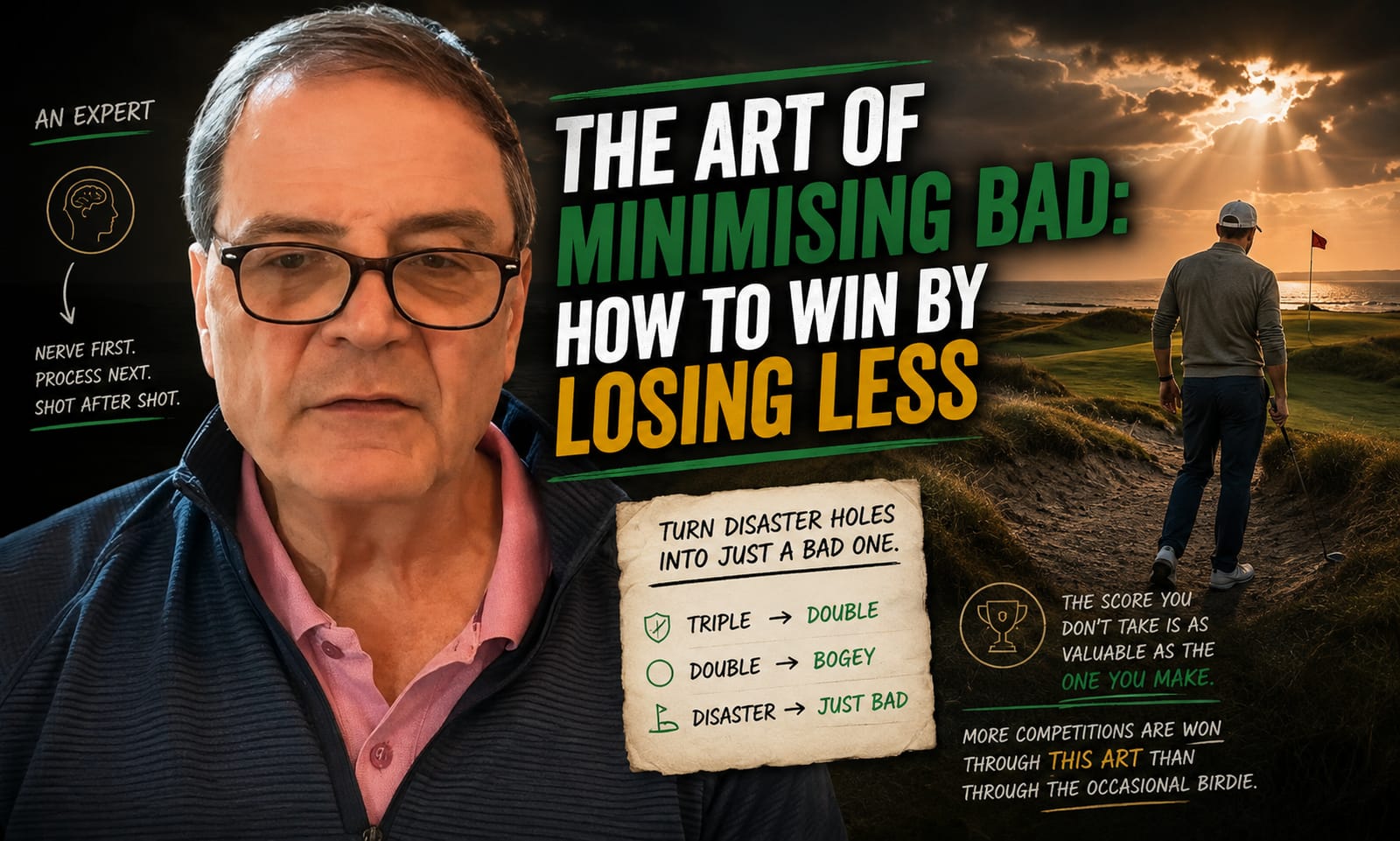
Most golfers obsess over birdies. I want to talk about something arguably more important, especially for mid-to-high handicappers: your ability to minimise the damage when things start to go wrong. The art of minimising bad is about turning a triple bogey into a double, a double into a bogey, a disaster hole into just a bad one. It is a nervous system regulation strategy, shot to shot, hole to hole. It requires a specific mental sequence, a precise physical response, and a reframe that most golfers have never been offered. More competitions are won through this art than through the occasional birdie. And I'd like to propose that you view it exactly as that: an art, and something to be proud of.
There is a bias in the way golfers think about their rounds. They remember the birdie on the fourth. They forget the triple they turned into a double on the eleventh. But here is what my work with golfers consistently shows: the ability to cap the damage is every bit as score-relevant as the ability to take advantage of a scoring opportunity. If you are a mid-handicapper and you convert three potential triples into doubles over a season, that is strokes saved that no amount of driving range practice would have produced.
The art I am describing is about a specific moment. You have hit a bad drive. You are in the trees, in a fairway bunker, or your approach has found trouble. The hole is not lost, but it is threatening to spiral. What happens in the next sixty seconds, before you even address the ball, determines whether that hole becomes a bogey or a catastrophe. The mechanism is not technique. It is your nervous system. It is the state you bring to the next shot. And that state is absolutely trainable. Explore all mental game articles to see just how much of this is learnable, not innate.
Ryan Fox at the 2025 Open Championship on the 15th hole is the image I keep coming back to. He had a horrible lie in the bunker. He could have gone for the heroic shot. It would have been stupid. Instead, he chipped it out sideways, accepted that bad was still bad, and then got down in two. He made his bogey. And that bogey, on that hole, in that moment, was every bit as important as any of his four birdies in the closing stretch.
What Fox demonstrated was not damage limitation in a passive sense. It was active, conscious, intelligent decision-making under pressure. It was the nervous system staying regulated enough for the thinking brain to remain online. It was, in the language I use, smart thinking under pressure. Often humble thinking under pressure. Accepting limitations. The heroic and the stupid are very close neighbours on that particular street, and the art of minimising bad means knowing which door you are knocking on. I wrote about this in more depth in The Wily Fox: How Ryan Fox Felt His Way to the Claret Jug.
When a hole starts to go wrong, your nervous system does not wait for your permission. The moment you register that your ball is in trouble, a stress response is already underway. Heart rate rises. Breathing becomes shallow and quick. The thinking brain begins to go offline. This is not weakness. This is biology. Polyvagal theory, which we draw on in the Better Game Golf programme, explains that your nervous system is constantly scanning for threat, and a ball in the rough registers as one. The body tightens. The grip pressure increases. The swing that follows carries all of that tension through it.
The critical insight here is that this cascade is not inevitable. It can be interrupted. But the interruption has to happen at the nervous system level first, before any strategic thinking is possible. If you try to think your way through a recovery shot while your body is still in a stress response, you are working against yourself. The thinking arrives at the wrong address. This is why the sequence I am about to describe starts with the body, not the mind.
(Try: Three-Compartment Breathing -- available in the Training section of the app)
The sequence for disaster recovery is the same one I use in the "You're in Trouble" framework: stop, name it, breathe, and think. It sounds simple. Under pressure, it is not. Let me walk through what each step actually does at the nervous system level.
Stop is an act of inhibition, in the Alexander Technique sense. Inhibition is not suppression. It is a conscious pause that prevents the habitual response from firing automatically. The habitual response to trouble is urgency: hurry up, get it over with, reach for the heroic shot. Stopping breaks that pattern before it becomes the action.
Name it means saying to yourself, clearly and without drama: I am in trouble. This is not pessimism. It is accuracy. Naming the situation activates a different part of the brain, the part that can respond rather than react. It also prevents the other habitual pattern, denial, which leads to attempting shots you have no business attempting.
Breathe is the intervention at the nervous system level. Three deep breaths into the abdomen, the chest, the neck, and a slow release. This is not metaphor. Deep diaphragmatic breathing directly activates the parasympathetic nervous system. It slows the heart rate. It reduces cortisol. It literally brings the thinking brain back online. The breath is the bridge between panic and performance.
Think only becomes possible once the first three steps are complete. And the thinking here is specific: what is the smartest shot available to me right now, given where I am and what I can realistically execute?
Conscious guidance and control, or CG&C, is the term from the Initial Alexander Technique that describes the mind's active involvement in directing the body. It is the opposite of habitual, automatic movement. In a recovery situation, CG&C means giving yourself clear, deliberate directions before the shot, not a list of swing thoughts, but a directive about what you are doing and why.
You are chipping out sideways. You are taking your medicine. You are making sure that bad does not become catastrophic. The direction is strategic, not technical. And it requires that the nervous system is calm enough to receive the direction in the first place, which is why the breathing step is not optional. CG&C in a recovery moment is the practical application of smart under pressure. It is the mechanism behind what Ryan Fox did on that bunker shot. He gave himself a clear direction, executed it, and moved on. The result was a bogey rather than a double. One shot saved. The round preserved.
(Try: Inhibition and Direction Exercise -- available in the Training section of the app)
In my framework, I work with zone colours to describe the mental and physiological state a golfer is in at any given moment. A red zone state is high arousal, panic, fight-or-flight, poor decision-making, and reactive movement. A green zone state is calm, focused, present, and capable of executing shots. The art of minimising bad is fundamentally about preventing a red zone trigger on one hole from pulling every subsequent hole into red zone territory with it.
Here is the pattern I see repeatedly. A golfer makes a double bogey on hole seven. They tell themselves it does not matter. But the body is still carrying the stress response. The breathing has not recovered. The grip pressure on the next tee is slightly elevated. The swing on hole eight reflects all of that, and hole eight becomes a bogey when it should have been a par. By hole nine the internal commentary has turned corrosive, and a perfectly manageable hole becomes another double. What started as one bad hole has become a three-hole collapse. The original disaster was not the problem. The failure to regulate after it was.
One of the personality dimensions I always raise when talking about this is the heroic-to-stupid spectrum. There is a particular kind of golfer, and you may recognise yourself here, for whom laying up, chipping out sideways, or taking an unplayable feels like an admission of failure. It feels cowardly. The ego wants the heroic shot. The ego wants to recover everything with one swing.
I want to propose a different frame entirely. Chipping out sideways is not cowardly. It is smart. The heroic response to trouble is very often very close to a stupid response. Ryan Fox at the 15th was not being cowardly when he took his medicine. He was being the opposite of stupid. And that reframe, from cowardly to smart, is not just motivational language. It is a genuine shift in how the nervous system processes the decision. When you label the conservative choice as smart rather than weak, the body follows. The tension drops. The execution improves. The hole ends at bogey rather than triple.
If you want to understand how anxiety physically changes what you do with the club in these moments, the article on Fear-Based Swing Patterns: How Anxiety Changes Your Technique is essential reading alongside this one.
The art of minimising bad is not just a course-management strategy. It is a practice. And like any practice, it needs to be noticed, recorded, and reflected on. My proposal is straightforward: after every round, make a note of the moments where you turned a double bogey into a bogey, or a triple into a double. Not in a scorecard sense, but in a narrative sense. What was the situation? What did you do? How did you regulate?
Most golfers only record what went wrong. They replay the bad shots, the missed putts, the chunks. They do not record the moments of genuine mental skill, the times they stopped the spiral, took the smart shot, breathed themselves back into green zone, and walked off the hole with one over rather than three over. Those moments deserve recognition. They are the evidence that the art is developing. And evidence matters, because the next time you are standing in a fairway bunker with a terrible lie, you need your nervous system to remember that you have been here before and handled it. That memory is built from reflection, not just experience. For more on building the mental side of your game away from the course, see How Busy Golfers Improve Away From the Golf Course.
Consistency in golf, real consistency, is not about hitting more great shots. It is about compressing the range between your best and your worst. The golfer who shoots 85 with a 79 inside it is already playing better than the golfer who shoots 82 with an 88 lurking behind the next bad stretch. Minimising bad is the discipline that compresses that range from below.
And here is what I find genuinely exciting about this for mid-to-high handicappers: the art of minimising bad is entirely learnable, and it is learnable faster than improving ball-striking or short game. Because it is a nervous system skill. It is a regulatory skill. It is a thinking skill. You do not need to hit the driving range to develop it. You need to practise the sequence: stop, name it, breathe, think. You need to rehearse the reframe: smart, not cowardly. You need to build the habit of noting the moments when you did it well. Over a season, the scores take care of themselves.
Start your free trial and let the AI caddie walk you through these concepts in real time, on the course, hole by hole.
It means the moment a hole starts to go wrong, your primary objective shifts. You are no longer playing for birdie or even par. You are playing to prevent the hole from compounding. A double bogey instead of a triple. A bogey instead of a double. The specific mechanism is a shift in how you assess the available shots, from what you wish you could do to what you can actually execute under the current conditions. This requires the nervous system to be calm enough for clear thinking. It requires inhibiting the impulse toward the heroic shot. It requires accepting the situation as it is, not as you wish it were. In practice, it means pausing before you reach the ball, breathing deliberately, naming the situation clearly, and then selecting the most conservative shot that still makes progress. Done consistently over eighteen holes and over a season, this art saves more strokes than almost any technical improvement.
Because the heroic shot requires near-perfect execution, and near-perfect execution is significantly less likely when your nervous system is already in a stress response. The physiology works against you: elevated heart rate, tighter muscles, shallower breath, reduced fine motor control. The heroic shot has a narrow margin for error even when you are fully composed. In a red zone state, that margin disappears almost entirely. And the cost of the heroic shot going wrong is catastrophic: the triple, the quadruple, the ball punched deeper into the trees. The heroic and the stupid are very close neighbours. What I have observed in my work with golfers is that the reframe from "cowardly" to "smart" is the single most effective mental shift for resisting the heroic impulse. Ryan Fox at the 2025 Open did not chip sideways because he lacked ambition. He did it because he was smart enough to know the difference.
The mechanism is physiological, not motivational. Deep diaphragmatic breathing, breathing into the abdomen, the chest, and the neck, directly activates the parasympathetic nervous system. This is the branch of the autonomic nervous system responsible for calming the stress response. It lowers heart rate. It reduces cortisol. It reduces the physical tension in the muscles, including the hands, arms, and shoulders. Critically, it also allows the prefrontal cortex, the thinking brain, to come back online. When you are in a stress response, decision-making is impaired. You are running on instinct and habit, and in a trouble situation, the habitual instinct is to attempt too much. Three deliberate breaths, slow and deep, interrupt that cycle at the source. This is why breathing is not the nice-to-have in the recovery sequence. It is the mechanism. Without it, stop, name it, and think are much less effective.
Inhibition, in the Initial Alexander Technique, does not mean suppression or denial. It means a conscious pause that prevents the habitual pattern from firing automatically. Every golfer in trouble has a habitual response: urgency, the impulse to play quickly and get the hole over with, or the reach for the glory shot. These are deeply ingrained patterns, reinforced by years of playing. Inhibition is the act of consciously pausing that pattern before it becomes action. It creates a gap between stimulus and response, between seeing the trouble and reaching for the club. In that gap, conscious guidance and control, CG&C, becomes possible. The golfer can assess the situation clearly, select the appropriate shot, and direct the execution with intention rather than reaction. Without inhibition, the habitual response wins every time, especially under pressure, when the brain defaults to what it knows best, even when what it knows best is not optimal.
The zone colour framework describes your current mental and physiological state. Red zone is high arousal: shallow breathing, tight muscles, racing thoughts, reactive decision-making, poor shot execution. Green zone is calm, focused, present, and capable. The problem with a disaster hole is not just the score it produces. It is the red zone state it tends to trigger, and the way that state persists into subsequent holes if it is not actively regulated. The nervous system does not reset automatically between holes. If you triple-bogey the seventh and walk to the eighth tee still in a red zone state, the eighth hole is already compromised before you have hit a shot. Disaster recovery mechanics are specifically about returning to a functional zone state before the next shot, not just on the hole where things went wrong, but as a shot-to-shot discipline throughout the round. The stop, name it, breathe, think sequence is the practical tool for that regulation.
For most mid-to-high handicappers, yes, and here is the argument. Technical improvement is slow, non-linear, and requires ingraining new movement patterns against the resistance of existing ones. Faulty sensory perception means that new movements often feel wrong even when they are right, which makes them hard to trust under pressure. Minimising bad, by contrast, is a cognitive and nervous system skill that can be practised immediately, on the course, with the swing you already have. If a 16-handicapper converts three potential triples into doubles over an eighteen-hole round, that is three shots saved with no change to their technique whatsoever. Over a season, that compounds significantly. I am not suggesting you stop working on your technique. I am suggesting that the mental and regulatory skills involved in minimising bad are being dramatically undervalued by most golfers relative to the score impact they actually produce.
This is one of the most important reframes in the art of minimising bad. Cowardly golf is playing conservatively out of fear, with a tight body, a paralysed mind, and no conviction behind the decision. Smart golf is playing the percentage shot with full commitment, because you have genuinely assessed the situation and chosen the best available option. The difference is internal, not visible from the outside. Two golfers can chip out sideways on the same hole. One is making a fearful default. The other is making an intelligent decision. The execution of those two shots will look and feel different, and will produce different results. The reframe I offer is not just semantic. When you label the conservative choice as smart rather than cowardly, your nervous system responds differently. The tension drops. The conviction rises. The shot is executed with a cleaner strike. The art of minimising bad is the art of smart, and smart is something to be proud of.
Start your free 7-day trial at bettergamegolf.com, let Sandy's AI caddie walk you through these concepts on your next round.
Stories are not decoration. In my experience, they are one of the most powerful transmission systems human beings have ever invented for getting wisdom from one person to another. That is exactly why ...
16 min read →You've got a round coming up and you're already dreading it. Your game hasn't been sharp, life has been relentless, and somewhere in the back of your mind a quiet voice is already writing the disaster...
15 min read →A golf mental reset isn't just a nice idea. It's a neurological necessity. When a bad shot cascades into a worse one, something very specific happens in your bodymind... your breathing shortens, your ...
15 min read →