
Better Golf Starts in Your Mind — Text Sandy free →
By Sandy Dunlop — Better Game Golf
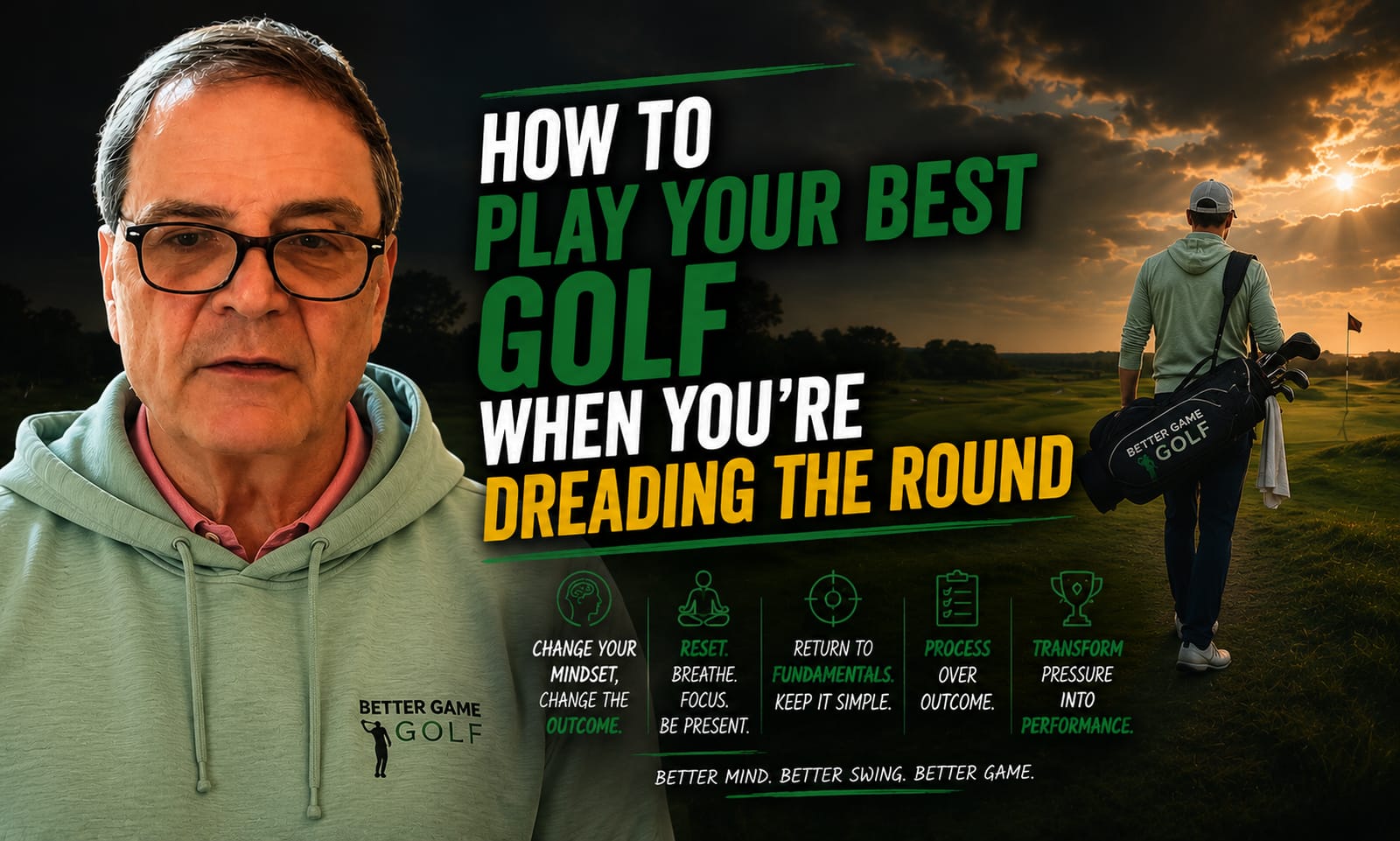
You've got a round coming up and you're already dreading it. Your game hasn't been sharp, life has been relentless, and somewhere in the back of your mind a quiet voice is already writing the disaster story. This is how to stop worrying about golf before it ruins the round entirely. What I want to show you is that pre-round dread is a distinct nervous system pattern, different from the anxiety you feel over a three-footer on the 18th. It fires earlier, it runs longer, and it does something specific: it narrows your thinking before you've even swung the club. But it's workable. The transformation you need might be closer than you think.
Most of what gets written about golf anxiety focuses on what happens mid-round: the tight chest over a short putt, the quick breath on the first tee, the loss of feel when the scorecard starts to matter. That's real, and it matters. But pre-round dread is something else. It's anticipatory anxiety, and it fires hours or even days before you set foot on the course.
What's happening in your nervous system is a threat response triggered not by a real situation but by an imagined one. Your brain doesn't distinguish cleanly between what's happening and what it predicts will happen. So if your last few rounds were poor, if you haven't practised, if you're exhausted from a busy week, your brain runs the pattern it knows: last time was bad, this time will be worse. The nervous system responds as if the disaster has already begun. Your breathing becomes shallow and quick. Your thoughts tighten. Your body is already in a mild stress state, and you haven't left the house.
What makes this particularly insidious is that it changes your shot selection before you play a single shot. You start managing for catastrophe rather than playing your game. Every decision on the course gets filtered through a mind that has already decided things are likely to go wrong. The good news is that once you recognise this as a nervous system pattern rather than a verdict on your game, you have options. You have agency. And that shift in perspective is the first thing worth holding onto.
Your thoughts become a self-fulfilling prophecy. I've seen this with golfers across every level. They arrive at the first tee having already played four or five disaster holes in their imagination. The internal narrative goes: game is poor, I haven't practised, I'm going to embarrass myself, this is going to be a shit show. And then, because the nervous system is already activated and the mind is already in threat mode, they play exactly to that prediction.
The cycle looks like this: poor preparation or life stress creates negative anticipation, which creates nervous system activation, which narrows attention and tightens movement, which produces poor early shots, which confirms the negative prediction, which deepens the cycle. Understanding this loop is the start of breaking it. It's not a verdict on your ability. It's a pattern. Patterns can be interrupted. You can read more in the Fear-Based Swing Patterns article about how exactly anxiety rewires your technique when this cycle takes hold.
Here's something I find genuinely helpful when I'm heading into a round I'm dreading: if you look at the great stories of the world, what you find is the hero goes on a roller coaster of emotion from despair to hope, from failure to success. And it is precisely this, the moment that renders the possibility of transformation, that seems to be available at any moment.
Think of that scene in Star Wars: Luke and Princess Leia in a horrible pit of metal objects and rising water, no visible way out. Everything seems to be falling apart. In the language of myth and storytelling, this is called the dark night of the soul, or the dark night of the hero. It's the lowest point on the journey. And as with all good stories, it's exactly the moment before things turn.
Your round coming up might feel like that pit. Your game is off, you're stretched thin, you're not sure you can get through the day without making a fool of yourself. But transformation can happen because something shifts externally, a break, a bit of good fortune, a shot that clicks. Or it can happen because something shifts internally, because you change your orientation. That internal shift is something you can choose. Holding that possibility in mind, lightly, without forcing it, is itself a useful reframe. This round doesn't have to be the verdict on your game. It might be the turning point.
This is where I think the idea of golf as metaphor becomes practically useful rather than just philosophically interesting. If a round is always a potential learning opportunity, a piece of self-knowledge as much as a performance, then a round you're dreading loses some of its threat. The stakes shift. You're not just there to shoot a number. You're there to discover something.
In Golf in the Kingdom, Shiva Irons tells Michael Murphy: "the basis for a change in the way a person plays the game must be laid in his entire life." That line has stayed with me for years because it points to something most golf instruction ignores. Sometimes the negative cycle before a round is golf trying to send you a message. Not about your swing. About something in your life that needs attention. The voice in your head saying you're not ready, you're not lined up, something's wrong: it might be right. Not about the golf. About the fact that your life has got out of control, you're working too hard, things need sorting. When I can hear that message clearly, the round itself immediately feels less threatening because I'm playing it for the right reasons.
This one can sound strange, and I'll say that upfront. But I find it genuinely works, and here's why I think it does. We have an unconscious mind that is often a lot more brilliant than our conscious mind, a lot more intelligent. One of the things I do when I'm stuck or dreading a round is I simply act as if I've got an internal guide.
For me, that guide has always been Shiva Irons, the whisky-drinking golf pro from Michael Murphy's Golf in the Kingdom. I imagine he's there. I tell him the situation. I say I've no idea what to do and I need help. And I don't know exactly how it works, but it's almost as if the mind, having been prompted with the right kind of question, searches your database of experiences and comes up with something. It doesn't work in a logical or linear way, but it seems to work.
I had a recent example of this. I was struggling with my driving and completely in my head about it. Shiva, my unconscious, came up with a single simple organising idea: remember you know how to throw a ball. That was it. It gave me what we call a body schema, a way to organise everything in a helpful way. Incredibly simple. Far from my mind before it arrived. But transformative in the moment. Try it. Ask your inner guide a question before your next round.
(Try: Inner Guide Visualisation — available in the Training section of the app)
The third practical move is non-judgmental awareness: just get calm for a little while and ask, what is actually going on? Invariably, when you do this properly, it's not as bad as you thought.
A technique I used to use when I was doing creativity work with groups is what we called the itemised response: find three genuine pluses in any idea, situation or experience, and then turn the negatives into directions rather than verdicts. So instead of "my driving is terrible", the direction becomes "I need a simple organising thought for my driving." Instead of "I haven't played in weeks", the direction becomes "I need to start with feel rather than swing mechanics today."
Try this the night before a round you're dreading. What are three positive things about your game right now? What are three things in your circumstances, however imperfect, that are actually working in your favour? The itemised response always has the same effect: it reframes. And that reframe is not self-deception. It's a genuinely more complete picture of reality than the catastrophe narrative your anxious mind was constructing.
When everything feels uncertain, the most useful thing you can do is strip back to fundamentals. Not to try something new, not to fix things mid-round, but to remind yourself of the structural, technical basics that have worked for you before: posture, stance, grip, the core movement patterns you know.
And alongside that, follow process not content. This is a distinction I come back to constantly in my work. Content is what you're trying to achieve, the score, the outcome, whether you beat your handicap. Process is how you're doing it, the pre-shot ritual, the breath, the routine. When you're dreading a round, your mind is flooded with content thinking. Redirect it to process. Your pre-shot routine is the golfing articulation of following process. You don't have to think about the outcome. Think about the process. Process thinking works. Content thinking doesn't.
(Try: Pre-Shot Ritual Builder — available in the Training section of the app)
When I wrote The Golfing Bodymind back in the 1980s, there was a whole section on yoga breathing exercises and nobody took much notice. What's happened since is that breath and breath control has become increasingly recognised as extraordinarily valuable, including for sports performance.
Here's the basic mechanism. Pre-round dread activates your nervous system. Breathing becomes shallow and quick. This in turn keeps the stress response active. But the moment you consciously deepen your breath, breathe into your abdomen, your chest, your neck, you begin to reset the system. The parasympathetic nervous system engages. Heart rate slows. Perception opens up. You have agency over your state.
A simple exercise I teach in the app: three inhales, held briefly, then a slow release. Repeat three times. Do it in the car before you drive to the course. Do it on the first tee. Do it any time you notice the anxious narrative starting. This isn't a trick. It's a genuinely powerful physiological intervention that the yogic tradition has known about for thousands of years, and that Western science is only now catching up with.
(Try: Three Compartment Breathing — available in the Training section of the app)
Yes, they're distinct, though related. First tee nerves are a nervous system response to the immediate situation: the eyes watching, the pressure of the first shot, the sense of occasion. Anticipatory anxiety fires much earlier, sometimes hours or days before you play. It's your nervous system responding to a predicted threat rather than a real one. Your brain runs the pattern from previous poor rounds, and the stress response activates before anything has actually happened. Because it runs longer, it tends to do more damage: it shapes your expectations, narrows your thinking, and changes your shot selection before you've gripped the club. Recognising it as a nervous system pattern rather than a verdict on your ability is the first step to working with it rather than being hijacked by it.
Content thinking is outcome-focused: the score, how you compare to others, whether you'll hold together over the last three holes, whether today confirms your suspicion that you're getting worse. Content thinking floods the mind when you're dreading a round because your attention keeps pulling toward the feared outcome. Process thinking is about what you're doing right now: the breath, the pre-shot ritual, the feel of the grip, the routine. In my work, the pre-shot ritual is the golfing articulation of following process. It gives your mind something concrete and sequential to do instead of catastrophising. The research and the lived experience both point the same direction: process thinking works, content thinking doesn't. When you're in a round you're dreading, returning to process is always the right move.
It's not positive thinking, which is really just content thinking with a cheerful tone. The inner guide idea is rooted in the understanding that we have an unconscious mind that is often a lot more brilliant than our conscious mind. When you ask your inner guide a question, what you're doing is prompting your mind to search your database of experiences in a non-linear, non-logical way. For me, the guide is Shiva Irons from Golf in the Kingdom. For you, it might be a different figure entirely. The form doesn't matter. What matters is that posing the question to an internal source of intelligence bypasses the anxious, overcrowded conscious mind and draws on something deeper. The driving example I mentioned, where the answer that came back was simply "remember how to throw a ball", producing a body schema that reorganised everything, is a real example of this. It sounds simple in retrospect. It was not simple before the question was asked.
The itemised response is a technique from creativity work. The rule is: find three genuine pluses in any situation before you allow yourself to address the negatives. And then, crucially, you don't state the negatives as verdicts, you reframe them as directions. "My short game is a mess" becomes "I'm going to keep the ball on greens and avoid chip shots today." "I haven't played in three weeks" becomes "I'm going to start with feel and swing freely rather than trying to be precise." The effect is always a reframe. It's not self-deception. It's a more complete and more useful picture of your situation than the catastrophe narrative that pre-round dread produces. Try it the evening before a round you're dreading. Three pluses in your game right now. Three directions from whatever concerns you. It takes five minutes and it reliably shifts the nervous system state.
In Golf in the Kingdom, Shiva Irons describes a voice that keeps telling Michael Murphy he's not lined up straight. Murphy keeps dismissing it as a negative thought, but the voice persists. Eventually, the insight lands: the message isn't about his alignment. It's about his life, which has become completely disorganised, his work consuming everything. Golf as metaphor means this: the game has a way of surfacing what's actually going on beneath the surface. When the dread before a round is intense and persistent, it's worth asking whether the message is really about your swing at all, or whether it's about something in your life that needs attention. That reframe is one of the most useful I know. It transforms the dreaded round from a threat into information. Every round becomes a learning opportunity, and the dread becomes a signal worth listening to rather than something to suppress.
It's simple, but not simplistic. When I wrote The Golfing Bodymind in the 1980s, the breath section was politely ignored. What we know now, from both the yogic tradition and Western sports science, is that conscious breath control is one of the most direct interventions available to a golfer. Here's the mechanism: dread and anxiety trigger shallow, quick breathing, which maintains the nervous system in a stress state, which tightens the body, narrows perception, and activates fear-based movement patterns. Deepening the breath into the abdomen, chest and neck, what I call three-compartment breathing, directly interrupts that cycle. The parasympathetic nervous system engages, heart rate drops, and you regain access to feel and perception. Breath can both anchor you and elevate you. It can calm the activated nervous system before a round, and it can also be the doorway into flow state during one. It's one of the few tools that works in both directions, which is why it sits at the centre of everything in Better Game Golf.
The pre-round dread pattern is workable. You have an inner guide, a body that responds to breath, a pre-shot ritual that can hold under pressure, and a reframe available that turns any round into a learning opportunity. These aren't abstract ideas. They're practical moves, each of which you can practise before your next round.
You can explore all of this, and find all the mental game articles in one place, at Better Game Golf. The app walks you through each of these concepts with exercises, recordings, and your AI caddie available on-course when the dread shows up mid-round and you need a prompt back to process.
Start your free 7-day trial at bettergamegolf.com — let Sandy's AI caddie walk you through these concepts on your next round.
Stories are not decoration. In my experience, they are one of the most powerful transmission systems human beings have ever invented for getting wisdom from one person to another. That is exactly why ...
16 min read →A golf mental reset isn't just a nice idea. It's a neurological necessity. When a bad shot cascades into a worse one, something very specific happens in your bodymind... your breathing shortens, your ...
15 min read →Most golfers obsess over birdies. I want to talk about something arguably more important, especially for mid-to-high handicappers: your ability to minimise the damage when things start to go wrong. Th...
17 min read →