
Better Golf Starts in Your Mind — Text Sandy free →
By Sandy Dunlop — Better Game Golf
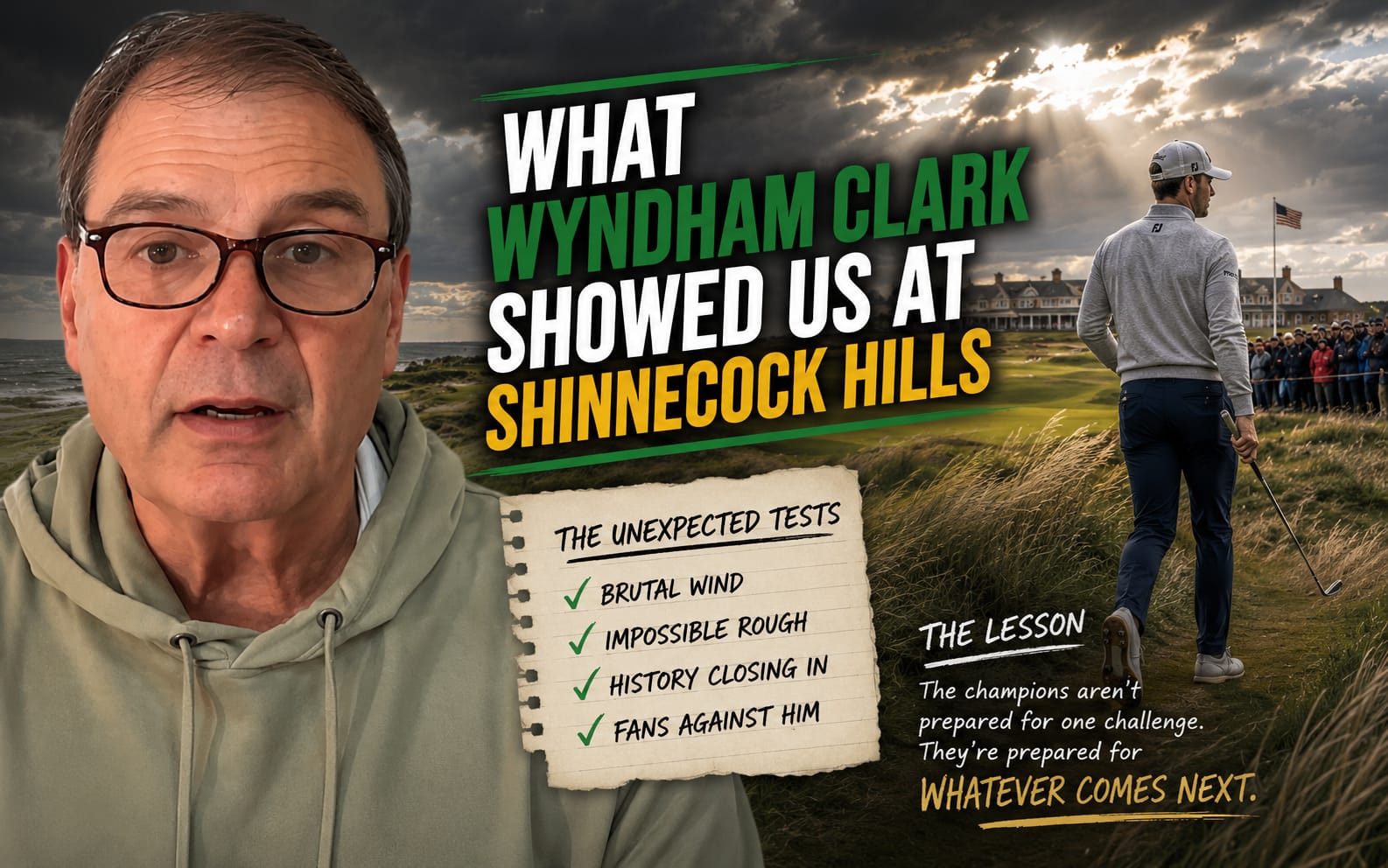
What Wyndham Clarke did at Shinnecock Hills was one of the most complete displays of golf mental toughness I've seen in years. Not because the course was brutal — the impossible rough, the high winds, the tabletop greens. Not because the world's best players were coming after him. Not even because a hundred-year-old record was hanging over every shot. It was because something entirely unpredictable happened, something you simply cannot script in preparation: the fans were booing his shots. He said afterwards, "They definitely did not want me to win." And yet he dealt with that. What I observed in Wyndham Clarke was a condition I call the always-already present — and it's something every golfer can develop.
The predictable pressure at a major championship is enormous, and most golfers — even elite ones — underestimate how much of it accumulates across four days. By the final round at Shinnecock Hills, Clarke had already absorbed three days of major championship golf. The mental exhaustion alone would have been immense. And then there was the historical shadow: in 1919, Mike Brady lost a five-shot lead at the US Open, and nobody has lost one since. That record was sitting right there. He could have made that particular history.
What I find fascinating about this kind of pressure is that it's knowable in advance. You can prepare for it. You can work with it. Before the event begins, you can map out what's coming: the leaderboard movements, the crowds, the weight of history, the scrutiny. This is where the bodymind approach I write about in The Golfing Bodymind becomes so relevant — because preparation for known pressure is a discipline. It requires relaxation work, concentration work, and the whole-body approach to keeping the nervous system regulated under stress. Golfers who do this work before they arrive at the first tee are already ahead. Sun Tzu said it plainly: the battle is won before it's ever engaged. Clarke had clearly done that work. The predictable pressure, as severe as it was, did not break him.
Greg Norman's 1996 unravelling at Augusta was very present at Shinnecock Hills. It was present in the commentary. It was present in every leaderboard graphic. And it should have been present in Clarke's mind too. When Sam Burns closed to within one shot, the possibility of a collapse was real. That's the moment where a lot of golfers — even professionals — lose the thread. The brain, under pressure, does something predictable: it reverts. As I explain in my work on golfing habits, when faced with a high-stakes situation, the brain wheels out what it knows best. And what it knows best is not necessarily what's optimal — it's what's familiar. Under pressure, the nervous system satisfices. It looks for "good enough," not for peak performance.
Burns closing the gap was the kind of momentum shift that can rewire a leader's internal state in seconds. The breathing shortens. The muscles tighten. The mind starts projecting forward to outcomes rather than staying in the present shot. This is where the zone work becomes critical. If you haven't built the relaxation and concentration habits before the pressure arrives, you're trying to find them in the middle of a storm. Clarke found them. That's not luck. That's preparation. You can read more about how choking happens and how to interrupt the pattern — the physiology and the psychology of it are deeply connected to what was at stake in those closing holes.
There is a particular quality you can develop, and the martial arts people know a lot about it. It's called June B in taekwondo — the always-ready present. The great twentieth-century philosopher Martin Heidegger talked about something similar: the always-already present. In martial arts, it's about being present for the surprise attack. The attack you didn't see coming. It is a state of mind that can be developed. That must be developed.
June B is not about being on edge or hypervigilant. It's almost the opposite. It's a quality of settled, open readiness — a state where you're calm enough to receive whatever arrives, and grounded enough not to be knocked over by it. In taekwondo, a practitioner in June B doesn't brace for a specific attack because they don't know which attack is coming. They maintain a quality of attention that allows them to respond to anything. That is exactly what I observed in Clarke's body language and decision-making throughout that final round. He wasn't reacting. He was responding. There's a profound difference. Reaction is the nervous system taking over. Response is the bodymind working as an integrated whole.
This is the part most golfers miss. You bring June B to the event before the event begins. It is not something you find when things go wrong. If you're waiting for the unexpected to arrive and then trying to access a quality of presence — you're already too late. The whole-body approach — relaxation, concentration, bodymind connection — is essential to building this state in advance. The breath work I use in the Better Game Golf programme is a direct entry point. When you've practised slowing your breathing, deepening it into your abdomen, your chest, your neck — and you've done that repeatedly, not just once or twice but daily — you build the nervous system's capacity to stay regulated when the unexpected hits.
This is why building a golf pre-shot routine that holds under pressure matters so much. The routine is not just a procedure for club selection and alignment. It's a vehicle for accessing the always-already present state. Every element of a well-built routine — breath, attention, physical settling — is a rehearsal for June B. Clarke's routine under those conditions, with crowds actively willing him to fail, was a masterclass in this.
I can only imagine what it does to a player in a state of heightened competition to hear booing after their shots. Clarke said afterwards, "They definitely did not want me to win." This was not the normal tension of a major championship crowd. This was active hostility. And in a highly charged state — a major, a medal round, a club final — it is very easy for the unexpected to knock you off course.
Here's why this matters physiologically. The nervous system in competitive sport is already operating under significant load. Heart rate is elevated. Cortisol is present. The threat-detection systems in the brain are active and sensitive. In that state, an unexpected social signal — rejection, hostility, disapproval — can trigger a cascade that feels disproportionate to its actual cause. The crowd's booing wasn't a physical threat. But the nervous system doesn't always distinguish clearly between physical and social threat. The body responds. The muscles can tighten. The breath can shorten. The focus can fracture. This is exactly the terrain that golf and anxiety work addresses at its deepest level — not just managing nerves before a round, but maintaining nervous system regulation when something genuinely unexpected disrupts your state mid-performance.
The fans booing puts this in a category of pressure that sits apart from the standard major championship experience. You can prepare for course difficulty. You can prepare for leaderboard pressure. You can prepare for the historical weight of a record. But you cannot specifically prepare for unexpected social hostility in a moment of maximum exposure. This is where June B — the always-already present — is not a nice philosophical concept. It is a survival skill for the competitive golfer.
What Clarke showed was that he had built something deeper than a strategy for the expected. He had built a quality of presence that held even when the ground shifted beneath him. That is the highest expression of golf mental toughness I've seen in a long time. Fair dues to him. He handled the predictable pressure and the unpredictable pressure. And he won. I'll be honest: I wanted Sam Burns to win. What happened to Burns in the 2023 US Open — the ruling that cost him — I perceived as a real injustice. I wasn't neutral. But fair dues to Wyndham Clarke.
When I work with golfers on the bodymind approach, relaxation is not a nice extra. It is the foundation. You cannot build concentration on a tense body. You cannot access June B when your nervous system is locked into threat response. The progressive body relaxation work — working through the toes and feet, the calves and thighs, the abdomen where anxiety is so often stored, the shoulders and neck, the hands and fingers, the scalp and eyes — is not a meditation exercise. It is training the nervous system to accept direction from the mind. That is Conscious Guidance and Control (CG&C), the Alexander Technique principle I draw on throughout my work.
When you do this regularly, something shifts. After a few weeks of daily practice, you can direct your attention to any part of the body and release tension at will. You have agency. You don't need the recording anymore. You've built the pathway. And that pathway is exactly what Clarke was using when the crowd turned against him — not consciously thinking "I will now relax my shoulders," but having that capacity available because he'd built it.
(Try: Total Body Relaxation — available in the Training section of the app)
Concentration in golf is talked about constantly and practised almost never. What I mean by concentration is not gritting your teeth and trying harder. It is the directed, quiet attention of a settled bodymind. It is what allows a golfer to be genuinely present for one shot, then one shot, then one more shot — without the mind pulling forward to outcomes or backward to errors. Explore the full range of mental game articles at Better Game Golf and you'll find this thread running through all of it: the bodymind approach to concentration is not effortful. It's the opposite. The quieter the mind, the sharper the attention.
Clarke's concentration through those final holes was not visible as effort. It was visible as composure. That composure is trained, not found. And the training is available to every golfer — not just touring professionals. Start your free 7-day trial and let Sandy's AI caddie walk you through the breath work, body work, and concentration exercises that build this foundation.
(Try: Three-Compartment Breathing — available in the Training section of the app)
Golf mental toughness is not about being hard or emotionless. In my experience, it's a quality of preparation and presence that holds under both predictable and unpredictable pressure. The predictable stuff you can train for — leaderboard tension, course difficulty, first tee nerves. But real mental toughness shows itself when something unexpected arrives, something you couldn't have scripted. What Wyndham Clarke demonstrated at Shinnecock Hills was a whole-body readiness — what I call the always-already present. That's built through relaxation work, concentration practice, and the bodymind connection over time. It is not a personality trait you're either born with or not. It is a trainable condition.
June B is a concept from taekwondo — the always-ready present. The martial arts understanding is that you cannot predict the exact nature of a surprise attack, so you train a quality of settled readiness that allows you to respond to anything. Martin Heidegger, the twentieth-century philosopher, described something philosophically similar. I apply it to golf because in any competitive round, there will always be something you didn't expect — a bad bounce, a rules controversy, a crowd that turns against you. If you've only prepared for the known pressures, you're vulnerable. June B is the state of being ready for what you can't predict. You bring it to the event before the event begins. Clarke had it at Shinnecock Hills, and it's why the booing didn't break him.
Clarke confirmed afterwards that the crowd actively did not want him to win — they were booing his shots. In a state of heightened competition, with a major championship lead to defend and Sam Burns closing within one shot, that kind of unexpected social hostility places an enormous additional load on the nervous system. The brain in a high-pressure state is already primed for threat detection. Active rejection from a crowd can trigger exactly the kind of physical tightening and mental fragmentation that causes a collapse. What's remarkable is that Clarke absorbed it without losing his state. That is the always-already present in action — an integrated bodymind that had been prepared for the unpredictable, not just the expected.
The always-already present is the quality of settled, open readiness I observed in Clarke's performance. It's not alertness in the anxious sense — it's more like groundedness. The foundation is the whole-body approach: relaxation, concentration, and bodymind connection, built through repeated daily practice before you ever get to the course. Breath work is the entry point. Three-compartment breathing — into the abdomen, the chest, the neck — calms the nervous system and creates the internal conditions for this quality of presence. Progressive body relaxation builds on that. Concentration training builds further. None of this is found in the moment. As Sun Tzu put it, the battle is won before it's ever engaged. You bring this state to the event. You don't find it there.
Most sports psychology advice tells you to "stay in the present" without telling you how to actually do that under extreme pressure. My approach goes deeper because it works with the whole bodymind — not just the mind. You can't think your way into the always-already present. You train your way there through the body. The Alexander Technique principle of Conscious Guidance and Control — CG&C — is central to this. The nervous system learns to accept direction. The body learns to release tension at will. The breath becomes a reliable anchor. When Clarke stood over a shot with the crowd booing, he wasn't reciting a mantra. He was in a trained state. That's the difference between a concept and a discipline.
Yes — and this is something I feel strongly about. The always-already present is not a gift reserved for touring professionals. It is a trainable condition of the bodymind. Amateur golfers face their own versions of unpredictable pressure all the time: a four-foot putt to win the club final, a first tee with an audience, a round where everything has gone right and the mind starts projecting forward to the scorecard. The same principles apply. Build the relaxation habit. Build the breath work habit. Build the concentration work. Do it daily, not just on the course. Over weeks and months, that settled readiness becomes available to you in the moments that matter. I've seen it happen repeatedly with golfers who commit to this process.
The specific detail is different — most club golfers won't face a hostile gallery at a major. But the category of pressure is the same: something unexpected that the nervous system wasn't specifically prepared for. For a club golfer, that might be a playing partner who makes a cutting remark, a slow group ahead that kills your rhythm, or a ruling that feels unjust. These are all versions of the unpredictable variable. The question is whether your bodymind can absorb the unexpected without fracturing. That's what June B is about. Clarke's situation was dramatic, but the principle he demonstrated is available to any golfer who does the preparation work. What happened to him on that final day is a useful mirror for all of us.
Start your free 7-day trial at bettergamegolf.com — let Sandy's AI caddie walk you through these concepts on your next round.
Stories are not decoration. In my experience, they are one of the most powerful transmission systems human beings have ever invented for getting wisdom from one person to another. That is exactly why ...
16 min read →You've got a round coming up and you're already dreading it. Your game hasn't been sharp, life has been relentless, and somewhere in the back of your mind a quiet voice is already writing the disaster...
15 min read →A golf mental reset isn't just a nice idea. It's a neurological necessity. When a bad shot cascades into a worse one, something very specific happens in your bodymind... your breathing shortens, your ...
15 min read →