
Better Golf Starts in Your Mind — Text Sandy free →
By Sandy Dunlop — Better Game Golf
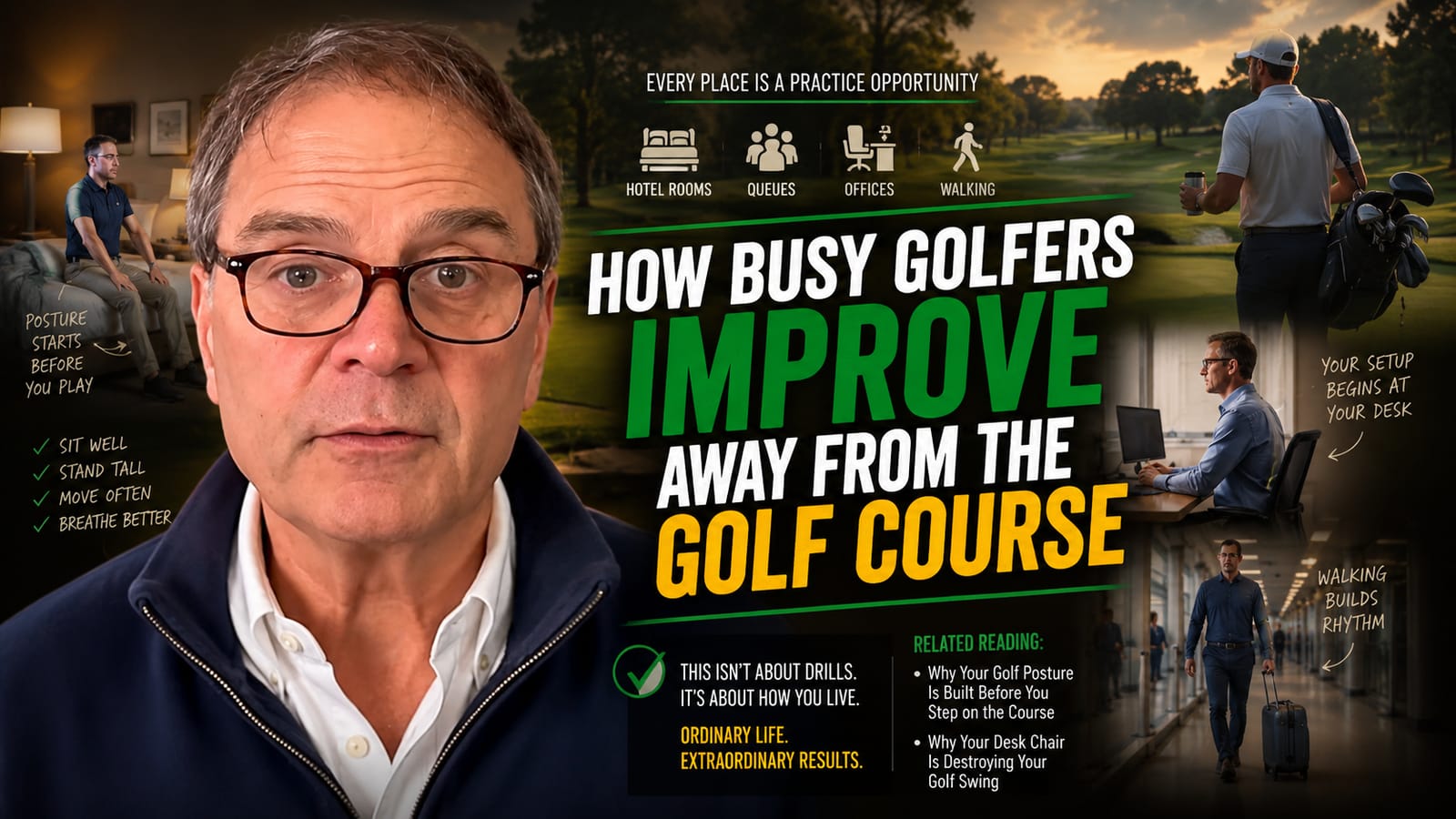
Most golfers believe that getting better requires time at the driving range or practice ground. I want to challenge that assumption directly. The most powerful golf practice away from the course happens in hotel rooms, airport queues, office chairs, and on pavements between meetings. Not because those places contain practice balls or swing trainers, but because your nervous system is active in every single one of them. How you sit, stand, walk, and breathe for the other twenty-three hours of your day is shaping the golfer who arrives on the first tee. This is not about efficient drills or 80/20 practice hacks. It is about reframing ordinary life as neurological training. And once you see it that way, you are never off the practice ground again.
I worked in global branding for years. Flights across oceans, back-to-back hotel rooms, taxis, offices, conference rooms. I found myself in the exact position most golfers in their thirties, forties, fifties, and sixties describe to me now: the wish to improve is absolutely there, but the practicalities simply are not. No time. No access. No range nearby.
What I discovered, and what sits at the heart of Better Game Golf, is that this framing is the problem itself. The moment you locate improvement exclusively at the golf course or driving range, you have already lost the majority of your training hours. You have surrendered every other waking moment to habits that are either building the golfer you want to be or quietly dismantling them.
The big idea I want you to take from this article is simple: reframe time and reframe place. The reframing of place means accepting that you do not have to be literally at the golf course for real training to occur. The reframing of time means recognising that the habits of everyday life are grist to the mill in the task of being better. Your nervous system does not switch off between rounds. It is always training. The question is what it is being trained to do.
Here is what the neuroscience tells us, and it matters. When you perform a movement frequently, your brain stores it in what are called Brain Maps. When you arrive on the course and face a shot under pressure, your brain wheels out what it knows best. And what it knows best is not what is optimal. It is what is familiar.
This means the movement patterns your body rehearses during the other twenty-three hours of your day are feeding those Brain Maps constantly. Slumped posture at a desk tightens the fascia chains that your golf swing depends on. Shallow, anxious breathing reinforces the autonomic nervous system responses that tighten your grip and shorten your backswing under pressure. Habitual tension in the shoulders and neck makes its way onto the course because it is simply what your body knows.
The golfing bodymind is not something you switch on at the first tee. It is operating continuously. That is why exploring how anxiety changes your technique is inseparable from what you do with your body the other twenty-three hours of your day. The nervous system does not distinguish between on-course and off-course time. You can use that fact, or you can ignore it.
Sitting is so prosaic, so utterly everyday, that it feels absurd to call it training. But here is the reality: if you are working in an office or travelling extensively, you may be sitting for six, eight, even ten hours a day. What happens in those hours is not neutral. It either supports the dynamic, integrated movement your golf swing requires or it systematically undermines it.
It is so easy to slump in various ways. And that slumping has a measurable impact on posture, on the muscles, and on the fascia. If you are doing it for extended periods, it can very seriously inhibit your ability to move in a free and dynamic way on the course. I have written more specifically about the mechanism behind this in the context of how sitting affects your golf swing, so I will not repeat the full science here. What I want you to take away right now is the mindset shift.
You can learn to sit athletically. That is not a metaphor. There are specific directions from the Initial Alexander Technique that you can apply while seated at your desk, on a plane, or in a meeting room. These are not dramatic movements. They are subtle internal adjustments of postural tone that keep the system alive and responsive rather than collapsing it into habitual compression. When you sit with that kind of awareness, you are not just avoiding harm. You are actively training the neuromuscular system your golf swing runs on.
(Try: Athletic Sitting Awareness -- available in the Training section of the app)
Some of the ideas on posture that we inherited from our Victorian ancestors are, to put it plainly, less than optimal. The military chest-out, shoulders-back instruction creates a body that is braced rather than balanced. Braced is the opposite of what you need on the course. You need what I call dynamic advantage: a state of readiness in which the body is neither collapsed nor held rigid, but poised.
When you are standing in a supermarket queue, waiting to check in for a flight, or simply pausing between meetings, that is a genuine training opportunity. The Initial Alexander Technique offers specific antagonistic directions, subtle adjustments of the relationship between head, neck, and spine, that you can apply in any standing situation. These are not exercises that make you look strange. Nobody around you will notice anything. But your nervous system notices. It is building a new pattern, one of integrated, dynamic uprightness, to replace the habitual patterns of collapse or bracing that so many golfers carry onto the course.
The reason this matters beyond posture is captured well in what I have observed about why your golf posture is built before you step on the course. By the time you are standing over the ball on the first tee, your postural pattern for that day is already established. The question is just which pattern it is.
(Try: Standing Directions Exercise -- available in the Training section of the app)
Walking is the movement we perform most often in daily life and, outside of the swing itself, perhaps the movement that most reveals the state of a golfer's bodymind. When Rory McIlroy is in form, watch him walk the fairway. It is almost like he is on a spring, bouncing lightly between shots. That is not a coincidence of personality. It is the physical expression of what the science of biotensegrity describes: a body whose tensional forces are balanced and integrated, producing movement that is light, springy, and energetically efficient.
Most of us walk in ways that leak energy rather than store and return it. The heel-strike-and-plod pattern that many people default to is the opposite of that spring. But you can learn ways of walking using what the Initial Alexander Technique calls antagonistic directions, the balance of forces through the body that creates that light, dynamic quality of movement. This is not about consciously managing every step. It is about training a new default through repetition in the hours and miles of walking you already do every day.
Every walk between your car and your office is a training session. Every walk between gates in an airport is a training session. The golfing bodymind you bring to the course on Saturday morning is, in no small part, built by how you moved through the world on Tuesday afternoon.
(Try: Walking Awareness Exercise -- available in the Training section of the app)
We breathe approximately twenty-two thousand times a day. Seven and a half million times a year. Every single one of those breaths is either reinforcing an anxious, shallow, sympathetic nervous system pattern or building the calm, centred, parasympathetically regulated state that peak golf performance requires. There is no breath that is neutral.
The reason I start the seven-day Better Game Golf introductory programme with breathwork is precisely because of this number. Twenty-two thousand daily repetitions. No other training modality comes close to that volume. The yogic tradition understood this thousands of years ago; the Sanskrit term pranayama translates as breath control, and it was recognised as the central discipline for mastering mind and body states long before Western sport science arrived at the same conclusion. What is happening in modernity is that breath and breathing exercises are increasingly recognised as extremely valuable, with scientists confirming that even small changes to how you inhale and exhale can improve sports performance.
The direct application for the golfer is through the autonomic nervous system. Anxiety and stress trigger the nervous system, raise blood pressure, and make you tighten up. Deep, deliberate breathing has an immediate and measurable counter-effect. It is not relaxation as a vague feeling. It is a direct intervention in your neurology. And you can practise it in a meeting, on a plane, or walking down a corridor. The three-compartment breath, into the abdomen first, then the chest, then the neck, is the foundational exercise. Try it now, wherever you are reading this.
(Try: Three-Compartment Breathing -- available in the Training section of the app)
There is something paradoxical about breath that I find genuinely fascinating. Deep breathing can do two apparently contradictory things. It can anchor you, centre you, give you a feeling of being rooted, which is essential in a competitive situation when your mind is starting to race. But it can also elevate you into a higher state, the kind of altered state associated with what we call being in the zone, or what the psychologists call flow.
If you want to understand how to trigger flow state before a round, breathwork is the most accessible entry point available to you. But the reason it works under pressure on the course is because you have trained it off the course. The golfer who uses conscious breathing throughout their working week builds a neuromuscular habit. When the pressure moment arrives on the fifteenth hole and the mind starts tightening, that habit is available. It has been rehearsed thousands of times in ordinary settings. The body knows what to do.
Being able to manage the autonomic nervous system is a hugely important competence that applies directly to performance on the golf course, particularly when you are under pressure. Breath is how you access that management. And unlike every other golf training tool, it requires no equipment, no space, and no time beyond what you are already spending being alive.
The Initial Alexander Technique, or IAT, is built around a concept called Conscious Guidance and Control, or CG&C. This is not about consciously managing every movement in real time. It is about training the mind to guide the body through a process of inhibition first stopping the habitual response and then giving new directional input. The result, over time, is a different default. The nervous system learns a new normal.
This is why IAT is so specifically relevant to the busy golfer's off-course situation. The techniques work precisely in everyday life contexts: sitting, standing, walking, breathing, bending, gripping. These are not supplementary exercises you bolt on to your day. They are a reframe of what your day already is. Every time you catch yourself slumping and choose to sit athletically instead, that is inhibition followed by direction. Every conscious breath in a stressful meeting is CG&C in action.
The goal is dynamic modulation of postural tone. That is the formal description. More simply: a body that is neither collapsed nor held rigid, but alive, responsive, and ready. A body whose 700 plus muscles are working in the integrated, interconnected way that a golf swing requires. That integration does not happen on the range. It is built through thousands of micro-moments of conscious choice in ordinary life.
You can explore the two-pillar approach to this kind of development in more depth at The Two-Pillar Approach to Golf Improvement: Golfing Bodymind and Alexander Golf.
One of the things I kept coming back to in all those years of long-haul flights and hotel rooms was this: my mind was always there. I could not get to the practice ground. But my mind was with me on the plane, in the taxi, in the hotel room. And many of the golfing bodymind exercises live entirely in that space.
Visualisation, mental rehearsal, concentration exercises, working with your emotional state before a round: none of these require a golf ball or a fairway. The imagination work in the Better Game Golf programme can be done lying on a hotel bed. The concentration exercises can be practised during a commute. The quality of attention you bring to a shot is trained during the thousands of moments of ordinary life where you either practice directing your mind or you let it scatter.
This is the systems thinking view of golf improvement, recognising that human beings are an integrated whole and can only be changed as a whole. The golfer who works only on technique and never on the mind, breath, and bodily habits they carry into the round is working on a fragment of the system. Real improvement requires the whole. And the whole is available to you every day, everywhere, in the most ordinary moments of your life.
For all mental game articles on this site, explore the full library here.
In my approach, golf practice away from the course is not about hitting balls in a net in the garage or watching swing videos on YouTube. It is about recognising that the nervous system, the postural patterns, the breath habits, and the state of mind you carry to the first tee are built continuously, twenty-four hours a day. Every hour you spend sitting slumped, breathing shallowly under stress, or walking in a way that leaks energy is training. The question is just whether it is training that serves your golf or undermines it. Better Game Golf offers specific exercises drawn from the Initial Alexander Technique and the golfing bodymind framework that work in hotel rooms, offices, and queues, turning the stuff of ordinary life into genuinely effective neurological preparation for the course.
Because of the numbers. Twenty-two thousand breaths a day, seven and a half million a year. No other training input comes close to that volume. More importantly, breath is the most direct lever you have for managing the autonomic nervous system. Anxiety, pressure, and competitive stress all show up first in your breathing: shallower, faster, higher in the chest. That breathing pattern triggers a cascade of physical tightening that distorts your grip, shortens your backswing, and destroys your putting tempo. The three-compartment breath I teach in the programme reverses that cascade immediately. And because you can practise it anywhere, the off-course hours become your highest-volume training ground for the single most important performance skill in golf.
Conscious Guidance and Control, or CG&C, is a concept from the Initial Alexander Technique. It describes the process of first using inhibition to stop a habitual response, then giving the body a new directional input. In practice, for a busy golfer, this might look like noticing you have slumped in your desk chair and consciously choosing to sit athletically instead. Or catching shallow, tight breathing in a stressful meeting and deciding to breathe deeply into the abdomen. These are not grand gestures. They are micro-moments of CG&C that, repeated across thousands of ordinary situations, build a new neurological default. The body learns a new normal. And that new normal arrives at the golf course with you.
Dynamic modulation of postural tone is my description for what happens when the body is neither collapsed nor held rigid, but alive and responsive. Most golfers exist somewhere between two unhelpful extremes: slouching through daily life and then bracing tensely over the ball. Neither state allows the free, integrated movement that a good swing requires. The IAT exercises I teach, applied through sitting, standing, and walking in everyday life, train the neuromuscular system to find and maintain a third option: dynamic readiness. When that becomes your body's default state through daily practice, it is the state you bring to the course. You stop having to consciously manufacture it on the first tee, because you have been living in it all week.
I would not use the word substitute, because that still accepts the framing that range time is the gold standard. What I would say is this: the mental dimensions of golf performance, your ability to manage pressure, access flow states, sustain concentration, and direct your imagination, are not supplementary to your physical game. They are part of the same integrated system. The golfing bodymind is a whole. Many of the exercises in the Better Game Golf programme, visualisation, concentration work, emotional regulation, quality-of-attention training, exist entirely in the mind and can be done anywhere. A golfer who neglects these dimensions and focuses only on swing mechanics when they do get range time is working on a fragment of the system. The off-course mental work is not a consolation prize. For many busy golfers, it may be where the most significant gains are available.
This depends enormously on consistency, but breathwork tends to produce the most immediate and noticeable effect. Most golfers who commit to five deliberate three-compartment breaths each morning and use the technique whenever they feel stress during their working day report a meaningful shift in their baseline nervous system state within a week or two. The postural and movement changes from IAT-based sitting, standing, and walking take longer to embed, because you are working against deeply rooted habits. Brain Maps do not rewrite quickly. But the direction of change is noticeable early, particularly if you arrive at the course after a week of conscious practice and compare how you feel warming up to how you felt before. The key principle is equifinality: the same end can be reached by a variety of paths, and every path you take through ordinary life counts.
The golfing bodymind is a made-up word, deliberately. It describes exactly what you bring to the golf course: not a body and a mind as separate things, but an integrated whole in which how you move shapes how you think, how you breathe shapes how you feel under pressure, and how you have been sitting for eight hours shapes how freely you can swing. Most conventional golf coaching separates these things: a swing coach works on mechanics, a sports psychologist works on the mental game, and never the twain shall meet. The golfing bodymind framework refuses that separation. It is rooted in systems thinking, the recognition that you are an integrated whole and can only be changed as a whole. That is why off-course neurological training is not a supplement to Better Game Golf. It is central to it.
The exercises described in this article are all built into the Better Game Golf programme: three-compartment breathing, athletic sitting, standing directions, walking awareness, and the full range of golfing bodymind mental work. Every one of them can be done away from the course, in the hours of ordinary life you already have.
Start your free 7-day trial at bettergamegolf.com and let Sandy's AI caddie walk you through these concepts on your next round.
Stories are not decoration. In my experience, they are one of the most powerful transmission systems human beings have ever invented for getting wisdom from one person to another. That is exactly why ...
16 min read →You've got a round coming up and you're already dreading it. Your game hasn't been sharp, life has been relentless, and somewhere in the back of your mind a quiet voice is already writing the disaster...
15 min read →A golf mental reset isn't just a nice idea. It's a neurological necessity. When a bad shot cascades into a worse one, something very specific happens in your bodymind... your breathing shortens, your ...
15 min read →