
Your golf is the sum of everything you do. Text Sandy free →
By Sandy Dunlop, Better Game Golf
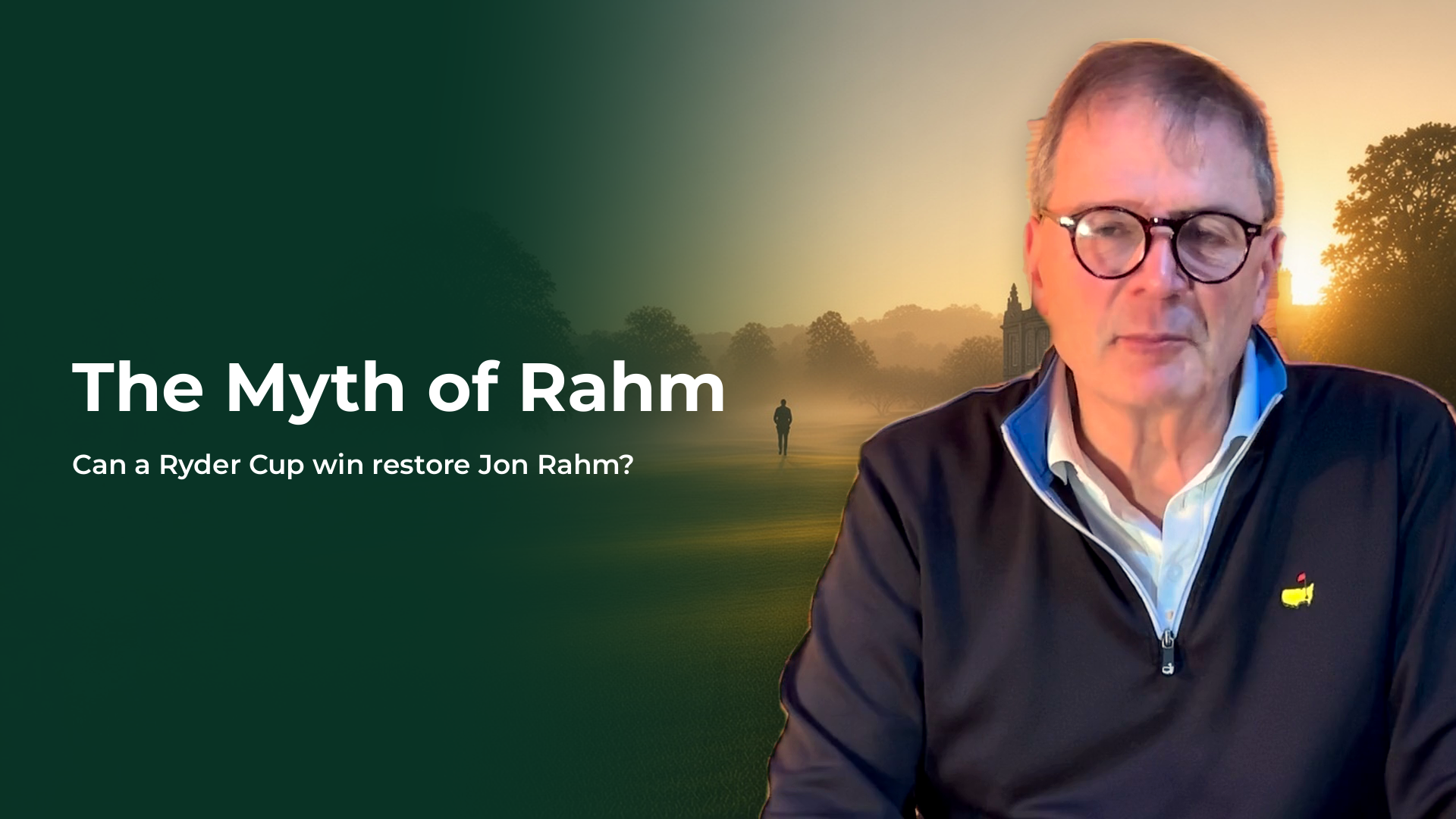
Can a Jon Rahm Ryder Cup win at Adare Manor restore him? My bet is yes. Rahm came from an absolutely legendary background, with that Spanish connection in the Ryder Cup, the line that runs from Seve to Olazábal to Garcia, and he was a worthy inheritor, really, of that incredible tradition. Then he betrayed the tribe by going off to LIV, and he went from hugely respected and loved to bad boy, villain. For some people, when you betray the tribe there is no way back. You've broken a bond. You can't heal the wound. With him, though, it's probably an exception. Were he to be part of a winning Ryder Cup team at Adare Manor next year, and were he to play a major role, pretty soon everything would be in the rear-view mirror. LIV forgotten, Rahm restored.
Last weekend in Abu Dhabi he wins the Abu Dhabi Championship, part of the Rolex Series in the Race to Dubai. A fine win. But where is he? What is his place in the heart of European and global golfers? That is the more interesting question, and it is not answered by a trophy.
Rahm came out of a lineage. Seve, who changed the meaning of European golf and set up the great contest in world golf. Olazábal, with all that Ryder Cup steel. Garcia, with all that emotion worn on the outside. These are not just players, they are a story that European golf tells itself about passion, about fight, about a value system that exists somewhere beyond money. Rahm inherited that, and he inherited it honestly. His performances, for example in Rome and at Bethpage, were amazing, and he was much loved for that.
And it wasn't just the Ryder Cup. Obviously he'd won two majors, so the respect was there on its own merits. What the Ryder Cup added was the romantic attachment. In my work I'd call that a mythic role, the part a golfer plays in a larger story that other people are emotionally invested in. Rahm had one of the best mythic roles in the game handed to him, and for a while he played it beautifully. That matters, because the moment you hold a mythic role, you are no longer judged purely on your scoring average. You are judged on whether you honoured the story.
Then he went to LIV. And here is the thing I keep coming back to, because it is the crux of the whole business. It wasn't just the leaving. It was more some of his behaviour in leaving that put him in the villain category.
Golfers are tribal in a way we rarely admit out loud. A tribe is a shared set of beliefs about what the game is for and what cannot be bought, and the Ryder Cup is the purest expression of it. There was a sort of romantic attachment, wasn't there, to that whole Spanish thing, that somewhere there's a value system that's beyond money. And yet here he was. He'd gone.
For a while the issue was, well, will he even be able to play in the Ryder Cup? He and Tyrrell Hatton, obviously, were good enough, and whatever obstacles there were, were removed. But the obstacle that actually mattered was never administrative. It was narrative. I've written before about why LIV Golf failed, and the short version is that it never understood the power of storytelling. It bought players. It did not buy stories, and it could not manufacture the thing that makes a Ryder Cup matter. Rahm stepped out of one story and into something that had no story at all. That is a much bigger price than anybody put a number on.
So he went from good guy to bad guy, and to a certain extent he was there. The Bethpage performance would have ameliorated some of that bad boy, but it was still there, sitting underneath everything.
What interests me as someone who works with golfers rather than as a commentator is what that does to a man inside the ropes. Carrying a role you did not choose is heavy. You are not just playing the shot, you are playing the shot while an audience decides what kind of person you are. That is a form of pressure very few amateur golfers will ever meet, but the structure of it is identical to what you feel standing on the first tee at your own club in front of people whose opinion you think you know. Your nervous system does not distinguish between a crowd of forty thousand at Bethpage and four members by the clubhouse window. It reacts to being watched and judged.
You can see this in the body before you see it in the scorecard. The head pulls back and down, the neck shortens, the breath goes shallow and quick. FM Alexander discovered exactly this when he found that even the thought of going on stage caused his head and neck to tense and shrink into his shoulders. The thought alone. Rahm, at Bethpage, had to hit golf shots while the thought of being the villain was in the room. That he played as well as he did tells you something about the man.
From a narrative point of view, were he to be part of a winning Ryder Cup team at Adare Manor next year, and were he to play a major role, pretty soon everything would be in the rear-view mirror. He'd be right back to that incredibly strong heritage that he's a part of, and he would become much loved again.
Why does one week do that when two years of fine golf elsewhere cannot? Because the Ryder Cup is where the tribe gathers. It is the ceremony. Redemption, in myth, almost never happens privately. It happens in front of the people who were wronged, in the place where the bond was broken. That is the whole architecture of the thing. A win in Abu Dhabi is a result. A point won for Europe on Irish soil, in front of a crowd that remembers, is a restoration.
And there is a practical dimension here for the ordinary golfer. Your own reputation at your club works the same way. If you have gone to pieces in the monthly medal three years running, you will not fix that reputation on the practice ground, however well you hit it. You fix it in the monthly medal. The place where the story broke is the place where it has to be rewritten, which is why I keep telling golfers that competitive rounds are not the test at the end of the work, they are the work.
I'm not sure it would be as much a kind of prodigal son story as one of just regaining. That distinction matters more than it sounds.
The prodigal son story requires the sinner to come home repentant, head bowed, and be forgiven by a generous father. That's not what I think is going on here. Nobody is asking Rahm to grovel. It was almost as if LIV would be seen as a sort of slight detour, a mistaken detour, and the whole thing would be absorbed back into a much larger and much older story about Spanish golf and the Ryder Cup. Not forgiveness so much as reabsorption.
Golfers do this to themselves all the time, and they usually choose the wrong story. A golfer who has had two bad years decides he needs a dramatic redemption arc, a total rebuild, a confession of all his faults. Usually what he actually needs is regaining. The game is still in there. The detour was a detour. I've explored this in depth in Golf Scenarios: How Stories Can Change the Way You Play, because the scenario you are running quietly in the background shapes what your body is allowed to do. If your scenario is "I am in disgrace and must earn my way back", you will play tight, defensive, apologetic golf. If your scenario is "I took a wrong turn and I am rejoining the road I was always on", you will play like yourself. Same golfer. Different story. Wildly different swing.
So my bet would be that he would come back and in a way cement his position as part of one of the great, much-loved, hugely respected golfing traditions, which is that of the Spaniards, and of course the great Seve.
Notice the word cement. The interesting possibility is not that Rahm gets back to where he was before LIV. It's that the detour, once redeemed at Adare Manor, actually strengthens his place in the tradition. Stories with no conflict in them are forgettable. Seve's myth is built as much on the car park at Lytham and his rows with authority as on the trophies. A hero who has never been in the wrong is a dull hero.
For the golfer reading this, that is not a trivia point, it's a working principle. The disasters in your golfing history are not stains to be hidden. They are the material. The round where you went out in 36 and came home in 52 is part of why a future good round will mean something. I've written about the art of minimising bad, and the deeper version of that idea is this: you are not trying to erase the bad from the record, you are trying to make sure it does not define the whole. Rahm's LIV years will not be erased. They will be reframed as a detour inside a bigger story. You can do exactly the same with yours.
Here's why changing your story is harder than it sounds. When we do a movement frequently, such as swinging the club, the brain stores these movements in what are called brain maps. Faced with a situation again, it wheels out what you've done before, and this all happens in a split second. The brain will always select what it knows best, and what it knows best is not what's optimal, it's what's familiar.
This applies to narratives just as much as to swings. If you have told yourself for fifteen years that you are a choker on the back nine, that is a well-worn map. Walking onto the fourteenth tee one shot ahead, your brain will wheel it out before you have consciously thought anything at all. The story is not a belief you are holding, it is a reflex you are running.
On top of that, our nervous system is set up to give us a good enough result. It's called satisficing, and being better than you ever thought you could be is not satisficing, it's optimising. Our human nature is not naturally going to be helpful in the quest.
So what do you do? You use inhibition, which is the Alexander Technique's great contribution. You stop. You do not immediately do the familiar thing. You give the system a gap, and into that gap you place a conscious direction. Applied to story, it looks like this: notice the old narrative arriving on the fourteenth tee, refuse to act from it, and consciously give yourself the one you've chosen instead. (Try: Inhibition and Direction — available in the Training section of the app)
Proprioception is the internal sense of our body, its parts and how it's moving, and it comes from stretch receptors giving us feedback. The problem is that these messages reward what is familiar. What feels right is wrong, and what is wrong feels right. That's faulty sensory perception, and it's one of the reasons golfers go round in circles for decades.
I'd argue there's an emotional equivalent, and the Rahm situation shows it clearly. The story that feels truest about yourself is usually just the story you've run most often. It has the warmth of familiarity, so you mistake familiarity for accuracy. "I'm not a good enough putter to win this." That doesn't feel like an opinion. It feels like a fact, because you have rehearsed it a thousand times.
The practical response is the same one I'd give a golfer rebuilding a move. Do not trust the feeling. Get external feedback. For the swing that means video, as I set out in Why Your Proprioceptive Sense Lies in Golf. For the story it means evidence, written down. What actually happened the last ten times you held a lead? Not what you remember. What happened. Most golfers are shocked when they count. The felt story and the recorded story are rarely the same thing, and the recorded one is the one worth playing from. You can find the whole framework across all mental game articles.
The Eastern disciplines, yoga, Zen and Tai Chi, were never caught up in the Enlightenment separation of mind and body promoted by the likes of Descartes. Their real focus, or essence, is on states of mind. Can you learn to manage and control your state of mind, especially under the pressures of competitive sport?
That is the question Rahm will face on the first tee at Adare Manor, and it's the question you face on the first tee at your club. Nobody can summon the zone on demand. I will never tell you otherwise. What you can do is make it more available, easier to fall into, by consistently arriving in a state where it becomes more likely.
Breath is where I'd start, because control of the breath is the key to the control of the golfing bodymind. Three inhales, into the abdomen, the chest, the neck, and gently let the breath out. Do not force it. Do it five times at the start of the day and anytime during a round when you notice the breath has gone shallow and quick, which it will do the moment you realise a good round is in the offing. (Try: Three Compartment Breathing — available in the Training section of the app)
The point is not that breathing fixes everything. The point is agency. You noticed, you acted, you changed your own state. That's the beginning of mastery of the golfing bodymind, and it is available to you on any hole, in any weather, in any state of disgrace or glory. If you want to work it through for your own game, talk to Sandy.
Because majors are individual achievements and the Ryder Cup is tribal. His two majors established respect, and that respect never really went away. What went away was love, and love is a tribal emotion. It is given by a group of people who believe you share their values. When Rahm went to LIV, the tribe's view was that he had chosen money over the value system that runs from Seve through Olazábal to Garcia. You cannot repair that with an individual trophy, however prestigious, because an individual trophy is not an act of belonging. A point won for Europe, in front of a European crowd, on Irish soil, is an act of belonging. That is why I say that if he plays a major role in a winning team at Adare Manor, pretty soon everything would be in the rear-view mirror.
A tribe in golf is a group bound by shared beliefs about what the game is for and what cannot be bought. The Ryder Cup is the clearest expression of that in European golf. Betraying the tribe means acting in a way that suggests those shared beliefs were never really yours. With Rahm, it wasn't just the leaving. It was more some of his behaviour in leaving that put him in the villain category. That is the part people found hard. For some people, when you betray the tribe there's no way back, you've broken a bond and you can't heal the wound. I think Rahm is probably an exception, because the tradition he belongs to is older and stronger than the breach, and because a Ryder Cup win would take place in exactly the arena where the bond was broken.
I'm not sure it would be as much a kind of prodigal son story as one of just regaining. The prodigal son narrative requires repentance and forgiveness, a sinner returning with his head down. I do not think that is what's actually happening, and I do not think it's what the crowd at Adare Manor would be looking for. It was almost as if LIV would be seen as a sort of slight detour, a mistaken detour, and the whole thing gets reabsorbed into a much bigger story. Regaining is quieter than redemption and in many ways stronger, because it says the thing was never lost, only mislaid. For ordinary golfers that distinction is worth stealing. You usually do not need a dramatic rebirth. You need to rejoin the road you were always on.
Directly. You are carrying stories about yourself whether you've examined them or not, and those stories are running your body before you've consciously decided anything. The golfer who "always" blocks it right off the tenth tee is not describing a swing fault, he's describing a brain map with a narrative attached. The mechanism is identical to the one operating on Rahm, just with smaller crowds. Your nervous system does not distinguish between forty thousand people at Bethpage and four members watching from the clubhouse window. It reacts to being seen and judged, and it does so with shortened neck, shallow breath and a grip that tightens without permission. The work is the same too: notice the story, inhibit the habitual response, give a conscious direction, breathe into the abdomen, chest and neck, and play the shot in front of you.
It can make better golf more available, which is the honest way to put it. I never promise the zone and I never promise a number. What I will say is what I see: when a golfer stops playing from a story of disgrace or doom, the body stops bracing, and a body that isn't bracing can coordinate. The swing was usually never the problem. A deep journey of this kind takes somewhere in the region of 30 to 90 days of consistent work, because you're working against habits that are largely unconscious, against satisficing, and against senses that reward the familiar. Some golfers see changes long before that. What I can promise is the direction of travel, which is being better than you ever thought you could be, self-authored, your own version, not somebody else's level.
Then stop. Genuinely. Some of the work in this area asks you to look at an old collapse, a round where you fell apart, a shame you have never spoken about, and for most golfers that is uncomfortable but perfectly manageable. For some, it reaches past golf into something bigger. If that happens, put the exercise down. Difficulty is not evidence that something is working, and nobody should be pushing through distress with a golf club in their hand. Talk to someone you trust, your GP, or a professional. This work sits alongside medical and psychological care, it never replaces it. The golf will wait. It always waits. You can return to the exercise another day, or not at all, and still make real progress using the breath, body and concentration work instead.
Start your free 7-day trial at bettergamegolf.com — let Sandy's AI caddie walk you through these concepts on your next round.
Why LIV Golf failed is, for me, simple. It was a fatally flawed concept right from the start, and one of the fundamental reasons is that they never understood storytelling. They never understood golf ...
19 min read →Stories are not decoration. In my experience, they are one of the most powerful transmission systems human beings have ever invented for getting wisdom from one person to another. That is exactly why ...
16 min read →You've got a round coming up and you're already dreading it. Your game hasn't been sharp, life has been relentless, and somewhere in the back of your mind a quiet voice is already writing the disaster...
15 min read →