
Better Golf Starts in Your Mind — Text Sandy free →
By Sandy Dunlop — Better Game Golf
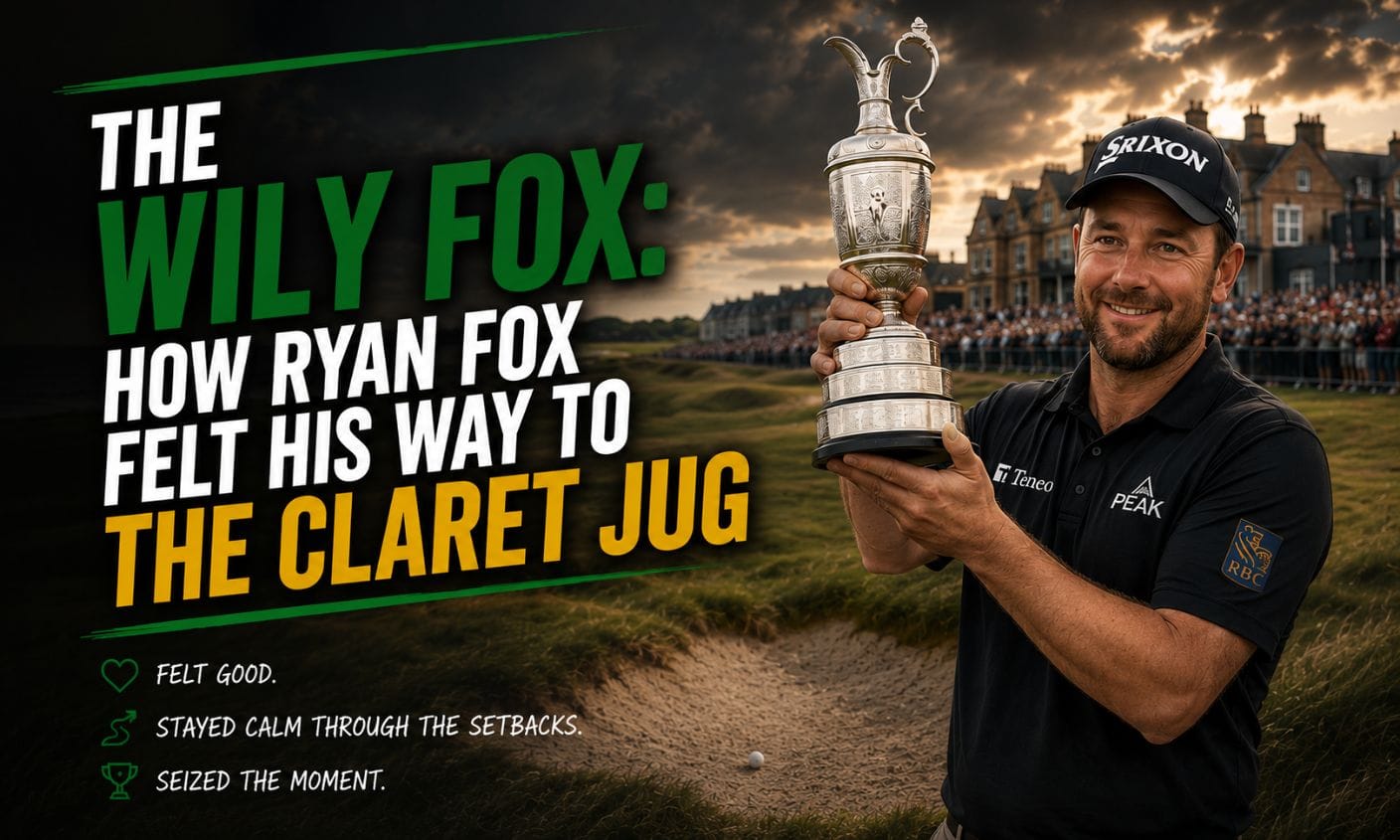
Ryan Fox's Open Championship victory at Royal Birkdale wasn't won by the best swing in the field. Fox himself would probably tell you that. What won it was something rarer, something most golfers never develop, and something I've been writing and teaching about for decades. Fox tuned in to how he was feeling under the greatest pressure of his golfing life, and instead of finding fear, he found something unexpected. He found that he felt good. Then he found a gear that most competitors never locate when it matters most. This is the story of what Fox did, why it worked, and what every golfer, at every level, can take from one of the most remarkable final rounds in Open Championship history.
Mid-round, Fox told his caddie something that stopped me in my tracks when I heard it. He said he was feeling unexpectedly good. Better than he expected. Under the greatest pressure of his golfing life, with the Claret Jug on the line at Royal Birkdale, he wasn't describing his swing thoughts or his game plan. He was describing a felt sense from inside. That is an uncommon thing. The fancy term for it is interoception, the sense that tunes inward, that picks up on what is actually going on inside the golfing bodymind. And it is one of the senses it is so easy to ignore.
So many golfers have no awareness of what is going on inside them during a round. They are locked in the head, tracking shots, calculating scores, monitoring their technique. Fox was doing something different. He was tuning in to an overall sense of "how am I feeling?" And what he found, rather than the fear or terror he perhaps expected, was that he felt good. That is not luck. That is a developed awareness. A built-in skill. In my work with golfers, I see this again and again: the players who perform under pressure are not the ones who manage fear the best. They are the ones who can actually read what is happening inside them, in real time, and use that information. Fox had built that sense. And on the biggest day of his career, it served him. If you want to explore what interoception looks and feels like in practice, the relaxation and body work exercises inside the Better Game Golf app are built specifically around tuning this sense in.
(Try: Body Scan Relaxation Exercise, available in the Training section of the app)
I coined the term golfing bodymind because I needed one word, one concept, that captures what we actually bring to the golf course. Not the body. Not the mind. Both, inseparably. Fox at Royal Birkdale was a demonstration of the golfing bodymind functioning at a very high level. His nervous system was calm enough that he could receive accurate information from inside himself. His mind was open enough to be surprised by what it found. And his body was free enough to deliver four birdies in the last six holes when the tournament was on the line.
This is not something that happens by accident. In my experience, golfers who can access this integrated state have usually done the work, whether they know it or not, to calm the nervous system, develop body awareness, and build a relationship with their emotional state rather than being driven by it. Fox, son of All Black legend Grant Fox, grew up in a sporting culture where mental toughness and physical awareness go together. You do not play at that level of rugby without understanding what is happening in your body under pressure. It is not a stretch to think some of that found its way into his golf. For more on how the golfing bodymind framework applies to real improvement, take a look at all mental game articles in the Better Game Golf learning library.
If you were watching the final round of the Ryan Fox Open Championship, you saw what happened on the 15th. The ball kicked off the front of the bunker and ran up to the opposite lip. It was a cruel, cruel outcome. He had no shot. It could have been the end of his challenge. Mostly the bunkers at Birkdale had been fair, collecting balls in the middle. Not so for Fox at the most important moment in the most important round. He had no chance of a par. Most likely a double.
What happened next is what I want to talk about. He calmly chips out sideways, away from the hole. No histrionics. Just calmness under pressure. And he gets down for a bogey that limited the damage. I will say this plainly: that bogey on 15 may well be the hole that won him the Claret Jug. It is the kind of moment most golfers never see for what it is. It looks like damage limitation. It is actually a peak performance moment. To accept an unacceptable situation, strip out the emotional reaction, make the only sensible decision, and execute it cleanly... that is a disciplined golfing bodymind doing exactly what it is supposed to do.
Perhaps Fox had read the Stoic philosophers like Rory and prepared himself for misfortune through the meditative practice of premeditatio malorum, the deliberate anticipation of setbacks. Perhaps he had watched his legendary father dig himself out of an impossible situation on the rugby field. Either way, the response was the same. Calm. Clear. Decisive. This is exactly what I write about in the End Gaining trap, where the obsession with the outcome destroys the very response that could achieve it.
Then came 17. A huge drive, just trickling into a bunker, almost certainly costing Fox his best chance of a winning birdie on the last two holes. Again, no shot at the green. Again, no histrionics, no drama. He just got on with it. No birdie. Move on.
What strikes me about this is the pattern. Two cruel breaks in the final stretch, and twice the same response. Not once. Twice. That is not a fluke emotional reaction. That is a trained way of being. The capacity to absorb the unacceptable and reset, without losing the thread of what you are doing, is one of the rarest qualities in competitive golf. I have written about what Wyndham Clarke showed at Shinnecock Hills, another golfer who found this quality when it mattered: what Wyndham Clarke's win teaches us about mental toughness. Fox at Birkdale belongs in that conversation. In fact, he may have pushed himself further into that territory than Clarke, given the sheer size of the occasion and the brutality of both breaks.
Now this is where it gets genuinely extraordinary. If you look at the scorecard, Fox made four birdies in the last six holes of the final round of a Major Championship, having absorbed two terrible breaks along the way. That is not grinding it out. That is not hanging on. That is stepping into another gear entirely, when it matters most. The kind of performance that makes you ask: what is actually happening here?
The Eastern mystics would call it lotus mind. My framework would describe it as being fully in the zone. Western sport science calls it flow. Whatever name you give it, what it describes is a state where the golfing bodymind is functioning as an integrated whole, where thinking and feeling and moving are not separate activities happening in parallel, but one seamless, coordinated response to the situation. The mind is not in the brain, not in some separate control room issuing instructions to the body. The mind is in the bodymind, inseparable from it. And in those six holes, Fox was operating from that place. To understand more about how this state works and how it can be cultivated, read my piece on how to trigger flow state before a round or explore the deeper article on golf flow state and how to get in the zone.
(Try: Visualisation Exercise, available in the Training section of the app)
These moments of intense pressure can send a competitor in two directions. Many fall apart when it matters most... and many did at Birkdale on that final Sunday. But a few, just a few, click into another gear. Fox clicked. And what interests me is not just that he clicked, but that the conditions for clicking were already in place before the back nine even began.
He had felt good mid-round. He had told his caddie. He had built and evidently continued to build on that interoceptive awareness as the round progressed. So when the pressure intensified, he was not starting from scratch trying to find a mental state. He was already connected to one. The two terrible breaks did not knock him out of it. They tested it, and it held. Then the putts started dropping. Then the birdies came. Then the Claret Jug was his. Well done Ryan. Very, very impressive. Not because of the technicals. The swing is not the best to look at. But those rare human qualities displayed under the greatest pressure mean this was an Open, and a finish, that will long be remembered.
The most important thing Fox showed us is that interoception is not a gift reserved for elite athletes. It is a trainable sense. In my work through Better Game Golf, the body work and relaxation exercises are designed specifically to develop this inward tuning. You learn to notice what is happening in your golfing bodymind, in your fingers, your shoulders, your belly, your breathing, and to use that information rather than ignore it. The golfers who improve most quickly in my experience are not always the ones who work hardest on technique. They are the ones who develop the deepest awareness of what is actually going on inside them. Start your free trial and begin building that sense from day one.
Fox did not win the Open because he had the best swing. He won because he had developed qualities that held under extreme pressure. Calmness. Awareness. Resilience. The ability to step into another gear. These are the foundations of real golf consistency, and they are built off the course as much as on it. If you want to understand what that journey looks like, read my piece on golf consistency and why getting better is a mountain worth climbing. The mountain Fox climbed at Birkdale was years in the making.
What made the Ryan Fox Open Championship victory so striking from a golfing bodymind perspective was the combination of interoceptive awareness and emotional resilience displayed in the same round. Fox told his caddie mid-round that he was feeling unexpectedly good. That is a rare thing. Under the greatest pressure of a golfing career, most players are locked in the head, tracking scores, managing anxiety. Fox was tuning inward, noticing what was actually happening inside him, and finding, rather than fear, something that felt like resource. Then he absorbed two cruel breaks in the closing holes without drama, and still made four birdies in six holes. That sequence tells me his golfing bodymind was functioning as an integrated whole, which is what peak performance actually looks like.
Interoception is the sense that tunes inward. It picks up on what is going on inside the body, the emotional signals, the physical sensations, the nervous system state. So many golfers have no awareness of what is going on inside the golfing bodymind during a round. They are entirely focused outward, on the target, the score, the other players. Interoception flips that. It asks: how am I actually feeling right now? Is my body tense or free? Is my breathing shallow or deep? For Fox, this sense told him mid-round at Birkdale that he felt good. That is actionable information. It means he could lean into that state rather than fight an imagined fear. In the Better Game Golf app, the body work exercises and relaxation practices are built to develop exactly this sense.
The golfing bodymind is a term I coined because no single word captured what we actually bring to the course. Body and mind are not two separate things in a golfer. They are one integrated system. When the golfing bodymind is functioning well, thinking, feeling, and moving happen as one coordinated whole. When it is fractured, the mind fights the body, technique overrides sensation, and performance falls apart under pressure. Fox at Birkdale was an example of an integrated golfing bodymind in action. His awareness, his calm, his ability to access another gear were not separate mental and physical achievements. They were one thing expressing itself through his golf.
Premeditatio malorum is a Stoic meditative practice, the deliberate anticipation of misfortune. The idea is that by rehearsing setbacks in advance, you reduce the shock of encountering them in reality, and you build a more measured response. We know Rory McIlroy has engaged with Stoic philosophy as part of his mental preparation. Fox's response on the 15th at Birkdale, calmly chipping out sideways with no histrionics after a brutally unlucky break, suggests a similar preparation, conscious or otherwise. For any golfer, the lesson is practical: before a round, spend a moment imagining that something will go wrong. A bad bounce. A missed putt. A bad break. Rehearse your calm response. It is not pessimism. It is preparation.
The zone is a specific state, not just a stretch of good holes. In my framework, it is what the Eastern mystics call lotus mind: a state where the golfing bodymind is functioning as an integrated whole, where there is no gap between intention and action, where the mind is not sitting in the brain issuing instructions but is fully present in the bodymind. Playing well can happen with a fair amount of internal noise, conscious technique, score tracking, mild anxiety. The zone is quieter than that, and more powerful. Fox's four birdies in six holes at Birkdale, after two terrible breaks, suggests he had moved into that state. Most golfers encounter it briefly and accidentally. The work I do through Better Game Golf is about learning to access it more deliberately. Read golf flow state: how to get in the zone for a deeper look.
Yes. Absolutely. And this matters because Fox's win was not built on technique. The swing is not the best to look at. It was built on interoceptive awareness, emotional resilience, and the ability to access another gear under pressure. These are trainable qualities. They are not reserved for Tour players. In my experience, a club golfer who develops genuine body awareness, who learns to breathe under pressure, who practises the kind of calm reset Fox showed on 15 and 17, will improve in ways that no swing tip alone could produce. The journey starts with awareness, and awareness starts with the simple practice of tuning in to your golfing bodymind, on and off the course. That is exactly what the Better Game Golf seven-day introduction is designed to begin.
This is the question at the heart of the whole story. My view is that Fox had already found his state mid-round, had named it, had told his caddie he felt unexpectedly good. He was not chasing a feeling. He was already in one. When the bad breaks came, they tested the state but did not destroy it, because the state was built on something real, an integrated golfing bodymind rather than fragile conscious control. Players who fall apart after bad breaks are usually holding their state together through effort and willpower. When the break goes against them, the effort collapses. Fox was not holding anything together. He was simply in it. That is the difference between zone golf and grind golf, and it is the difference that delivered him the Claret Jug.
Ryan Fox felt his way to the Claret Jug. You can start feeling your way to your own best golf. Start your free 7-day trial at bettergamegolf.com — let Sandy's AI caddie walk you through these concepts on your next round.
Stories are not decoration. In my experience, they are one of the most powerful transmission systems human beings have ever invented for getting wisdom from one person to another. That is exactly why ...
16 min read →You've got a round coming up and you're already dreading it. Your game hasn't been sharp, life has been relentless, and somewhere in the back of your mind a quiet voice is already writing the disaster...
15 min read →A golf mental reset isn't just a nice idea. It's a neurological necessity. When a bad shot cascades into a worse one, something very specific happens in your bodymind... your breathing shortens, your ...
15 min read →