
Better Golf Starts in Your Mind — Text Sandy free →
By Sandy Dunlop — Better Game Golf
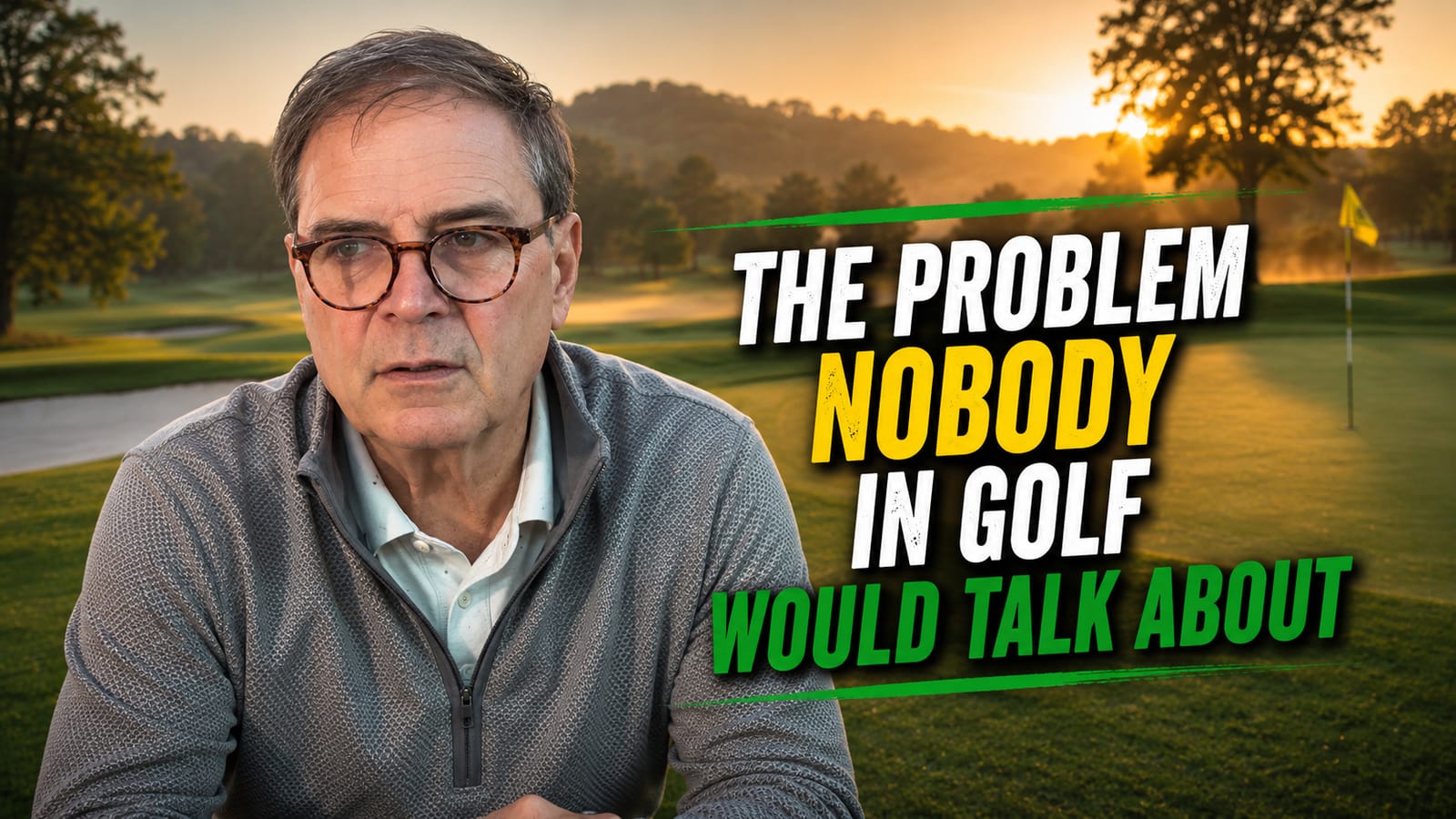
Here's the problem I set out to solve over forty years ago, and it's still the problem most golfers won't address honestly. When I was playing competitive amateur golf across Ireland, Scotland, and England, one question consumed me: why is it that under the pressure of intense competitive golf, certain people seem to be able to lift their games to another level and others effectively fall apart... they crumble? Back then, there were hundreds and hundreds of books on golf and almost nothing addressing an issue like that. The mental game golf world simply didn't exist. There was a stigma around the mental side, as if anyone who engaged with it had mental health problems. That stigma kept golfers stuck for decades. What I discovered... and what I built my life's work around... is that the answer was never "mental" in the way people think. It's about the relationship of mind and body, of mind and emotion, of mind and spirit. Everything is connected.
When I wrote The Golfing Bodymind in 1980, I was in my twenties, and I was convinced I'd identified something that could genuinely transform how golfers performed under pressure. I was invited by Neil Coles, one of the European Ryder Cup players and a big name at the time, to present to the European professionals at what's now the BMW at Wentworth. They were all there. They all seemed very interested in it. The session we had went well. But nobody was willing to actually do anything much about it. There was a sort of stigma around the mental side, as if anyone engaged with it had mental health problems. So it wasn't really a business. We did set up a little organisation called Sporting Body Mind, but it wasn't really a business. I had to go off and do other things.
That experience taught me something vital. The problem wasn't that golfers didn't recognise they crumbled under pressure. They knew. Everyone in that room at Wentworth knew. The problem was that admitting you needed help with your mental game felt like admitting weakness. This created a silence around the most important variable in competitive golf. And that silence persisted for years. Even today, with sports psychology now mainstream, golfers still struggle to engage honestly with what's happening between their ears... and more importantly, in their bodies... when it matters most. If you've ever felt that acknowledging your nerves or anxiety is somehow a sign you don't belong in competition, you're carrying the residue of that old stigma. And it's costing you shots.
Part of the reason the mental game golf conversation was so stunted is rooted in how Western psychology itself was built. Western psychology tends to study those who have mental health problems and find it difficult to cope. That's where the research funding went. That's what the textbooks covered. So when golfers heard "psychology," they heard "there's something wrong with you." But Eastern psychology focused on the healthy... on people dealing with performance. The thing about playing sport at a high level is you've got to have got your act together to do anything at a high level. In many ways, yoga was dealing with the states of mind of a performer, and they have very interesting ways of describing the different states of mind.
I grew up in India for my first eleven years, and that experience shaped everything I later built. The Eastern traditions never separated mind from body the way Descartes and the Western Enlightenment did. They understood that breath, posture, balance, and states of mind were all part of one integrated system. When I encountered Roberto Assagioli's Psychosynthesis through Michael Murphy's iconic Golf in the Kingdom, it confirmed what I already sensed: the tools golfers needed already existed, but they lived in traditions that the golfing world hadn't bothered to look at. Assagioli's work, like much of Eastern psychology, is for the relatively healthy in mind and spirit. It is for this reason that it offers so much that is of help to the ambitious golfer. If you're curious about how these mental game approaches apply across different levels, the principles are universal.
Here's what I've seen in golfer after golfer, decade after decade. You're on the 15th hole. You've done well today. A good round is in the offing. You keep going like this, you'll be in a very good position. And you become aware of this. But you also become aware that as you entertain that thought of an outstanding round, mind and body become a little bit more tense. Your breathing, almost certainly, becomes more shallow and more quick. This is your nervous system being hijacked, and most golfers don't even notice it happening.
Anxiety and stress trigger our nervous system. They raise our blood pressure. They make us tighten up. And this doesn't just happen on the shot... it happens in the space between shots, where golfers lose rounds without realising it. The thought of a good score, the memory of a bad hole, the anticipation of a difficult tee shot ahead... all of these activate the same physiological cascade. Your breathing becomes shallow, your muscles tighten, your proprioception degrades, and by the time you stand over the ball, you're already compromised. I've written extensively about how to stay focused between shots because this in-between space is where most competitive golf is actually won or lost. The shot itself takes seconds. The walk between shots is where the nervous system either stays regulated or spirals.
In yoga, the breath is the uniting mechanism... it brings together mind and body and spirit. The term they use for breath control is pranayama, and there's a Sanskrit saying: "breath is life, so if you breathe well, you will live long on Earth." When I wrote The Golfing Bodymind, there was a whole section on yoga breathing exercises. At the time, no one took much notice. But what I understood then, and what science now confirms, is that the breath was the mechanism rather than telling yourself to relax. The breath was a mechanism that you could affect your physiology. We didn't have the language of nervous system regulation at the time, but that's exactly what it was.
The simple act of stopping, breathing quickly and shallow and deepening it has an immediate effect. You can test that for yourself right now. Scientists have even done research that says even making slight changes to the way we inhale and exhale can improve sports performance. But here's the paradox in breathing that I find extraordinary: deep breathing can anchor us, it can centre us, it can give us a feeling of being rooted. And that can be very important in a competitive sporting situation. But ironically, it can also elevate us to a higher state... the states of flow or peak experience or being in the zone. So breath can both anchor us and elevate us. It can energise us, bring us alive. But it can also relax and calm. Understanding this dual nature of breath is what separates golfers who can stay relaxed while playing from those who simply tell themselves to calm down and wonder why it never works.
(Try: Three-Compartment Breathing — available in the Training section of the app)
Completely central to my approach is something rooted in what's called systems thinking. It's radically different from a typical method that tries to change things like a golf swing, piece by piece, fault by fault, symptom by symptom. This approach is holistic. This means recognising that human beings are an integrated whole, and they can only be changed as a whole. It means that a golf swing is a coordinated whole... well, maybe in many cases, a poorly coordinated whole... but that it can only be changed as a whole.
Western science worked out by breaking things into bits and studying how this variable affected that variable, and much was achieved. However, emergent science such as quantum physics, neuroscience, complexity theory, and neurobiology are all very different. They're rooted in a systems thinking approach. And in this worldview, everything is connected, and you simply cannot separate the parts from the whole. In relation to the body, we have 700-plus muscles that need to function in a very interconnected way, working in groups in relation to the whole, integrated with 200-plus bones and 350-plus joints. When a golfer tries to fix their swing with isolated tips while their nervous system is dysregulated and their breathing is shallow, they're applying a piece-by-piece fix to a systems problem. This is why your best golf happens when you stop trying... because stopping the effort of piecemeal control allows the system to operate as a whole.
My work draws on three powerful systems thinking approaches, two of which are still little known in the golfing world. The first is the Initial Alexander Technique (IAT), based on the work of FM Alexander, an Australian actor who lost his voice. He found through observation that even the thought of going on stage caused his head and neck to tense and shrink into his shoulders. IAT directly addresses the vice-like grip of habits through techniques of inhibition, which stop and inhibit the habitual ways, and then give conscious guidance and control (CG&C). This is a very innovative way of getting mind and body working together to deliver real, integrated change.
The second is Psychosynthesis, which offers great ways of navigating the emotions we encounter in competitive sport and understanding the many dimensions of our personality, with a promise of helping us recover an undivided self. As Shiva Irons put it in Golf in the Kingdom: "the basis for a change in the way a person plays the game must be laid in his entire life."
The third comes from the Eastern disciplines of Yoga, Zen, and Tai Chi, with their paradoxical wisdom of beginner's mind and effortless effort. They understand energy and its direction, but most of the time, their real focus is on states of mind. Can you learn to manage and control your state of mind, especially under the pressures of competitive sport? Together, these three approaches deliver the fundamentals of integrated movement, the promise of an undivided self, and the ability to control states of mind. This is the foundation for accessing flow states in golf, regardless of your handicap.
Let me be brutally honest about why this is so difficult. As Machiavelli put it, "there's nothing more difficult to take in hand, more perilous to conduct, or more uncertain in its success than to take a lead in the introduction of a new order of things." What I'm offering is a golfing new order of things. It's tough. It's really tough to change deeply rooted habits of a lifetime and of playing the game.
First, there's the demon of awareness... or rather, lack of it. Most golfing habits are so hard-wired we don't even know what they are. They're unconscious. They're taken for granted. They're so familiar that we don't even have to think about them anymore. So what we're dealing with is something that we really don't know what it is.
Second, when we do a movement frequently, the brain stores these movements in what are called brain maps. When faced with a situation, it wheels out what you've done before, and this all happens in a split second. Especially when it matters, the brain will always select what it knows best. And what it knows best is not what's optimal... it's what it's familiar with. This is why golfers choke under pressure... the brain reverts to familiar patterns that were never designed for the moment at hand.
Third, our nervous system is set up for what's called satisficing... getting a good enough result. Being better than you ever thought you could be is not satisficing. It's optimising. So our human nature is not naturally going to be helpful in this quest.
In The Matrix, the hero Neo faces the ultimate choice: the red pill or the blue pill. The red represents enlightenment and breaking free of the system... and for us, that's our habits. The blue represents comfort, the known, and being trapped. What the Golfing Bodymind offers is a potential practical way out. But it needs discipline and will.
There's another obstacle that catches golfers off guard: faulty sensory perception. When you try to feel your way into a new movement, you're tuning into proprioception, the internal sense of your body and how it's moving. But the problem is that these sense organs send messages about what is familiar, not what is right. When you're trying to do the new, it's going to feel wrong. So what feels right is wrong, and what is wrong feels right. This is why isolated tips fail. This is why "just relax" doesn't work. This is why you need a systems approach that addresses the whole of you, not just the bit you think is broken.
So in short, we don't know what we're doing, and every instinct in our body mind is not to change it anyway. But you can be the architect of your golfing destiny. You will probably need some scaffolding for a while, and it really helps to have a plan. One systems concept is equifinality: the same end can be reached by a variety of paths. Start your free 7-day trial at Better Game Golf and let the scaffolding meet you where you are.
(Try: Total Body Relaxation — available in the Training section of the app)
For decades, "psychology" was associated almost exclusively with mental illness in the Western world. Western psychology tended to study those who had mental health problems and found it difficult to cope. So when a golfer heard "you might benefit from working on your mental game," what they actually heard was "there's something wrong with you." I experienced this first-hand when I presented to the European Tour professionals at Wentworth. They were all interested, but nobody was willing to actually do anything much about it. The stigma meant there wasn't really a business in sports psychology for a long time. This is why I had to go off and do other things after writing The Golfing Bodymind in 1980. The residue of that stigma still lingers today, even though the mental game golf conversation has become far more mainstream.
Bodymind is a made-up word, but it describes exactly what I focus on... the body and the mind that you bring to the golf course, and critically, the connection between them. The term rejects the Western separation of mind and body promoted by Descartes and instead recognises that human beings are an integrated whole. Your golf swing is not separate from your breathing, which is not separate from your emotional state, which is not separate from your state of mind. A systems thinking approach means you cannot fix the swing while ignoring the nervous system, or calm the nerves while ignoring the breath. The Golfing Bodymind framework draws on the Initial Alexander Technique, Psychosynthesis, and Eastern disciplines of Yoga, Zen, and Tai Chi to address the whole golfer rather than isolated symptoms.
In yoga, the breath is the uniting mechanism that brings together mind and body and spirit. The term for breath control is pranayama, and it's been understood for thousands of years. What makes breathing so powerful for golfers is that it's a mechanism through which you can directly affect your physiology, rather than telling yourself to relax and hoping something changes. When anxiety triggers your nervous system, your breathing becomes shallow and quick, your blood pressure rises, and your muscles tighten. Simply deepening your breath has an immediate effect on reversing this cascade. But there's a paradox: deep breathing can both anchor you and elevate you to higher states of consciousness associated with being in the zone. It energises and calms simultaneously. This dual capacity makes it the single most important skill a golfer can develop.
Faulty sensory perception is one of the biggest obstacles to genuine improvement. When you try to change your swing or your movement patterns, you rely on proprioception, the internal sense of your body and how it's moving. The problem is that your stretch receptors send messages about what is familiar, not what is optimal. So when you attempt something new, even if it's mechanically better, it feels wrong. And when you revert to your old pattern, it feels right. This means what feels right is wrong, and what is wrong feels right. This is why golfers can receive excellent instruction, understand intellectually what needs to change, and still revert to old patterns, especially under pressure. It's not a failure of will. It's a feature of how the sensory system works. The Initial Alexander Technique's methods of inhibition and conscious guidance and control are specifically designed to address this problem.
The three approaches are the Initial Alexander Technique, Psychosynthesis, and Eastern disciplines including Yoga, Zen, and Tai Chi. Each addresses a different dimension of the whole golfer. The Initial Alexander Technique delivers the fundamentals of integrated movement through its techniques of inhibition and conscious guidance and control. Psychosynthesis, drawn from Roberto Assagioli's work, offers the promise of an undivided self by helping golfers navigate emotions and the many dimensions of personality that compete for control during a round. The Eastern disciplines provide the ability to control states of mind, working with breath, posture, balance, and paradoxical concepts like beginner's mind and effortless effort. Together, these three deliver integrated movement, an undivided self, and mastery of states of mind, which are the preconditions for peak performance and flow states in golf.
This is the question that started everything for me. Playing competitive amateur golf across Ireland, Scotland, and England, I watched certain players lift their game when the pressure intensified while others effectively fell apart. The answer is not about talent or toughness in any simplistic sense. It's about the state of the whole system. When pressure hits, the nervous system activates. If a golfer has no mechanism for regulating that activation, breathing becomes shallow, muscles tighten, brain maps fire familiar but suboptimal patterns, and proprioception degrades. The golfer who thrives under pressure isn't immune to these responses... they've developed the disciplines to regulate them. They can breathe into the activation instead of being consumed by it. Their relationship between mind and body remains intact rather than fragmenting. This is not a talent you're born with. It's a skill you develop through practice with the right disciplines, which is precisely what I've spent forty years building.
Start your free 7-day trial at bettergamegolf.com and let Sandy's AI caddie walk you through these concepts on your next round. You'll begin with the breathing exercises that started everything, move through total body relaxation, and begin to experience what it actually means to work with your golfing bodymind as an integrated whole rather than fighting it piece by piece. The problem nobody would talk about is now the solution waiting for you to try.
Stories are not decoration. In my experience, they are one of the most powerful transmission systems human beings have ever invented for getting wisdom from one person to another. That is exactly why ...
16 min read →You've got a round coming up and you're already dreading it. Your game hasn't been sharp, life has been relentless, and somewhere in the back of your mind a quiet voice is already writing the disaster...
15 min read →A golf mental reset isn't just a nice idea. It's a neurological necessity. When a bad shot cascades into a worse one, something very specific happens in your bodymind... your breathing shortens, your ...
15 min read →