
Better Golf Starts in Your Mind — Text Sandy free →
By Sandy Dunlop — Better Game Golf
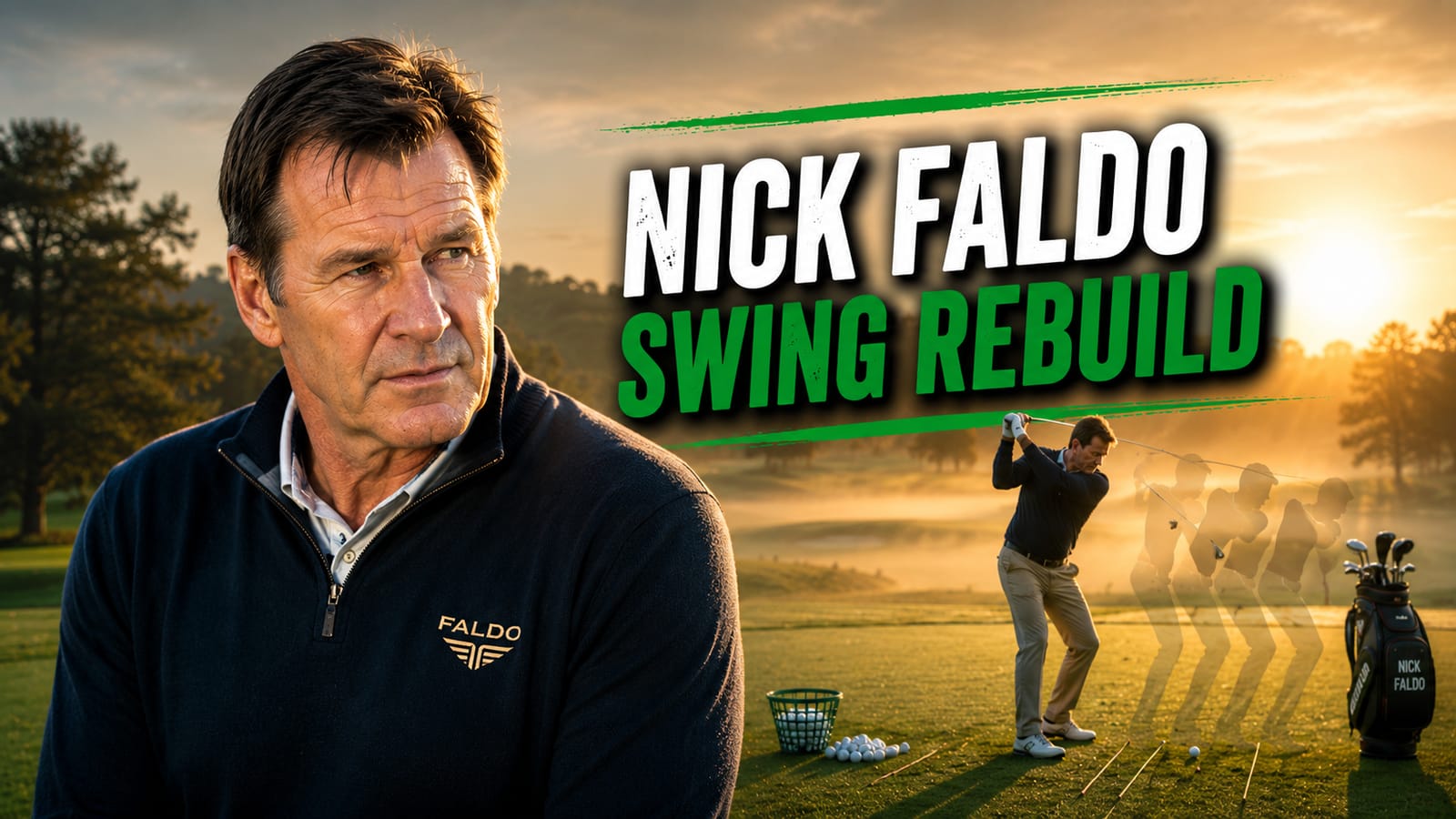
The Nick Faldo swing rebuild is one of the most remarkable stories in professional golf. In 1985, a man who had already won 13 times on the professional circuits, including a win at the Heritage in the States, made a decision that most people thought was insane. He decided he wasn't good enough to win golf's majors, and his game needed an overhaul. He signed up with a coach who wasn't particularly well known at the time... David Leadbetter... and they laid out a plan to work together over two years to build a swing that would help Nick win a major. Two years and one month later, he shot 18 pars in a row at Muirfield to win the Open Championship. But what isn't perhaps acknowledged is what happened in between. That's the part I find remarkable. That's where the real story lives.
In 1975, we were at the English Amateur at Royal Lytham and St Annes, and before the tournament had begun, word went out that there was a competitor who announced, before the tournament had begun, that he was going to win. That person was one Nick Faldo. Now very few of us had heard who this person was, and needless to say the comments didn't go down very well. "Who does he think he is" would have been the sentiment felt by just about everyone there. But he did win, and he won well. In a way, Nick Faldo announced himself on a wider scene that week. What we didn't know at the time is that he was going to become one of the greats in European golf. He was already a class above all the other competitors who'd entered this tournament. That kind of self-belief... declaring victory before a ball has been struck... is something most golfers would never dream of doing. But it tells you something about the mental architecture that was already in place with Faldo, even as a young amateur. The willpower was there from the very beginning.
If we move 10 years forward to 1985, Nick Faldo had won 13 times on the professional circuits, including that win in the States at the Heritage. By any normal measure, this was a hugely successful career. But Faldo realized he wasn't good enough to win golf's majors. That's a staggering piece of self-awareness. Most golfers at that level would be satisfied. They'd take the wins, enjoy the ranking, and carry on. But Faldo was not interested in satisficing. In my work, I draw on a concept that's deeply relevant here: our nervous system is set up to give us a good enough result. Our primary focus is to get by. It's called satisficing, and being better than you ever thought you could be is not satisficing... it's optimizing. Faldo made the decision to optimize. He looked at his game with total honesty and concluded that the swing he had would not hold up under major championship pressure. That kind of ruthless self-assessment is rare, and it's the first step in what I describe in The Golfing Bodymind as the Call to an Adventure.
The Nick Faldo swing rebuild was not a tweak. It was not a tip from a magazine or an adjustment on the range. It was a two-year commitment to dismantle what was working and build something entirely new. He signed up with David Leadbetter, who had been working with Nick Price and David Frost, and together they laid out a plan. Two full years of reconstruction. Now, when I write about the journey to being better than you ever thought you could be, I describe it as a Call to an Adventure. Getting there means moving into an unknown world. You will go literally where you have never gone before. You will have to acquire new skills and likely new attitudes and beliefs. You will also have tough times, times when it feels like you are going nowhere, making no progress, even having a sense that things are falling apart. Faldo said yes to all of that. He took what I call the red pill. In The Matrix, the ultimate choice facing Neo was the red pill or the blue pill. The red represents enlightenment and breaking free of the system... for us, that's our habits. The blue represents comfort, the known, and being trapped. Faldo chose red. And the system he was breaking free from was his own deeply ingrained swing.
Before any golfer decides to embark on genuine change, I suggest they spend a moment considering the yes voice and the no voice. The yes voice is the excitement of a new journey, the hope, the possibility, the reward, the "being better than" idea. But the no voice is the recall that you've tried, perhaps many times before, to improve, to step up. You might feel reluctant to say yes because you're worried about the acute disappointment you will experience if this particular one doesn't work out. Faldo clearly had a powerful yes voice. But make no mistake, his no voice would have been screaming too. He was already winning tournaments. He was already one of the best players in Europe. The no voice would have said: why risk it? Why throw away what's working? What if Leadbetter's ideas don't pan out? What if you lose two years and come back worse? That tension between yes and no is something every golfer faces at a smaller scale whenever they commit to real change. The difference with Faldo is the scale of the bet and the discipline to see it through. If you've ever wondered how to stop overthinking your golf swing, consider that Faldo had to live inside that overthinking for two solid years while a new pattern was being laid down.
In 1985 and 1986, Nick Faldo didn't win. That's the part of the Nick Faldo swing rebuild story that most people gloss over, but it's the part I think is remarkable. If you really want a change, there will be a period when things get worse. Not many people can handle that transition. I call it the Dark Night of the Golfer. During this period, Faldo was dismantling a swing that had won him 13 tournaments and replacing it with movements that his body didn't yet recognize as its own. The brain works in a specific way here that makes this brutally difficult. When we do a movement frequently, such as swinging the club, the brain stores these movements in what are called brain maps. When faced with a situation, it wheels out what you've done before, and this all happens in a split second. Especially when it matters, the brain will always select what it knows best. And what it knows best is not what's optimal... it's what it's familiar with. Faldo was fighting his own brain maps every single day for two years. His body's proprioception, the internal sense of how the body is moving, was sending him signals that the new swing was wrong. This is what FM Alexander identified as faulty sensory perception: what feels right is wrong, and what is wrong feels right. Every instinct in his body was telling him to go back to the old swing.
By all accounts, Faldo just stuck with his routine when things weren't working out. And that's the point. He had the willpower to stick with his disciplines and his routines when everything inside him was resisting. This is not just mental toughness in the way that phrase is usually thrown around in golf. This is a man whose entire sensory system, whose nervous system, whose brain maps were all conspiring to drag him back to the familiar. And he overrode all of it. The concept of inhibition from the Initial Alexander Technique is directly relevant here. Inhibition is the ability to stop and prevent the habitual response. It's not suppression. It's a conscious decision not to do what the body automatically wants to do, and then to give conscious direction toward the new pattern. This is what Alexander called Conscious Guidance and Control (CG&C). Faldo may not have used that terminology, but that is precisely what he was doing for two years. He was inhibiting his old swing, refusing to let the brain maps take over, and consciously directing a new, integrated movement pattern. The fact that he did this while competing on tour, while the results were poor, while the golfing world questioned his sanity... that is extraordinary discipline. For any golfer dealing with the frustration of change, I'd recommend reading about fear-based swing patterns and how anxiety can sabotage the very changes you're trying to make.
The Nick Faldo swing rebuild is a perfect illustration of why the systems thinking approach matters. A typical method tries to change a golf swing piece by piece, fault by fault, symptom by symptom. But this approach is holistic. Human beings are an integrated whole, and they can only be changed as a whole. A golf swing is a coordinated whole... well, in many cases a poorly coordinated whole... but it can only be changed as a whole. Faldo and Leadbetter were not fixing a slice or adjusting a grip in isolation. They were rebuilding an entire movement system. The 700-plus muscles in the body work in groups in relation to the whole, and they need to work in an integrated way with the 200-plus bones and 350-plus joints. When you change the swing plane, the hip rotation changes, the shoulder turn changes, the weight distribution changes, the grip pressure changes, the timing changes. Everything is connected. This is why it took two years, not two weeks. And this is why there is no shortcut. As Machiavelli put it, "there's nothing more difficult to take in hand, more perilous to conduct, or more uncertain in its success than to take a lead in the introduction of a new order of things." What Faldo undertook was a golfing new order of things.
Two years and one month after beginning the rebuild, Nick Faldo was playing in the Open Championship at Muirfield. And he shot 18 pars in a row to beat out Paul Azinger and win. Eighteen pars at Muirfield. Think about what that round represents. Not fireworks. Not birdies and eagles. Pars. Consistent, relentless, pressure-proof pars on one of the most demanding links courses in the world. That final round was the ultimate expression of a swing that had been rebuilt from the ground up to hold under pressure. The old swing might have produced lower individual scores on good days, but it would not have delivered 18 consecutive pars when the Open Championship was on the line. This is what optimization looks like versus satisficing. The remarkable journey of transformation was successful. The swing held. The new brain maps had been laid down deeply enough that under the most extreme pressure, the body did what it had been trained to do. It's a story that resonates with how Rory McIlroy's brain won the Masters... a different era, a different player, but the same principle of mental architecture holding when it mattered most.
Now, I'm not suggesting you need to disappear for two years and rebuild your swing from scratch. What I am saying is that the principles Faldo demonstrated are the same principles that apply to any golfer who wants to be better than they ever thought they could be. In a way, what we're doing with Better Game Golf and The Golfing Bodymind is looking at how to manage such a transition. The ups and downs of the journey. The Dark Night of the Golfer. The faulty sensory perception that makes the new feel wrong. The brain maps that keep pulling you back to the old. The disciplines of breath, body awareness, concentration, and emotional management that give you the tools to stay on course when everything feels like it's falling apart. The three core disciplines I work with... the Initial Alexander Technique for integrated movement, Psychosynthesis for the undivided self, and the Eastern disciplines of Yoga, Zen, and Tai Chi for states of mind... these are the scaffolding that makes this kind of transformation possible. Faldo had Leadbetter as his scaffolding. You can be the architect of your golfing destiny, but you will probably need some scaffolding for a while. Explore all our mental game articles for a broader picture of what this journey involves.
(Try: Relaxation Exercise... available in the Training section of the app)
One of the things that makes the Dark Night of the Golfer so difficult is what happens to the nervous system during prolonged periods of poor performance. Anxiety and stress trigger the nervous system. They raise blood pressure. They make us tighten up. And when you're already struggling with a swing that doesn't feel like your own, that tightness compounds everything. The simple act of stopping shallow, quick breathing and deepening it has an immediate effect on calming the nervous system. This is not a minor detail... it's foundational. In the Eastern traditions, breath control is called pranayama, and there's a Sanskrit saying: "breath is life, so if you breathe well, you will live long on Earth." I included a whole section on yoga breathing exercises when I wrote The Golfing Bodymind back in the 1980s. At the time, nobody took much notice. Now, scientists have done research confirming that even slight changes to the way we inhale and exhale can improve sports performance. For a golfer enduring a difficult transition, breath work is the first line of defence against the nervous system sabotaging the process. Learning how to stay relaxed while playing golf is not a luxury... it's a survival skill during any period of genuine change.
The second dimension that makes transformation possible is what Psychosynthesis calls the undivided self. When a golfer is in the middle of a rebuild, there are competing voices inside. One voice wants the new swing. Another voice wants the comfort of the old. Another voice is terrified of public failure. Another voice is impatient for results. These are what Psychosynthesis identifies as sub-personalities, and when they're running the show, you get fragmented, inconsistent golf. What Faldo demonstrated, whether he knew the terminology or not, was an ability to unify those competing parts of himself around a single purpose. As Shivas Irons put it in Michael Murphy's Golf in the Kingdom, "the basis for a change in the way a person plays the game must be laid in his entire life." Faldo didn't just change his swing. He changed his entire approach to competition, to practice, to discipline. He recovered an undivided self in service of a clear goal. For any golfer who feels pulled in different directions on the course... wanting to play freely but gripped by fear, wanting to commit but holding back... the work of building the undivided self is where real freedom comes from. Understanding how to play golf without fear begins here.
(Try: Concentration Exercise... available in the Training section of the app)
The Nick Faldo swing rebuild took two years and one month from the time he began working with David Leadbetter in 1985 to his Open Championship victory at Muirfield in July 1987. During this period, Faldo did not win a tournament. That's a critical detail. He was competing on the European Tour and occasionally in the United States, but the results were poor compared to his previous form. In my framework, I call this period the Dark Night of the Golfer... the inevitable phase where things get worse before they get better. The brain maps of his old swing were deeply ingrained, and the new patterns hadn't yet been laid down firmly enough to perform under pressure. Faldo had to endure this entire period relying on discipline, routine, and willpower rather than results.
Faldo had won 13 times on the professional circuits by 1985, including a win at the Heritage in the States. But he realized he wasn't good enough to win golf's majors. This is the difference between what I call satisficing and optimizing. Our nervous system is set up to give us a good enough result... to get by. That's satisficing. Most golfers, most people, operate at this level. But Faldo wanted to optimize. He looked at his swing and concluded, with remarkable honesty, that it would not hold up under the sustained pressure of a major championship. That decision required overcoming the no voice... the voice that says "why risk what's working?"... and committing fully to the yes voice and the adventure of genuine transformation.
The Dark Night of the Golfer is my term for the inevitable period of deterioration that occurs when a golfer commits to genuine, deep change. It draws on the concept of the Dark Night of the Soul from mystical traditions. When you dismantle habitual patterns... whether it's a swing, an approach to pressure, or a way of thinking on the course... there is a period where the old way no longer works and the new way hasn't yet taken hold. During this time, proprioception is unreliable because of faulty sensory perception: what feels right is wrong, and what is wrong feels right. The brain maps keep pulling you back to familiar patterns. Results decline. Confidence wavers. Most golfers quit during this phase and go back to their old habits. The ones who break through, like Faldo, are the ones who have the willpower to stick with their disciplines and routines even when nothing seems to be working.
Faulty sensory perception is a concept from the work of FM Alexander, founder of the Alexander Technique. It describes the phenomenon where our internal sense of our body... our proprioception... sends us signals that are calibrated to what's familiar rather than what's optimal. When Faldo was learning his new swing, every sensation in his body would have been telling him it was wrong, because his proprioceptive system was calibrated to 13 years of the old movement pattern. The new positions, the new timing, the new sequencing... all of it felt foreign. This is why you cannot "feel your way" to a new swing through sensation alone. The sensors themselves are sending misleading messages. Alexander's solution was Conscious Guidance and Control (CG&C)... using the mind to direct movement rather than relying on feel. Faldo's two-year commitment was, in essence, a massive exercise in overriding faulty sensory perception until new brain maps were established.
Absolutely, though the scale and timeline will be different. What Faldo demonstrated are universal principles: the commitment to genuine change over satisficing, the willingness to endure the Dark Night of the Golfer, the discipline to maintain routines when results are poor, and the understanding that real change is holistic... it cannot be achieved piece by piece. In my work with Better Game Golf, I offer the same core disciplines that make this kind of transformation possible: the Initial Alexander Technique for integrated movement, Psychosynthesis for building the undivided self, and Eastern disciplines for managing states of mind. You don't need two years or a world-class coach. You need a framework, the right exercises, and the willpower to stick with the process. The 7-day introductory programme in the app gives you a taste of these disciplines, starting with breath work and body awareness... the foundations that Faldo would have needed just as much as any club golfer.
Eighteen consecutive pars to win the 1987 Open Championship is significant because of what it reveals about the nature of the rebuilt swing and the mental state behind it. This was not a round of fireworks. It was a round of relentless consistency under the most extreme pressure. It demonstrated that the new swing, built over two years, had been internalized deeply enough to hold when the stakes were highest. The brain maps had been rewritten. The new patterns had moved from conscious effort to something approaching automatic. In my framework, this is what happens when the Dark Night is survived and the new order of things takes root. The old swing might have produced lower scores on good days, but it would not have delivered this kind of grinding, unbreakable consistency at Muirfield. Eighteen pars is the proof that holistic, systems-based transformation works.
The Nick Faldo swing rebuild story is not just history. It's a blueprint for what's possible when you commit to genuine change and have the disciplines to survive the difficult middle. If you want to explore the breath work, body awareness, concentration exercises, and state-of-mind training that make this kind of transformation possible for your game, start your free 7-day trial at bettergamegolf.com. Let my AI caddie walk you through these concepts on your next round. You can be the architect of your golfing destiny... but a bit of scaffolding helps.
Stories are not decoration. In my experience, they are one of the most powerful transmission systems human beings have ever invented for getting wisdom from one person to another. That is exactly why ...
16 min read →You've got a round coming up and you're already dreading it. Your game hasn't been sharp, life has been relentless, and somewhere in the back of your mind a quiet voice is already writing the disaster...
15 min read →A golf mental reset isn't just a nice idea. It's a neurological necessity. When a bad shot cascades into a worse one, something very specific happens in your bodymind... your breathing shortens, your ...
15 min read →