
Better Golf Starts in Your Mind — Text Sandy free →
By Sandy Dunlop — Better Game Golf
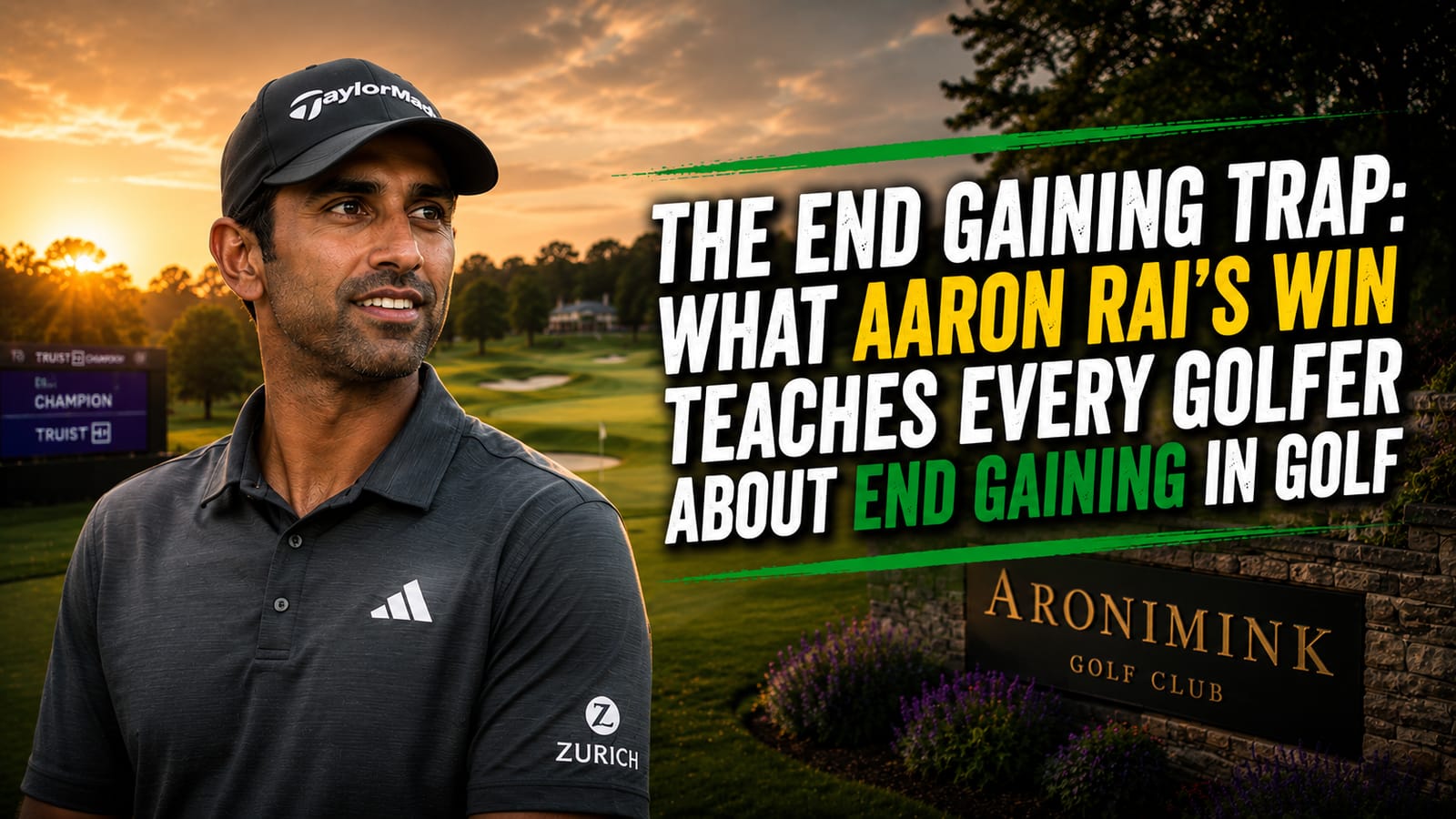
End gaining in golf is the silent killer of great rounds. It's what happens when your mind locks onto the outcome... the score, the win, the career-best number... and loses contact with the process that actually produces the result. Aaron Rai's victory over Rory McIlroy at the 2025 PGA Championship at Aronimink is, in my view, one of the most remarkable demonstrations of what happens when a golfer resists end gaining under the greatest pressure imaginable. Rai was a means whereby thinker, not an end gainer. The end gaining was enormous... it was life changing... but his total focus was on the process, the means whereby. And I think that was a remarkable achievement. What follows is my breakdown of what this victory teaches every golfer about the trap of end gaining and the discipline required to avoid it.
What's really interesting about the PGA Championship final round is what happened on the three holes that most favour Rory's great length. The 9th and the 16th are both par fives that Rory could reach with a mid to low iron. The 13th he could hit with a three wood. These are holes designed for a player with Rory's power. So what was the score on those three holes on the final day? Aaron Rai goes eagle, birdie, birdie. Rory goes par, one over par. That's a five shot difference on just three holes. That was the difference. It would have put Rory at nine under and he'd have tied Aaron. Now if you add up the score over the four days, there was a seven shot difference on those three holes alone. So if Rory had scored the same as Aaron on the holes that most favour Rory's great length, he would have won.
This isn't a criticism of Rory. It's an observation about what end gaining does to a golfer when the stakes are highest. When a player knows these are "their" holes, the mind shifts from process to expectation. The internal narrative becomes "I should birdie this" or "this is where I pull away." That's end gaining. The moment you're thinking about the result you should be getting, you've lost contact with the means of getting it. As I explored in my piece on Rory McIlroy's Masters mental game, the brain under pressure reverts to what it knows best, and what it knows best isn't always what's optimal.
What I think Aaron Rai's victory was, fundamentally, was a triumph for a man who had a remarkable process. He was a means whereby thinker, not an end gainer. Now let me be clear about what that means, because it's a concept from the Initial Alexander Technique that I believe is profoundly relevant to golf. F.M. Alexander distinguished between two modes of operating. The end gainer fixates on the result and throws everything at it, usually by relying on habitual patterns. The means whereby thinker focuses entirely on the process... the steps, the quality of each action, the conscious guidance and control of what they're doing right now.
The end gaining for Rai was enormous. Winning a major championship is life changing. It transforms your career, your finances, your standing in the game. But his total focus was on the process, the means whereby. That is an extraordinary thing to sustain over 72 holes of a major championship, and particularly on Sunday when every cell in your body is screaming at you to think about what this round means. This is not positive thinking. It's not "staying in the moment" as some vague mental coaching platitude. It's a disciplined, practised skill of inhibition... stopping the habitual end gaining response before it takes over your nervous system and your swing.
Here's what most golfers don't understand about end gaining in golf. It doesn't just appear when you're leading a tournament. It's operating all the time. It's there when you're standing on the first tee thinking about what score you want to shoot. It's there when you've got a six footer for birdie and you're already calculating what it does to your round. It's there on every approach shot where you're thinking about the pin instead of the process. The reason it gets worse under pressure is neurological. When anxiety rises, the nervous system shifts into a state of heightened arousal. Blood pressure goes up, breathing becomes shallow and quick, muscles tighten, especially in the neck, shoulders, and hands. The brain, under threat, does what it's evolved to do... it selects the most familiar pattern, not the most effective one. This is what I call the brain wheeling out what you've done before, and it happens in a split second.
So under pressure, you get a double whammy. The end gaining thought... "I need to make this"... triggers the nervous system into a fight-or-flight response, which then triggers the brain to select habitual movement patterns, which are often the very patterns you've been trying to change. This is why golfers choke under pressure... it's not weakness, it's biology. And it's why the discipline of inhibition, of stopping the end gaining response before it cascades through your system, is so critical.
F.M. Alexander was an Australian actor who lost his voice... a deal breaker for an actor. But through careful self-observation he found that even the thought of going on stage caused his head and neck to tense and to shrink into his shoulders. That single observation led to a lifetime's work on posture, breathing, and what he called Conscious Guidance and Control (CG&C). His approach is now widely used by professional actors, musicians, and singers all over the world. But it's hugely relevant to golfers, and here's why.
The Initial Alexander Technique is a systems thinking approach to the vital matter of integrated movement. It directly addresses the vice-like grip of habits and habitual ways of playing golf. The technique of inhibition stops and inhibits the habitual ways, and then giving conscious direction is a very innovative way of getting mind and body working together to deliver real, integrated change. In the golf context, inhibition means pausing before your shot... not just a physical pause, but a mental one. You're stopping the automatic, habitual response to the stimulus. The stimulus might be the sight of water, the pressure of a crucial putt, or simply the desire to hit a great shot. The habitual response is to tense up, to grip tighter, to rush. Inhibition gives you the space to choose a different response. This is exactly what Aaron Rai appeared to be doing all week at Aronimink.
Let me make this practical for you. Think about the last time you had a really important shot. Maybe it was a drive on a tight hole in a competition, or a pitch over a bunker with out of bounds behind the green. What did your mind do? If you're honest, it probably jumped straight to the outcome... "don't go right," "I need to get this close," "if I make bogey here I'm done." That's end gaining. Your mind went to the end result and your body tried to produce that result using whatever habitual pattern the brain selected. The means whereby approach is fundamentally different. Instead of thinking about where the ball needs to go, you direct your attention to the quality of the process. What's the state of my breathing? Am I tense in my neck and shoulders? Have I given myself conscious direction for this shot? Am I in the right state of mind to execute?
This isn't easy. In fact, as Machiavelli put it, "there's nothing more difficult to take in hand, more perilous to conduct, or more uncertain in its success than to take a lead in the introduction of a new order of things." But this is exactly what getting better at golf requires... a golfing new order of things. As I wrote about in Nick Faldo's two years in the dark, genuine transformation demands a willingness to let go of the familiar and trust a process that initially feels wrong. Because what feels right is wrong, and what is wrong feels right. That's faulty sensory perception, and it's one of the biggest obstacles every golfer faces.
The way the brain works is that when we do a movement frequently, such as swinging the club, the brain stores these movements in what I call Brain Maps. And when faced with a situation, it wheels out what you've done before, and this all happens in a split second. Let's say you're trying to change something and you've got a tip or an instruction in mind. But one of the challenges is, especially when it matters, the brain will always select what it knows best. And what it knows best is not what's optimal... it's what it's familiar with.
This is why end gaining is so destructive. The end gaining thought creates urgency. Urgency triggers the nervous system. The nervous system activation causes the brain to default to its most practised pattern. So you get the double bind... you want a different result, but the way you're going about getting it guarantees you'll produce the same old result. Rai's achievement at Aronimink was to break this cycle under the most extreme pressure imaginable. He stayed with his means whereby process even when every instinct would have been screaming at him to think about winning a major.
There's another dimension to this that most golfers never consider. Our nervous system is set up to give us a good enough result. Our primary focus, biologically, is to get by. It's called satisficing. And being better than you ever thought you could be is not satisficing... it's optimising. So our human nature is not naturally going to be helpful in the quest we're considering here. This is why I describe the journey of real improvement as working against your own human nature. You're working against satisficing. You're working with habits that are largely unconscious and that you don't really know what they are. And you're working with senses... proprioception... that are faulty because they reward the familiar and the comfortable.
In short, you don't know what you're doing, and every instinct in your body mind is not to change it anyway. That sounds bleak, but it's actually liberating when you understand it. Because once you see the trap, you can work with it rather than against it. That's what inhibition and conscious direction give you... a practical way out. It's tough, and it needs discipline and will, but you can be the architect of your golfing destiny. For more on all the mental game concepts I work with, there's a growing library of articles that explore these ideas in depth.
If you want to become a means whereby thinker rather than an end gainer, the single most important place to start is breath. Control of the breath, as people in the East have known for a long time, is the key to the control of mind and body... control of the golfing body mind. It's key to controlling blood flow, heartbeat, and even clarity and focus of mind. And indeed the altered states of consciousness that are associated with being in the zone. The Sanskrit tradition has a saying: "breath is life, so if you breathe well you will live long on Earth."
On a practical level, when you notice end gaining thoughts creeping in... and they will... the breath is your first line of defence. Slow, deep, three-compartment breathing into the abdomen, the chest, and the neck. This calms the nervous system, lowers blood pressure, and creates the space for inhibition to work. Without this, the cascade from end gaining thought to nervous system activation to habitual brain map selection happens automatically and instantly. As I discuss in how to stay relaxed while playing golf, developing a breathing practice is the foundation upon which everything else is built.
(Try: Three Compartment Breathing — available in the Training section of the app)
The practical application of inhibition on the golf course means developing the skill of pausing between stimulus and response. The stimulus is whatever triggers your end gaining... seeing the leaderboard, calculating your score, noticing the water on the left. The habitual response is to tense up, grip tighter, think about outcome. Inhibition is the conscious decision to not react in the habitual way. It's not suppressing the thought. It's acknowledging it and choosing not to let it dictate your physical response.
This is what I believe Rai was doing all week. Each shot, each hole, each moment of pressure was met with the same disciplined process. Not suppression of emotion, not pretending the stakes weren't enormous, but a conscious decision to stay with the means whereby. To direct his attention to the process rather than the prize. That's a practised skill. You don't develop it on Sunday at a major... you develop it through daily discipline. Through breath work, through body awareness, through the kind of exercises that form the core of the Better Game Golf programme. And then, when the pressure comes, you have something you can actually do. You have agency.
(Try: Inhibition and Direction — available in the Training section of the app)
There's a beautiful paradox at the heart of all this. The less you focus on the result, the better the result tends to be. This is not magical thinking... it's neuroscience. When you release the grip of end gaining, the nervous system calms, the muscles release their unnecessary tension, the brain selects more integrated movement patterns rather than defensive habitual ones. You breathe more deeply. Your vision widens. You enter what the Eastern traditions call effortless effort and what modern sport science calls flow state.
Aaron Rai at Aronimink looked like a man in flow. He looked relaxed, purposeful, undistracted. He didn't look like a man trying to win his first major. He looked like a man executing his process, shot after shot, hole after hole. And the result was life changing. The paradox is that the life-changing result came precisely because he wasn't thinking about the life-changing result. That's the means whereby. That's the antidote to end gaining. And that's available to every golfer willing to put in the work.
End gaining is a term from the Alexander Technique that describes the habit of fixating on the outcome of an action rather than the process of performing it. In golf, end gaining shows up as thinking about your score, the result of a shot, or what a round means to you... instead of focusing on the quality of execution in this moment. It's not just "thinking about results." It's a neurological cascade. The end gaining thought triggers your nervous system, which raises tension, which causes your brain to select habitual movement patterns rather than optimal ones. Aaron Rai's PGA Championship victory was remarkable precisely because he avoided this trap under the most intense pressure. He was a means whereby thinker, focused entirely on process, even though the end gaining... winning a major... was enormous and life changing.
The short answer is process. On the three holes that most favoured Rory's great length... the 9th, the 13th, and the 16th... Aaron Rai went eagle, birdie, birdie on the final day while Rory went par, one over par. That's a five shot difference on three holes. Over the four days, there was a seven shot difference on those three holes alone. If Rory had scored the same as Aaron on the holes that most favour his great length, he would have won. But this isn't about Rory failing. It's about what happens when expectation... end gaining... meets pressure. When you know a hole should be "your" hole, the mind shifts from process to expectation, and the body follows with tension and habitual patterns. Rai stayed with his means whereby process throughout, and the results speak for themselves.
The means whereby is the Alexander Technique counterpart to end gaining. Where end gaining focuses on the result, the means whereby focuses on the process... the quality of each step in achieving the result. In golf, this means directing your attention to your breathing, your posture, your state of mind, your conscious direction of the swing, rather than where you want the ball to go or what the shot means to your score. It's a disciplined, practised skill that requires what Alexander called inhibition... the ability to stop the habitual response to a stimulus and consciously choose a different, more integrated response. It's not "staying in the moment" as a vague platitude. It's a specific, trainable technique that changes how your nervous system responds to pressure.
Because knowing what to do and being able to do it under pressure are two completely different things. The brain stores movement patterns in brain maps, and when faced with a high-pressure situation, it wheels out what it knows best... not what's optimal, but what's familiar. End gaining makes this worse because the thought of the outcome triggers the nervous system into a fight-or-flight state, which then causes the brain to default to its most practised pattern. On top of this, our proprioception... our internal sense of how we're moving... is faulty. What feels right is wrong, and what is wrong feels right. So even when golfers try to "feel" their way to a better swing under pressure, the senses mislead them back to the habitual pattern. That's why disciplines like inhibition and conscious direction are so important... they give you a way out of this trap.
Absolutely, and in some ways more than low handicappers. High handicappers are often the most aggressive end gainers because every shot carries the weight of wanting to "fix" their game. They stand over a drive thinking "don't slice it" or approach a green thinking "just get it on." These are end gaining thoughts, and they trigger exactly the tension and habitual patterns that produce the results they're trying to avoid. Learning to shift from end gaining to means whereby thinking... starting with breath control, developing body awareness, practising inhibition... can produce dramatic changes even without touching the technical side of the swing. As I outline in the chapter on golfing habits, the systems thinking approach recognises that a golf swing is a coordinated whole that can only be changed as a whole. End gaining pulls you into piece-by-piece, fault-by-fault thinking. The means whereby works with the whole.
Start with breath. Three-compartment breathing... into the abdomen, the chest, the neck, and gently let it out... is the foundation. Do it every day, not just on the course. When you can calm your nervous system with breath, you've created the space for inhibition to work. On the course, begin noticing when end gaining thoughts appear. Don't fight them. Just notice them and use your breath to create a pause between the stimulus and your response. In that pause, give yourself conscious direction... not a swing thought, but a direction for your state of being. "Neck free, head forward and up" is classic Alexander direction. Over time, this becomes your process, your means whereby. The start a free trial of the Better Game Golf app and let the AI caddie walk you through these concepts step by step, on and off the course.
Aaron Rai's victory at Aronimink wasn't luck. It was the result of a remarkable process, sustained under enormous pressure, by a man who had trained himself to be a means whereby thinker. You can develop that same discipline. It starts with understanding end gaining, practising inhibition, and building a process rooted in breath, body awareness, and conscious direction. Start your free 7-day trial at bettergamegolf.com and let Sandy's AI caddie walk you through these concepts on your next round.
Stories are not decoration. In my experience, they are one of the most powerful transmission systems human beings have ever invented for getting wisdom from one person to another. That is exactly why ...
16 min read →You've got a round coming up and you're already dreading it. Your game hasn't been sharp, life has been relentless, and somewhere in the back of your mind a quiet voice is already writing the disaster...
15 min read →A golf mental reset isn't just a nice idea. It's a neurological necessity. When a bad shot cascades into a worse one, something very specific happens in your bodymind... your breathing shortens, your ...
15 min read →