
Better Golf Starts in Your Mind — Text Sandy free →
By Sandy Dunlop — Better Game Golf
Most golfers don't improve because they collect tips with no framework to organise them. I've seen this for decades. A golfer reads a magazine, watches a YouTube video, gets a nugget from a playing partner, and tries to bolt it onto a swing that has no underlying structure. It's like hanging pictures on a wall that hasn't been built yet. What you actually need are two things: a model and a method. The model is a complete golfer whose game gives your practice direction. The method is a plan-do-review loop that gives you honest feedback. Without both, you're thrashing in the unknown. A golf improvement framework isn't a collection of swing thoughts. It's a coherent system that organises everything you do on the practice ground and the course into a whole that makes sense. Every golfer has a better round inside them. The question is always method and direction.
Here's the core distinction most golfers never grasp: a tip is isolated, a model is a complete framework. Tips fail because there's nowhere to hang them. Think about it. Someone tells you to "keep your left arm straight" or "fire your hips." Where does that fit in relation to everything else you're doing? What about your grip, your posture, your breathing, your balance, your state of mind? A tip addresses one variable as if the rest of the system doesn't exist.
In my work, I've always been rooted in what's called systems thinking. It's radically different from a typical method that tries to change things piece by piece, fault by fault, symptom by symptom. Human beings are an integrated whole, and they can only be changed as a whole. A golf swing is a coordinated whole... well, maybe in many cases a poorly coordinated whole... but it can only be changed as a whole. Your 700-plus muscles work in groups in relation to the whole. They need to work in an integrated way with your 200-plus bones and 350-plus joints.
When you understand this, you see why the tip-based approach is fundamentally flawed. It treats your swing like a machine where you can swap out one part without affecting the others. That's not how the body works. That's not how the mind works. And as I've explored in the problem nobody in golf would talk about, the conventional golf instruction world has been avoiding this reality for a long time.
There's a deeper reason tips don't stick, and it has to do with how your brain actually works. When you do a movement frequently, such as swinging the club, the brain stores these movements in what are called brain maps. When faced with a situation again, it wheels out what you've done before, and this all happens in a split second. You're on the 7th tee with a tip in mind... "turn your shoulders more"... but especially when it matters, the brain will always select what it knows best. And what it knows best is not what's optimal. It's what it's familiar with.
This is compounded by something called faulty sensory perception. Your internal sense of your body, your proprioception, sends messages that reward what's familiar. When you're trying to do the new, it's going to feel wrong. So what feels right is wrong, and what is wrong feels right. This is why a golfer can leave a lesson feeling like they've "got it," then revert entirely within three holes. The tip didn't have a framework to live in, and the nervous system rejected it.
Our nervous system is set up to give us a good enough result. Our primary focus is to get by. It's called satisficing. Being better than you ever thought you could be is not satisficing. It's optimising. So your human nature is not naturally going to be helpful in this quest. You need a framework that accounts for this reality, not a tip that ignores it.
So what does a genuine golf improvement framework contain? At minimum, it needs three things: a model that gives you direction, a method that gives you feedback, and a discipline that addresses mind and body as a connected system. In my approach, I draw on three systems thinking disciplines. The Initial Alexander Technique delivers the fundamentals of integrated movement and what's called Conscious Guidance and Control (CG&C), a unique way of involving the mind in its vital relationship with the body. Psychosynthesis offers the promise of an undivided self and ways of navigating the emotions we encounter in competitive sport. And disciplines from the East... Yoga, Zen, Tai Chi... offer the ability to control states of mind, to work with posture, breath, balance, and paradoxical concepts like beginner's mind and effortless effort.
Not every golfer will use my specific framework. But every golfer needs a framework of some kind. The point is this: before you choose one, you need to understand what a complete framework looks like and what it should deliver. If it only addresses mechanics, it's incomplete. If it only addresses mindset, it's incomplete. As I explored in the two-pillar approach to golf improvement, the mechanical and the mental are not separate domains. They're one system.
Most golf improvement models on the market are mechanical. They address swing positions, angles, sequences. Some of them are excellent within their domain. Leadbetter's work, for example, brought systematic thinking to swing instruction. But as I've written about in what Leadbetter got right and wrong, the mechanical approach on its own creates a problem: it leaves the golfer's mind out of the equation, or treats it as a separate add-on.
When you evaluate a golf improvement framework, ask yourself: does this model account for what happens under pressure? Does it address the fact that my nervous system will revert to the familiar when the stakes go up? Does it have anything to say about breathing, relaxation, emotional regulation, concentration? If the answer is no, the model is incomplete. It may teach you positions, but it won't teach you how to access those positions on the 15th hole when a good round is in the offing and your body is tightening up.
Mechanical models also tend toward what the Alexander Technique calls end-gaining: going directly for the result without attending to the means by which you get there. This is the end-gaining trap that snares most ambitious golfers. They want the result so badly that they skip over the process. A framework worth following will address the means, not just the end.
On the other side, there's a growing market in "mental coaching" for golfers. Some of it is excellent. Much of it is superficial. The term mental coach is much used these days, but there'd be no such thing as that in Yoga and Zen. It's not about the mental. It's about the relationship of the mind and the body, of mind and emotion, and mind and the spirit or soul. Everything is connected.
When a mental coach tells you to "stay positive" or "trust your swing," that's a tip, not a framework. Where does that instruction connect to your breathing? To your posture? To the tension in your hands and forearms? To the way your neck tightens when you stand over a three-foot putt? A genuine framework connects all of these. It doesn't treat the mind as floating above the body giving instructions. It recognises what I call the golfing bodymind: the mind and the body you bring to the golf course, connected and functioning as one.
If you're evaluating a mental game approach, ask: does it include body work? Does it address relaxation as a skill that can be trained? Does it connect breathing to state management? Does it acknowledge that you cannot separate mental from physical in a sport that demands integrated movement under pressure? If it's all affirmations and no breath work, no body awareness, no connection to actual movement... it's incomplete.
(Try: Breath Work Exercise and Relaxation Exercise... available in the Training section of the app)
Here's my practical advice for the golfer standing at the decision point, trying to choose among different approaches. First, the framework must be holistic. It must address mind and body as a connected system. Second, it must have a built-in feedback mechanism. In my approach, this is the plan-do-review loop: film yourself, see what you actually do, try something, film again, review, repeat. Without honest feedback, you're operating on faulty sensory perception. You think you're doing one thing, and you're doing another entirely.
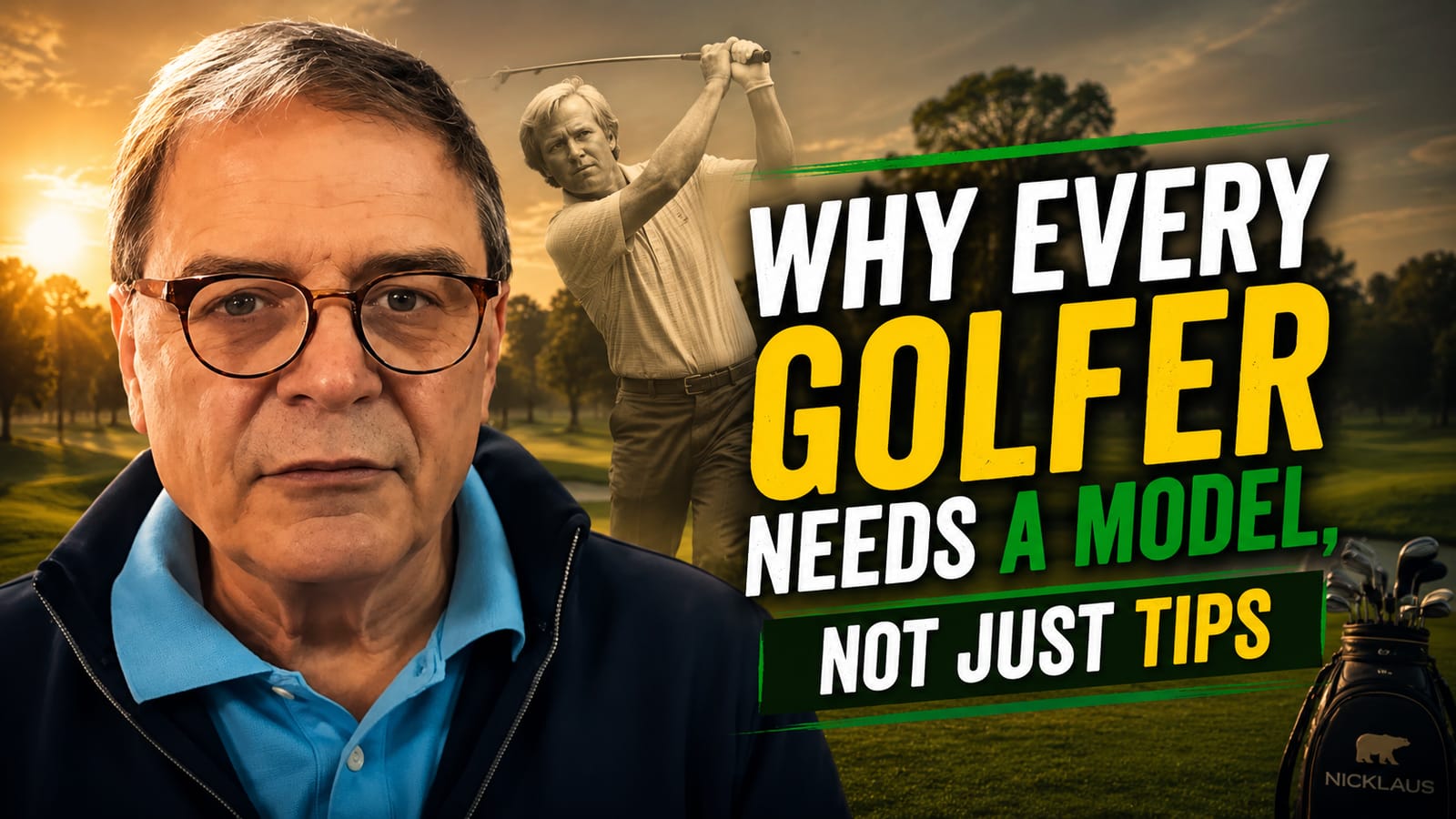
Third, the framework should give you a model to move toward. This is where the concept of choosing a world-class golfer comes in. Pick someone whose physique matches yours, then go deep. Not YouTube highlights, but their book. Hogan, Faldo, Nicklaus each wrote frameworks, not tip collections. Hogan's Five Lessons is a complete system. Faldo's journey, as I explored in his two years in the dark, was a total rebuild guided by a clear model. These golfers didn't collect tips. They built integrated wholes.
Fourth, ask yourself: does this framework have a discipline attached to it? Can I practice it daily? Does it include exercises that train breath, body awareness, concentration, and imagination... not just on the range but away from the course? If it only works when you're hitting balls, it's not deep enough.
Before you choose any model, you need to know where you are. And I mean really know. Film yourself with a tripod. Not just the full swing. Film your driver, your irons, your chips, your bunker shots, your putting. Most golfers have never seen themselves putt. They've never seen their actual setup for a chip shot. They don't know what they look like over the ball because proprioception has been lying to them for years.
This is the first step of the plan-do-review loop. Film, then watch. Don't watch with judgment. Watch with curiosity. What do you actually do? Not what do you think you do. Not what your playing partner told you that you do. What does the camera show? This is the beginning of real awareness, and awareness is the foundation of any framework worth following. As I always say, most golfing habits are so hard-wired we don't even know what they are. They're unconscious. They're taken for granted. They're so familiar that we don't even have to think about them anymore. The camera breaks through that.
Once you see what you actually do, you can begin to ask: what model am I trying to move toward? And is the framework I've chosen actually getting me there? Without this feedback loop, you're guessing. And guessing is how golfers spend years collecting tips and never improving. You can explore more about how to break through this plateau across all our mental game articles.
Here's where it gets interesting. One systems concept I value is equifinality: the same end can be reached by a variety of paths. You don't have to adopt one guru's system wholesale and reject everything else. But you do need coherence. If you're going to combine elements from different approaches, they must fit together logically.
For example, you might take your mechanical model from Hogan's framework... his grip, his plane, his footwork. But you layer on the Alexander Technique principles of inhibition (stopping the habitual response before it fires) and conscious direction (giving your mind specific instructions about how the body should coordinate). And you support both with breath work and relaxation exercises drawn from Eastern disciplines. This isn't random eclecticism. It's building a coherent system from compatible parts.
The key question when combining elements is: do these approaches agree on fundamentals? If one system says "tighten your core" and another says "release unnecessary tension," you have a conflict. If one says "think about your swing positions" and another says "stop overthinking"... well, as I've written about in how to stop overthinking your golf swing... the resolution lies in understanding that conscious direction is not the same as overthinking. Conscious direction works with the body. Overthinking works against it.
The model gives you direction. The method gives you feedback within it. This is the critical relationship most golfers miss. Without the model, you're thrashing in the unknown. You film yourself, you see problems, but you don't know what to move toward. Without the method, you have a beautiful picture of an ideal swing in your head but no way of knowing whether you're actually getting there.
Here's how it works in practice. You choose your model... let's say you're built like Faldo, tall and methodical. You study his framework. You understand his principles. Then you film yourself. You compare what you see with what the model shows. You identify the biggest gap. Not seven gaps. One. You work on that one thing, using conscious direction rather than muscling it into place. You film again. You review. You repeat. This is the plan-do-review loop, and it's the engine of real improvement.
The discipline comes in doing this consistently, not for a week but for months. As Machiavelli put it, "there's nothing more difficult to take in hand, more perilous to conduct, or more uncertain in its success than to take a lead in the introduction of a new order of things." What we're talking about is a golfing new order of things. It's tough. It needs discipline and will. But you can be the architect of your golfing destiny. You just need a model to move toward and a method to get you there, together forming a golf improvement framework that actually works.
Start your free trial and let the AI caddie walk you through these concepts on your next round.
Everything I've outlined here points toward one promise: you being better than you ever thought you could be. Not being Rory McIlroy or Scottie Scheffler. Being you, at a level of performance and under pressure that is beyond what you ever thought was possible. In essence, you surprising you.
To get there is a journey, and it's a call to an adventure. You will go literally where you have never gone before. You'll acquire new skills and likely new attitudes and beliefs. You'll have tough times, times when it feels like you're going nowhere, even having a sense that things are falling apart. This is normal. This is the territory. The demons of inertia, cynicism, and fear are real. But a complete framework gives you something tips never can: it gives you a map of the territory. You know where you are, you know where you're going, and you have a method for navigating the difficult stretches.
The yes voice is the excitement of possibility. The no voice is the recall that you've tried before and been disappointed. I understand both. But once the considered decision is made, things change. There's no going back. The commitment made means the resources you need will somehow appear. They cannot do the journey for you, but they can help. That's what a framework is: scaffolding that needs to be there for something new to be built.
In the film The Matrix, humanity was portrayed as imprisoned within a system. The hero Neo faced the ultimate choice: the red pill or the blue pill. The red represents enlightenment and breaking free. For us, that's breaking free of our habits. The blue represents comfort, the known, being trapped. What a genuine golf improvement framework offers is a potential practical way out. It's a tough road, and it needs discipline and will. But the alternative... collecting tips forever, satisficing, never truly improving... that's the blue pill. And most golfers take it without even realising they had a choice.
A golf swing model is not a single tip or a series of positions to copy. It's a complete framework that gives your practice direction. In my work, I encourage golfers to choose a world-class player whose physique matches theirs and then go deep into that player's actual instruction... not YouTube highlights, but their book, their system. Hogan's Five Lessons, for example, isn't a collection of tips. It's an integrated whole where grip, stance, plane, and movement all connect logically. A model gives you something to move toward, a picture of what a complete, coordinated swing looks like in a body built like yours. Without it, you're collecting fragments with no structure to organise them. The model works in partnership with a method (the plan-do-review loop) to create a genuine golf improvement framework.
It's not about copying in the sense of mimicry. It's about having a model that gives your practice direction. The distinction matters. If you try to copy Rory McIlroy's speed and athleticism but you're built like Colin Montgomerie, you'll injure yourself. But if you choose a professional whose physique and temperament match yours and study their framework... how they think about the swing as a whole, how they approach practice, how they handle pressure... you have a compass. Faldo's two-year rebuild wasn't copying someone else. It was building a new system based on sound principles, guided by a clear model of what he wanted to become. That's the approach I recommend. Find someone whose body and game resonate with yours, and study their system deeply.
The best golf instruction book is the one that offers a complete framework, not a tip collection. Hogan's Five Lessons: The Modern Fundamentals of Golf remains outstanding because it presents the swing as an integrated whole where every element connects to every other. Jack Nicklaus's Golf My Way does something similar. Faldo's A Swing for Life is underrated. What these books have in common is that they were written by golfers who thought in systems, not fragments. For the mental and bodymind side, I wrote The Golfing Bodymind precisely because nothing existed that connected the physical and mental dimensions into a single framework. The best book for you is the one that matches your physique, your temperament, and your willingness to go deep rather than skim the surface for quick fixes.
A practice plan that works is built on the plan-do-review loop. First, film yourself... not just full swing, but chips, bunker shots, putting. See what you actually do. Then choose one element to work on, guided by your model. Practice it with conscious direction, not just repetition. Film again. Review. Repeat. The key is that this loop provides honest feedback, which overrides the faulty sensory perception that tells you everything feels fine when it isn't. Most practice plans fail because they're just repetition without awareness. Hitting 100 balls on the range while thinking about dinner isn't practice. It's reinforcing existing brain maps. Real practice means being present, directing your attention, and checking the result against your model. Do this consistently and you have a framework for genuine, measurable improvement.
Hogan's great contribution was presenting the swing as a complete, interconnected system. His Five Lessons lays out the grip, stance, backswing, downswing, and follow-through not as separate tips but as elements of a unified whole where each part depends on every other. He was, in essence, a systems thinker before the term existed in golf. His famous statement that the secret was "in the dirt"... meaning practice... is often misunderstood. He didn't mean mindless repetition. He meant disciplined, thoughtful work on a complete system. Hogan's approach was a framework, not a collection of fixes. This is exactly why his book remains relevant decades later while the tip-of-the-month from golf magazines is forgotten by the next issue.
A golf improvement framework is a coherent system that connects everything... mechanics, mind, body, breathing, emotional regulation, practice method, feedback loops... into an integrated whole. A tip is an isolated fragment: "keep your head still," "slow down your backswing," "think positive." The tip has nowhere to live. It floats free, disconnected from everything else you're doing. When pressure hits, your brain discards the tip and reverts to its brain maps. A framework, by contrast, is embedded in how you practice, how you think, how you breathe, how you manage your state. It doesn't fall apart under pressure because it's not a surface-level instruction. It's a discipline that has been trained into your bodymind through consistent practice. This is the fundamental difference, and it's why tip-collecting golfers plateau while framework-based golfers improve.
Yes, but with care. The concept of equifinality tells us the same end can be reached by a variety of paths. You can take your mechanical model from one source, your mental game approach from another, and your body awareness practice from a third. But they must be compatible. If one system emphasises tension and another emphasises release, you have a conflict. The test is coherence: do these elements fit together logically, or are they pulling you in different directions? In my own framework, I combine the Initial Alexander Technique for integrated movement, Psychosynthesis for emotional navigation, and Eastern disciplines for state management. These three systems are compatible because they all take a holistic, systems-thinking approach. The danger is random eclecticism... grabbing a tip from here and a drill from there without any underlying logic. That's just tip-collecting in disguise.
Start your free 7-day trial at bettergamegolf.com and let Sandy's AI caddie walk you through these concepts on your next round. Experience what it means to have a framework, not just tips. Discover the plan-do-review loop, the breath work, the body awareness exercises, and the model-based approach that gives your practice real direction. You can be the architect of your golfing destiny. The question is whether you'll take the red pill or the blue.
Stories are not decoration. In my experience, they are one of the most powerful transmission systems human beings have ever invented for getting wisdom from one person to another. That is exactly why ...
16 min read →You've got a round coming up and you're already dreading it. Your game hasn't been sharp, life has been relentless, and somewhere in the back of your mind a quiet voice is already writing the disaster...
15 min read →A golf mental reset isn't just a nice idea. It's a neurological necessity. When a bad shot cascades into a worse one, something very specific happens in your bodymind... your breathing shortens, your ...
15 min read →