
Better Golf Starts in Your Mind — Text Sandy free →
By Sandy Dunlop — Better Game Golf
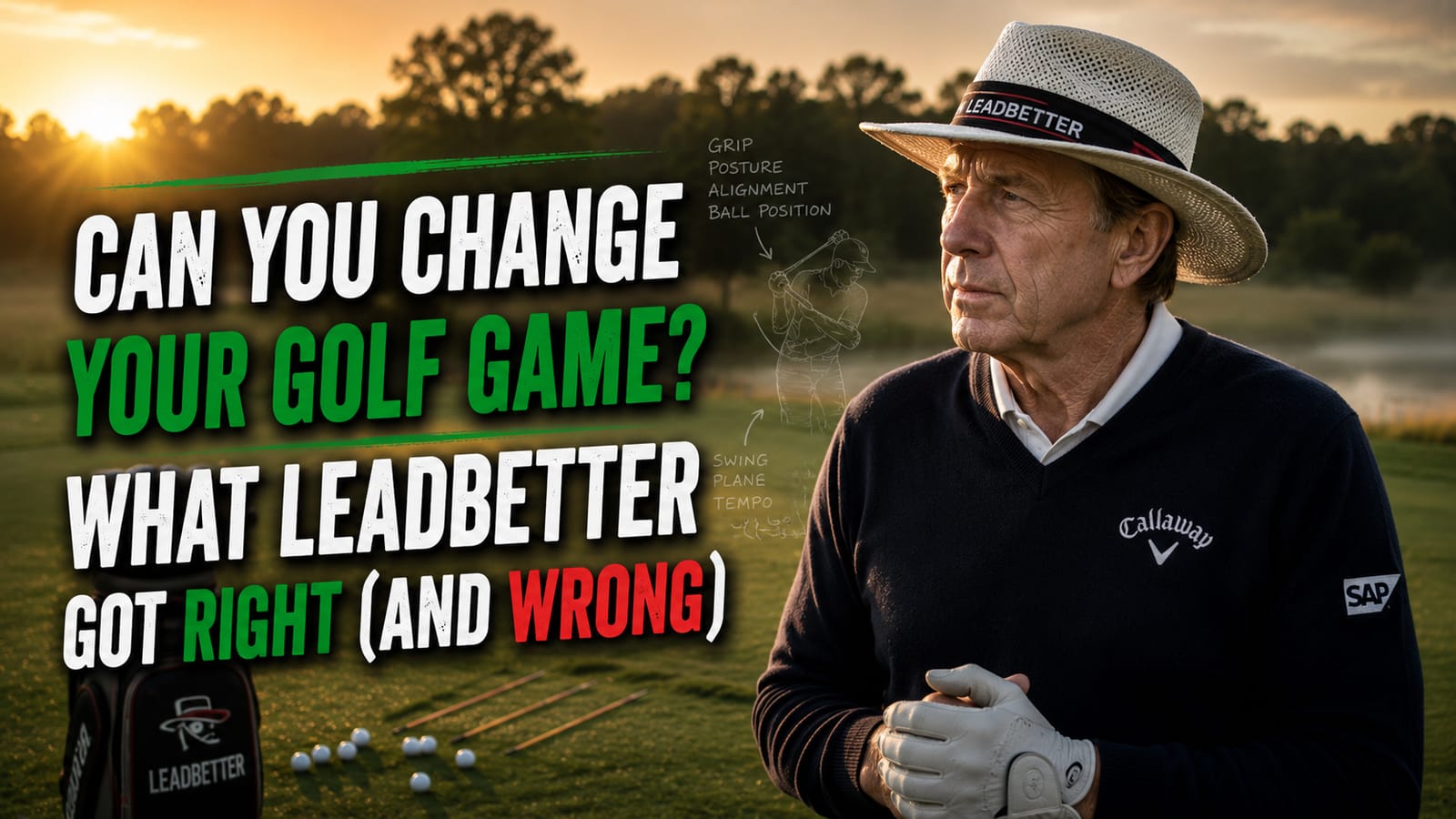
Can you change your golf game? I mean really change it... not just tinker around the edges, but transform the habits of a lifetime and perform at a level beyond what you ever thought possible? David Leadbetter, one of the most respected coaches in the history of the game, was once asked this very question. His answer was essentially no. He said that by your mid-20s, you've formed a kind of golfing DNA. You can make changes on the range, but under pressure on the course, you'll revert to your old habits. Now, what Leadbetter did with Nick Faldo and Nick Price... taking them from good to great, from tournament winners to major champions... that's one of the great transformation stories in golf. But his conclusion for the average golfer was bleak. And that's exactly the assumption I want to challenge.
Leadbetter was not wrong about the power of habits. He was absolutely right that by a certain age, most golfers have deeply ingrained patterns that are incredibly resistant to change. The way the brain works is that when you perform a movement frequently, such as swinging a club, the brain stores those movements in what I call brain maps. When faced with a similar situation again, the brain wheels out what you've done before, and this all happens in a split second. You might have a tip or an instruction in mind, something you've been working on diligently at the range. But especially when it matters, the brain will always select what it knows best. And what it knows best is not what's optimal... it's what's familiar.
This is exactly what Leadbetter was describing. He watched golfers rebuild their swings in controlled environments, only to see those changes evaporate under competitive pressure. The old patterns come flooding back because the brain is designed to protect what's known. I wrote about this phenomenon in detail when looking at Nick Faldo's two years in the dark during his total rebuild. Even a player of Faldo's calibre and iron will found the process agonising. So yes, Leadbetter was right that habits are powerful. Where he was wrong is in concluding that the average golfer is essentially stuck.
To be fair to Leadbetter, he didn't say there was nothing you could do. He suggested you could get fit, lose weight, remember old drills that worked before, and revise golfing basics. These are all valid. But notice what they have in common: none of them involve fundamental change. They're about managing what you already have, not transforming it. It's satisficing... the nervous system's default setting of getting a good enough result. Our primary focus as human beings is to get by, and being better than you ever thought you could be is not satisficing. It's optimising. So our human nature is not naturally going to be helpful in the quest we're considering here.
Leadbetter's recommendations amount to polishing the existing machine. And for many golfers, that might be enough. But if you're reading this, I suspect you want more. You want to know whether real, structural change is possible. Whether you can break through the ceiling that's been holding you back for years. And the answer, in my experience, is yes... but not through the methods Leadbetter was thinking of. Not through piece-by-piece, fault-by-fault, symptom-by-symptom mechanical instruction. The way you change your golf game at its core is by the way you think, by the way you use your mind.
Western science worked out its method by breaking things into bits and studying how one variable affected another, and much was achieved. Most golf instruction follows exactly this model. Fix the grip. Adjust the takeaway. Flatten the plane. Change the weight shift. Each piece gets isolated, analysed, and corrected as if a golf swing were a machine you could disassemble and reassemble. But human beings are not machines. We are an integrated whole, and we can only be changed as a whole. A golf swing is a coordinated whole... well, maybe in many cases a poorly coordinated whole... but it can only be changed as a whole.
This is what I call a systems thinking approach, and it's radically different from the typical method. Emergent sciences like quantum physics, neuroscience, complexity theory, and neurobiology are all rooted in systems thinking. In this worldview, everything is connected. You simply cannot separate the parts from the whole. We have 700-plus muscles, 200-plus bones, and 350-plus joints, and they all need to function in a deeply interconnected way. Trying to change one piece while ignoring the system is why so many golfers experience fear-based swing patterns where anxiety literally changes their technique. The mechanical fix never addresses the underlying state of the whole system.
Here's where it gets really tricky, and this is something almost no one in mainstream golf instruction talks about. Let's say you're determined to change, and you decide to feel your way into the new movement. You tune into your body, particularly your body in motion, trying to do what you know is right because you've got a tip or instruction. What you're doing is tuning into proprioception, the internal sense of your body, its parts, and how it's moving. Proprioception comes from stretch receptors in your body that give you feedback.
But the problem is that these receptors initially report what is familiar as what is right. When you're trying to do something new, the new thing is going to feel wrong. So what feels right is wrong, and what is wrong feels right. This is called faulty sensory perception, and it's one of the biggest obstacles to genuine change. It means that trusting your feelings during a swing change is often precisely the wrong strategy. Your senses are rewarding the familiar and the comfortable, not the optimal. This is why golfers can spend months on the range grooving something new, then step onto the first tee on a day that matters and watch it all disappear. The body pulls them back to what feels right... which is the old pattern. Understanding this is crucial, and it's the problem nobody in golf would talk about for far too long.
So to sum it up: we don't know what we're doing, and every instinct in our bodymind is not to change it anyway. Our habits are largely unconscious. Our brain maps default to the familiar. Our nervous system satisfices rather than optimises. And our proprioception is faulty, rewarding old patterns and punishing new ones. No wonder Leadbetter concluded that fundamental change was essentially impossible for the average golfer.
But here's what he missed. He was thinking about change from the outside in... mechanical instruction imposed on the body. What I'm proposing is change from the inside out, through the way you use your mind in relationship with your body. This is what I mean by the golfing bodymind. Bodymind is a made-up word, but it describes exactly what we're working with. The body and the mind are connected, and the quality of that connection determines the quality of your golf. When the mind is stuck in the brain, disconnected from the body, you get overthinking, tension, and reversion to old habits. When the mind is distributed through the body, integrated and alive, you get the conditions for genuine transformation. The disciplines I draw on... the Initial Alexander Technique, Psychosynthesis, and Eastern practices like Yoga and Zen... all work on this integration rather than on isolated mechanical parts.
The Initial Alexander Technique offers something I've found nowhere else in the golfing world: a practical method for breaking the vice-like grip of habits. At its core are two concepts. First is inhibition... not the psychological kind, but the ability to stop and refuse to respond in your habitual way. When you're standing over the ball and every fibre of your being wants to execute the same old pattern, inhibition is the skill of pausing that automatic response. It creates a gap, a moment of choice where something new becomes possible.
The second concept is Conscious Guidance and Control (CG&C)... a way of involving the mind in its vital relationship with the body. Rather than trying to mechanically position your body parts, you learn to give conscious direction to the whole system. This is not thinking about your swing. It's directing your use of yourself as an integrated whole. FM Alexander, an Australian actor who lost his voice, discovered that even the thought of going on stage caused his head and neck to tense and shrink into his shoulders. His work on posture and breathing that arose from this observation is now widely used by professional actors, musicians, and singers worldwide. It is hugely relevant to golfers because it addresses the same problem: habitual patterns of tension that distort performance under pressure.
(Try: Inhibition Exercise... available in the Training section of the app)
The second discipline I draw on comes from Psychosynthesis, the work of Roberto Assagioli, which first came to the golfing world's attention through Michael Murphy's iconic book Golf in the Kingdom. What makes Psychosynthesis so significant is that it bucked a trend in Western psychology. Where most of psychology was a study of the mentally troubled or ill, Assagioli's work, like much of Eastern psychology, is for the relatively healthy in mind and spirit. And it is for this reason that it offers so much to the ambitious golfer.
To play golf at any serious level of competence, you have to have your act together. Psychosynthesis offers ways of understanding the many dimensions of our personality with a promise of helping us recover an undivided self. As one guest at a post-round dinner party put it, "What is golf but a coming together of our separate parts?" And as Shiva Irons himself said, "The basis for a change in the way a person plays the game must be laid in his entire life." This is not about swing tips. It's about who you are when you stand over the ball. It's about navigating the emotions we encounter in competitive sport... the fear, the excitement, the anger, the self-doubt... and learning to work with uncontrollable sub-personalities rather than being hijacked by them. This connects directly to what I explore in my work on how to play golf without fear.
The final set of disciplines comes from the East... Yoga, Zen, and Tai Chi. These traditions were never caught up in the Enlightenment separation of mind and body promoted by the likes of Descartes. There'd be no such thing as a "mental coach" in Yoga and Zen. It's not about the mental. It's about the relationship of the mind and the body, of mind and emotion, and mind and the spirit or soul. Everything is connected.
What these disciplines offer are practical tools for controlling states of mind, especially under the pressures of competitive sport. Breath control... what the yogis call pranayama... is the key to control of mind and body, control of the golfing bodymind. It governs blood flow, heartbeat, clarity and focus of mind, and indeed the altered states of consciousness associated with being in the zone. There's a Sanskrit saying: "Breath is life. If you breathe well, you will live long on Earth." Deep breathing can anchor you, centre you, give you a feeling of being rooted in a competitive situation. But paradoxically, it can also elevate you to a higher state. It can energise and bring you alive, or it can relax and calm. This duality is why breath work is so central to everything I teach. If you want to understand more about accessing these elevated states, I've written extensively about golf flow state and how to get in the zone.
(Try: Three-Compartment Breathing Exercise... available in the Training section of the app)
In The Matrix, humanity was portrayed as imprisoned within a system run by artificial intelligence. The hero Neo faced a choice: the red pill or the blue pill. The red represents enlightenment and breaking free of the system. For us, that system is our habits. The blue represents comfort, the known, and being trapped. What the golfing bodymind offers is a potential practical way out. It's a tough road, and it needs discipline and will. But you can be the architect of your golfing destiny.
I call this a Call to Adventure because that's exactly what it is. Getting to the level of performance and composure under pressure that is beyond what you ever thought possible means moving into an unknown world. You will go literally where you have never gone before. You will have to acquire new skills and likely new attitudes and beliefs. You will also have tough times, times when it feels like you are going nowhere, making no progress, even having a sense that things are falling apart. As Machiavelli put it, "There is nothing more difficult to take in hand, more perilous to conduct, or more uncertain in its success than to take a lead in the introduction of a new order of things." This is a golfing new order of things.
Before deciding whether to set off, it's worth considering both the yes voice and the no voice. The yes voice is the excitement of a new journey, the hope, the possibility, the being-better-than idea. But the no voice is the recall that you've tried, perhaps many times before, to improve, to step up. You might feel reluctant to say yes because you're worried about the acute disappointment you will experience if this particular attempt doesn't work out. That's honest, and I respect it.
But here's what I've seen across decades of working with golfers: the demons are real but they are knowable. There's the demon of inertia... the sheer weight of doing nothing. The demon of cynicism... "I've heard this before." And the demon of fear... fear of failure, fear of looking foolish, fear of hope. Your awareness, your brain, your nervous system, and your senses are all set up in ways that make real change difficult. But not impossible. Once the considered decision is made, things change. There's no going back. The commitment means that the resources and guides you need will somehow appear. They cannot do the journey for you, but they can help. A guide is like scaffolding that needs to be there for something new to be built. Explore all our mental game articles to see the full scope of what's available to support your journey.
The Body Scan (1 min)
David Leadbetter essentially said that by a golfer's mid-20s, they've formed a golfing DNA... a technique that is deeply embedded. He acknowledged that changes might succeed on the range but said that by the time you get to the course, especially when it matters, you'll revert to your old habits. His recommendations for improvement were limited to things like getting fit, losing weight, revisiting old drills, and revising basics. In other words, he believed you could manage your existing game but not fundamentally transform it. I think he was right about the power of habits and the tendency to revert, but wrong about the conclusion. The reason is that he was thinking about change through mechanical instruction alone, not through the relationship of mind and body that I call the golfing bodymind.
Faulty sensory perception is the phenomenon where your internal body sense... your proprioception... reports familiar movements as "correct" even when they're not. When you try to do something new, it feels wrong because the stretch receptors in your body are calibrated to reward what's habitual, not what's optimal. This is why golfers can spend hours grooving a change on the range and have it feel great, then lose it entirely under the pressure of a real round. What feels right is wrong, and what is wrong feels right. Understanding this concept is liberating because it explains why "just feeling it" is not a reliable path to change. You need methods that work around this sensory bias, which is exactly what techniques like inhibition and conscious direction provide.
In the Initial Alexander Technique, inhibition doesn't mean suppression or psychological repression. It means the conscious decision to stop and refuse to respond in your habitual way. When you stand over the ball, your brain maps fire up the familiar pattern in a split second. Inhibition is the skill of creating a pause in that automatic response... a gap where choice becomes possible. Without inhibition, you're a prisoner of your habits no matter how much you know about what you should be doing differently. It's the foundational skill that makes Conscious Guidance and Control possible, because you can't direct yourself into a new pattern if the old one has already fired. This is why I consider it the single most important concept for any golfer serious about real change.
Systems thinking means recognising that a golf swing is not a collection of independent parts that can be fixed in isolation. It's a coordinated whole involving 700-plus muscles, 200-plus bones, and 350-plus joints, all functioning in deeply interconnected ways. Western science achieved much by breaking things into variables and studying them separately, but this approach has severe limitations when applied to human movement. You cannot separate the grip from the shoulder tension from the breathing pattern from the emotional state and fix them independently. They're all connected. A systems thinking approach works on the whole person, which is why the three disciplines I use... the Initial Alexander Technique, Psychosynthesis, and Eastern practices... are all holistic. They change the system, not just a component within it.
Yes, and it's not as strange as it sounds. Control of the breath, as people in the East have known for thousands of years, is the key to control of mind and body. Pranayama... breath control... governs blood flow, heartbeat, clarity of mind, and the altered states of consciousness associated with being in the zone. Scientists have confirmed that even slight changes to the way we inhale and exhale can improve sports performance. In practical terms, I use a three-compartment breathing technique... breathing into abdomen, chest, and neck... that you can start your free trial to experience directly. It calms the nervous system, reduces tension, and creates the conditions for your best golf. It can anchor you when you're anxious and elevate you when you need to access a higher state of focus.
The term "mental coach" implies that the mental side is separate from the physical, and you just need to get your head right. But there'd be no such thing as a mental coach in Yoga and Zen. It's not about the mental. It's about the relationship of the mind and the body, of mind and emotion, and mind and spirit. The golfing bodymind approach draws on three integrated disciplines: the Initial Alexander Technique for integrated movement, Psychosynthesis for recovering an undivided self, and Eastern practices for mastering states of mind. These are not positive-thinking exercises or visualisation tricks bolted onto a mechanical swing method. They address you as a whole human being and work on the quality of the connection between your mind and body, which determines the quality of your golf under pressure.
You can change your golf game. Not by adding another swing tip or remembering an old drill, but by transforming the relationship between your mind and your body. The golfing bodymind approach gives you practical tools... inhibition, conscious direction, breath control, emotional navigation... that work with your whole system rather than against it.
Start your free 7-day trial at bettergamegolf.com — let Sandy's AI caddie walk you through these concepts on your next round.
Stories are not decoration. In my experience, they are one of the most powerful transmission systems human beings have ever invented for getting wisdom from one person to another. That is exactly why ...
16 min read →You've got a round coming up and you're already dreading it. Your game hasn't been sharp, life has been relentless, and somewhere in the back of your mind a quiet voice is already writing the disaster...
15 min read →A golf mental reset isn't just a nice idea. It's a neurological necessity. When a bad shot cascades into a worse one, something very specific happens in your bodymind... your breathing shortens, your ...
15 min read →